We've heard from multiple contributors that the Reconciler forking
mechanism was confusing and/or annoying to deal with. Since it's
currently unused and there's no immediate plans to start using it again,
this removes the forking.

Fully removing the fork is split into 2 steps to preserve file history:

**#25774 previous PR that did the bulk of the work:**
- remove `enableNewReconciler` feature flag.
- remove `unstable_isNewReconciler` export
- remove eslint rules for cross fork imports
- remove `*.new.js` files and update imports
- merge non-suffixed files into `*.old` files where both exist
(sometimes types were defined there)

**This PR**
- rename `*.old` files
We've heard from multiple contributors that the Reconciler forking
mechanism was confusing and/or annoying to deal with. Since it's
currently unused and there's no immediate plans to start using it again,
this removes the forking.

Fully removing the fork is split into 2 steps to preserve file history:

**This PR**
- remove `enableNewReconciler` feature flag.
- remove `unstable_isNewReconciler` export
- remove eslint rules for cross fork imports
- remove `*.new.js` files and update imports
- merge non-suffixed files into `*.old` files where both exist
(sometimes types were defined there)

**#25775**
- rename `*.old` files
Log more info on the status of the process_artifacts_combined job to
help with debugging, and exit with exitcode 1 if anything goes wrong

Test plan: Ran the workflow
[successfully](https://github.com/facebook/react/actions/runs/3595185062)
Moves the existing alias set building logic from inferMutableLifetimes to a
separate pass.

Additionally maintain abstract state to refine aliasing to not include
primitives.
HIRTreeVisitor previously passed a string label (for certain blocks). This
changes to pass the raw BlockId, and have codegen convert that to a string. I'm
not sure if we'll need this but it would be helpful for eg visiting the IR and
emitting a new IR, while mapping block ids forward. Even if we don't need that
it makes sense for Codegen to decide how to convert a block id into a label
(which has to obey the rules of an identifier, not the visitor's concern).
### Changes made:
- Running with enableFizzExternalRuntime (feature flag) and
unstable_externalRuntimeSrc (param) will generate html nodes with data
attributes that encode Fizz instructions.
```
<div
  hidden data-rxi=""
  data-bid="param0"
  data-dgst="param1"
></div>
```
- Added an external runtime browser script
`ReactDOMServerExternalRuntime`, which processes and removes these nodes
- This runtime should be passed as to renderInto[...] via
`unstable_externalRuntimeSrc`
- Since this runtime is render blocking (for all streamed suspense
boundaries and segments), we want this to reach the client as early as
possible. By default, Fizz will send this script at the end of the shell
when it detects dynamic content (e.g. suspenseful pending tasks), but it
can be sent even earlier by calling `preinit(...)` inside a component.
- The current implementation relies on Float to dedupe sending
`unstable_externalRuntimeSrc`, so `enableFizzExternalRuntime` is only
valid when `enableFloat` is also set.
They're fairly related, but I figured it's worth keeping more examples.

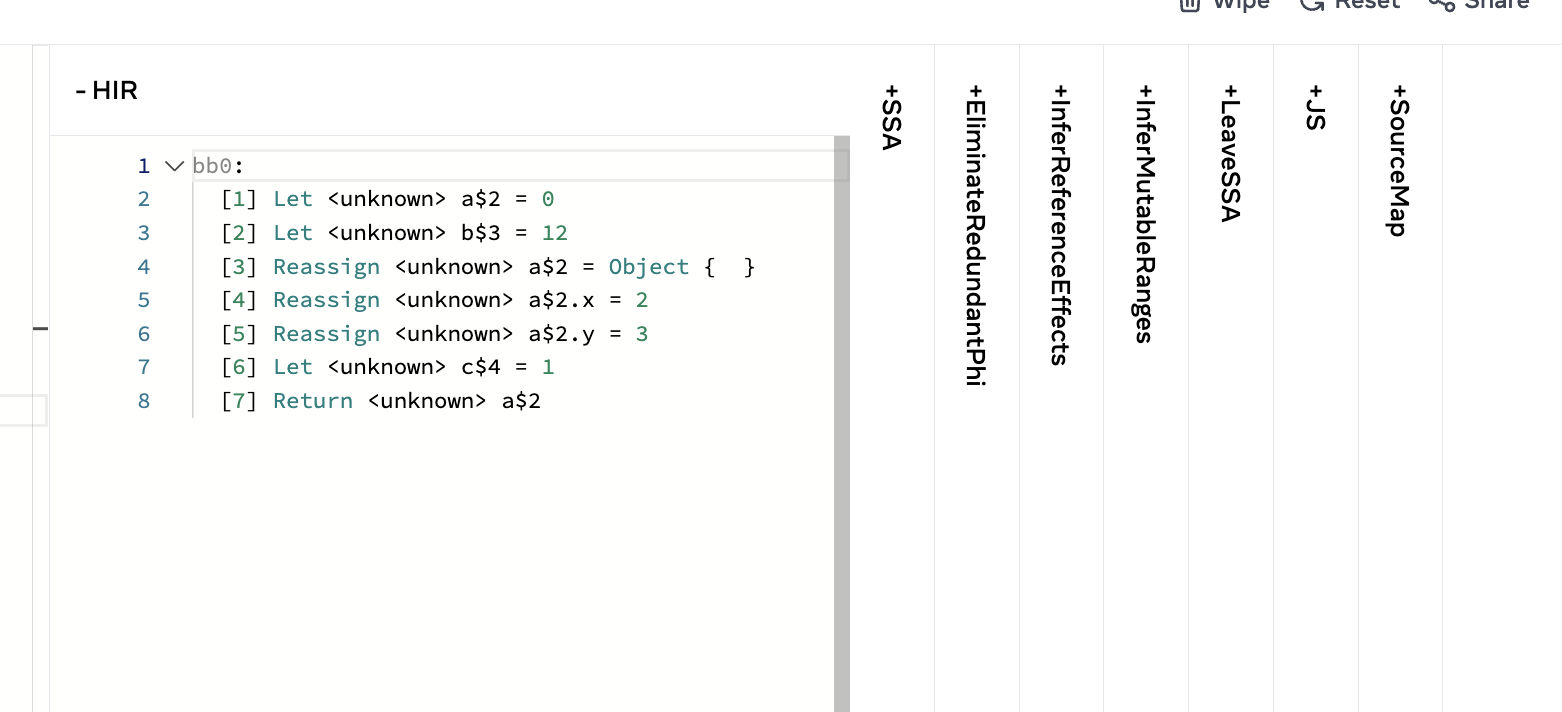
- For the `while` example we need to codegen into a single expression. - For the
expression with contained assignment we need to either keep the SSA ids around
or re-create a similar expression during codegen.
Add option for ref function to return a clean up function.

```jsx
<div ref={(_ref) => {
  // Use `_ref`
  return () => {
    // Clean up _ref
  };
}} />
```

If clean up function is not provided. Ref function is called with null
like it has been before.

```jsx
<div ref={(_ref) => {
  if (_ref) {
    // Use _ref
  } else {
    // Clean up _ref
  }
}} />
```
The `automaticLayout` config option for Monaco causes it to remeasure itself,
and the parent container's height being longer than the screen causes it to
constantly grow infinitely. You can observe this bug by going to the playground,
expanding any tab, and watch the scrollbar grow as the editor quickly grows to
ridiculous heights and your laptop starts glowing red hot and̶͙̕ H̴͉͘e comes
t̵͙́o ̴̜̿de̷̼̚s̷̻̍ec̶̮͒rate all knowled̵̥̆ge
<!--
  Thanks for submitting a pull request!
We appreciate you spending the time to work on these changes. Please
provide enough information so that others can review your pull request.
The three fields below are mandatory.

Before submitting a pull request, please make sure the following is
done:

1. Fork [the repository](https://github.com/facebook/react) and create
your branch from `main`.
  2. Run `yarn` in the repository root.
3. If you've fixed a bug or added code that should be tested, add tests!
4. Ensure the test suite passes (`yarn test`). Tip: `yarn test --watch
TestName` is helpful in development.
5. Run `yarn test --prod` to test in the production environment. It
supports the same options as `yarn test`.
6. If you need a debugger, run `yarn debug-test --watch TestName`, open
`chrome://inspect`, and press "Inspect".
7. Format your code with
[prettier](https://github.com/prettier/prettier) (`yarn prettier`).
8. Make sure your code lints (`yarn lint`). Tip: `yarn linc` to only
check changed files.
  9. Run the [Flow](https://flowtype.org/) type checks (`yarn flow`).
  10. If you haven't already, complete the CLA.

Learn more about contributing:
https://reactjs.org/docs/how-to-contribute.html
-->

## Summary
Jest caching wasn't working correctly for
`transform-react-version-pragma`. One condition for including
`transform-react-version-pragma` is that `process.env.REACT_VERSION` is
set, but it wasn't included in the cache key computation. Thus local
test runs would only run without `transform-react-version-pragma`, if
jest runs weren't using the `-reactVersion` flag and then added it.

Inlined the `scripts/jest/devtools/preprocessor.js` file, because it
makes it more obvious that `process.env.REACT_VERSION` is used in
`scripts/jest/preprocessor.js`

<!--
Explain the **motivation** for making this change. What existing problem
does the pull request solve?
-->

## How did you test this change?

<!--
Demonstrate the code is solid. Example: The exact commands you ran and
their output, screenshots / videos if the pull request changes the user
interface.
How exactly did you verify that your PR solves the issue you wanted to
solve?
  If you leave this empty, your PR will very likely be closed.
-->

Repro step:
- Clear jest cache
- node ./scripts/jest/jest-cli.js --build --project devtools
--release-channel=experimental --reactVersion 18.0
- node ./scripts/jest/jest-cli.js --build --project devtools
--release-channel=experimental

Before:
Jest cached the first run with `REACT_VERSION` set, so in the second run
`transform-react-version-pragma` is still there and runs only the
regression tests on old react versions.

After:
- The second run runs all tests and ignore `// @reactVersion` as
expected.
The argument was unused and a confusing boolean argument that's easy to mix up.
Suggesting to remove it until we see a need for it at which point we might want
to introduce an enum to make the argument more obvious.
In `<StrictMode>` in dev hooks are run twice on each render.

For `useId` the re-render pass uses the `updateId` implementation rather
than `mountId`. In the update path we don't increment the local id
counter. This causes the render to look like no id was used which
changes the tree context and leads to a different set of IDs being
generated for subsequent calls to `useId` in the subtree.

This was discovered here: https://github.com/vercel/next.js/issues/43033

It was causing a hydration error because the ID generation no longer
matched between server and client. When strict mode is off this does not
happen because the hooks are only run once during hydration and it
properly sees that the component did generate an ID.

The fix is to not reset the localIdCounter in `renderWithHooksAgain`. It
gets reset anyway once the `renderWithHooks` is complete and since we do
not re-mount the ID in the `...Again` pass we should retain the state
from the initial pass.
<!--
  Thanks for submitting a pull request!
We appreciate you spending the time to work on these changes. Please
provide enough information so that others can review your pull request.
The three fields below are mandatory.

Before submitting a pull request, please make sure the following is
done:

1. Fork [the repository](https://github.com/facebook/react) and create
your branch from `main`.
  2. Run `yarn` in the repository root.
3. If you've fixed a bug or added code that should be tested, add tests!
4. Ensure the test suite passes (`yarn test`). Tip: `yarn test --watch
TestName` is helpful in development.
5. Run `yarn test --prod` to test in the production environment. It
supports the same options as `yarn test`.
6. If you need a debugger, run `yarn debug-test --watch TestName`, open
`chrome://inspect`, and press "Inspect".
7. Format your code with
[prettier](https://github.com/prettier/prettier) (`yarn prettier`).
8. Make sure your code lints (`yarn lint`). Tip: `yarn linc` to only
check changed files.
  9. Run the [Flow](https://flowtype.org/) type checks (`yarn flow`).
  10. If you haven't already, complete the CLA.

Learn more about contributing:
https://reactjs.org/docs/how-to-contribute.html
-->

## Summary
Submit https://github.com/facebook/react/pull/25698 again after fixing
the devtools regression tests in CI.
The PR changed lanes representation and some snapshot tests of devtools
captures lanes. In devtools tests for older versions, the updated lanes
representation no longer matched. The fix is to disable regression tests
for those tests.

## How did you test this change?

<!--
Demonstrate the code is solid. Example: The exact commands you ran and
their output, screenshots / videos if the pull request changes the user
interface.
How exactly did you verify that your PR solves the issue you wanted to
solve?
  If you leave this empty, your PR will very likely be closed.
-->

```
./scripts/circleci/download_devtools_regression_build.js 18.0 --replaceBuild
node ./scripts/jest/jest-cli.js --build --project devtools --release-channel=experimental --reactVersion 18.0
```

Unrelated to this PR. There was some issue with jest caching when I
locally ran that command. it didn't seem to include the @reactVersion
transform, but if I manually modified `scripts/jest/preprocessor.js` or
ran ` yarn test --clearCache`, the jest test runs correctly.
This is a follow-up to merging ranges. I realized that we need to mark terminal
ids as visited _before_ processing the branches of that terminal (whereas before
we were marking terminal ids only _after_ processing the branches). That exposed
another bug where interleaving could fail to be detected (with an error,
thankfully) if one of the branches had completed already.

Our small test suite is already really good!
This demonstrates a situation we don't handle well today. The basic structure is
that you have some variable defined at the top level, then some control flow
like if/switch where _all_ branches reassign the variable, then some code after
that references the resulting phi node:

```javascript

let x1;

// ... mutate/read x1

if (cond) {

x2 = {};

} else {

x3 = {};

}

x4 = phi(x2, x3);

```

We currently group x3, x3, and x4 into a scope together, but note that...there's
no `let` declaration for any of those! This means that it looks like the scope
for x2 and x3 start in the consequent/alternate, but the true scope spans from
before-after the if. I'm inclined to say that LeaveSSA should run _before_ scope
analysis, and produce something like the following in this case:

```javascript

let x1;

// ...mutate/read x1

let x2; // new variable declaration for the new version of x

if (cond) {

x2 = {};

} else {

x2 = {};

}

x2;

```

This then allows us to construct a correct range for x2, which starts in the
other block.
- [x] Merge scopes that are interleaved

- [x] Merge scopes if they both cross control-flow boundaries together

- [x] Don't merge scopes that strictly shadow

Still WIP because I want to double-check and see if i can find a simpler
algorithm for this. But it works.
This is a random driveby improvement. I realized that we can eliminate `return`
statements if a) they have no value and b) they are in the top-level block.
Functions implicitly return at that point — there can't be any succeeding
instructions anyway — so we can save bytes in the output.
Visits the HIR as a tree and updates mutable ranges to ensure their range end is
aligned with the block in which the scope is declared:

```javascript

function foo(cond, a) {

⌵ original scope

⌵ expanded scope

const x = [];    ⌝    ⌝

if (cond) {      ⎮    ⎮

...            ⎮    ⎮

x.push(a);     ⌟    ⎮

...                 ⎮

}                     ⎮

...                   ⌟

}

```

The implementation tracks the block in which each scope "starts" (first
instruction with an operand in that scope), and then finds the first instruction
at that block (or a parent) which is after the scope's end.
Refactors `Identifier.scope` to be a `ReactiveScope` object with an id and
range. This gives us a place to later add a list of dependencies for the scope.
## Edit

Went for another approach after talking with @gnoff. The approach is
now:
- add a dev-only error when a precomputed chunk is too big to be written
- suggest to copy it before passing it to `writeChunk`

This PR also includes porting the React Float tests to use the browser
build of Fizz so that we can test it out on that environment (which is
the one used by next).

<!--
  Thanks for submitting a pull request!
We appreciate you spending the time to work on these changes. Please
provide enough information so that others can review your pull request.
The three fields below are mandatory.

Before submitting a pull request, please make sure the following is
done:

1. Fork [the repository](https://github.com/facebook/react) and create
your branch from `main`.
  2. Run `yarn` in the repository root.
3. If you've fixed a bug or added code that should be tested, add tests!
4. Ensure the test suite passes (`yarn test`). Tip: `yarn test --watch
TestName` is helpful in development.
5. Run `yarn test --prod` to test in the production environment. It
supports the same options as `yarn test`.
6. If you need a debugger, run `yarn debug-test --watch TestName`, open
`chrome://inspect`, and press "Inspect".
7. Format your code with
[prettier](https://github.com/prettier/prettier) (`yarn prettier`).
8. Make sure your code lints (`yarn lint`). Tip: `yarn linc` to only
check changed files.
  9. Run the [Flow](https://flowtype.org/) type checks (`yarn flow`).
  10. If you haven't already, complete the CLA.

Learn more about contributing:
https://reactjs.org/docs/how-to-contribute.html
-->

## Summary

Someone reported [a bug](https://github.com/vercel/next.js/issues/42466)
in Next.js that pointed to an issue with Node 18 in the streaming
renderer when using importing a CSS module where it only returned a
malformed bootstraping script only after loading the page once.

After investigating a bit, here's what I found:

- when using a CSS module in Next, we go into this code path, which
writes the aforementioned bootstrapping script


https://github.com/facebook/react/blob/5f7ef8c4cbe824ef126a947b7ae0e1c07b143357/packages/react-dom-bindings/src/server/ReactDOMServerFormatConfig.js#L2443-L2447

- the reason for the malformed script is that
`completeBoundaryWithStylesScript1FullBoth` is emptied after the call to
`writeChunk`
- it gets emptied in `writeChunk` because we stream the chunk directly
without copying it in this codepath

https://github.com/facebook/react/blob/a438590144d2ad40865b58e0c0e69595fc1aa377/packages/react-server/src/ReactServerStreamConfigBrowser.js#L63
- the reason why it only happens from Node 18 is because the Webstreams
APIs are available natively from that version and in their
implementation, [`enqueue` transfers the array buffer
ownership](https://github.com/nodejs/node/blob/9454ba6138d11e8a4d18b073de25781cad4bd2c8/lib/internal/webstreams/readablestream.js#L2641),
thus making it unavailable/empty for subsequent calls. In older Node
versions, we don't encounter the bug because we are using a polyfill in
Next.js, [which does not implement properly the array buffer transfer
behaviour](https://cs.github.com/MattiasBuelens/web-streams-polyfill/blob/d354a7457ca8a24030dbd0a135ee40baed7c774d/src/lib/abstract-ops/ecmascript.ts#L16).

I think the proper fix for this is to clone the array buffer before
enqueuing it. (we do this in the other code paths in the function later
on, see ```((currentView: any): Uint8Array).set(bytesToWrite,
writtenBytes);```


## How did you test this change?

Manually tested by applying the change in the compiled Next.js version.

<!--
Demonstrate the code is solid. Example: The exact commands you ran and
their output, screenshots / videos if the pull request changes the user
interface.
How exactly did you verify that your PR solves the issue you wanted to
solve?
  If you leave this empty, your PR will very likely be closed.
-->

Co-authored-by: Sebastian Markbage <sebastian@calyptus.eu>
 Samuel Susla
 dependabot[bot]
 Jan Kassens
 lauren
 Sathya Gunasekaran
 Joseph Savona
 Sebastian Silbermann
 Mengdi Chen
 Joe Savona
 mofeiZ

 Tianyu Yao
 Josh Story
 jacdebug

 Jimmy LaiandSebastian Markbage