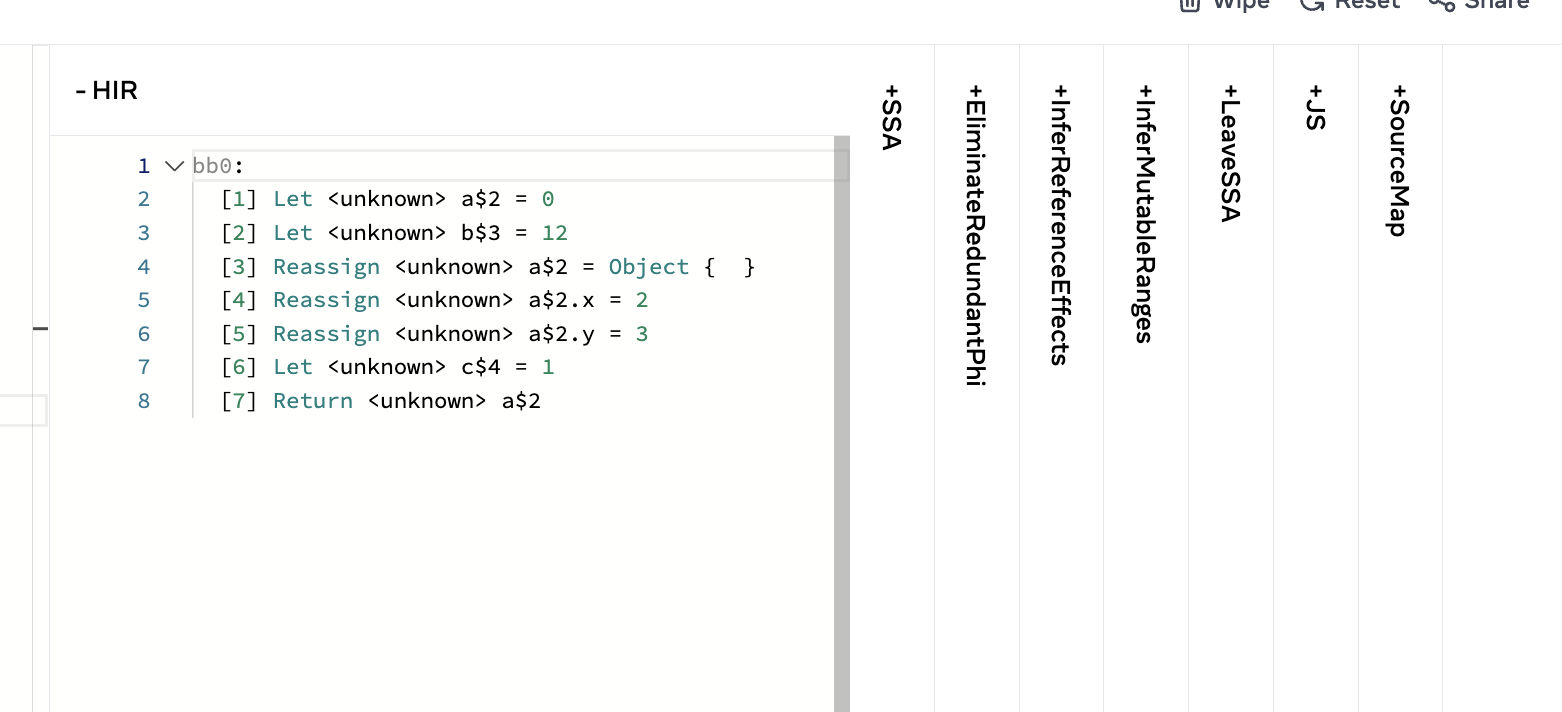
HIRTreeVisitor previously passed a string label (for certain blocks). This
changes to pass the raw BlockId, and have codegen convert that to a string. I'm
not sure if we'll need this but it would be helpful for eg visiting the IR and
emitting a new IR, while mapping block ids forward. Even if we don't need that
it makes sense for Codegen to decide how to convert a block id into a label
(which has to obey the rules of an identifier, not the visitor's concern).
They're fairly related, but I figured it's worth keeping more examples.

- For the `while` example we need to codegen into a single expression. - For the
expression with contained assignment we need to either keep the SSA ids around
or re-create a similar expression during codegen.
The `automaticLayout` config option for Monaco causes it to remeasure itself,
and the parent container's height being longer than the screen causes it to
constantly grow infinitely. You can observe this bug by going to the playground,
expanding any tab, and watch the scrollbar grow as the editor quickly grows to
ridiculous heights and your laptop starts glowing red hot and̶͙̕ H̴͉͘e comes
t̵͙́o ̴̜̿de̷̼̚s̷̻̍ec̶̮͒rate all knowled̵̥̆ge
The argument was unused and a confusing boolean argument that's easy to mix up.
Suggesting to remove it until we see a need for it at which point we might want
to introduce an enum to make the argument more obvious.
This is a follow-up to merging ranges. I realized that we need to mark terminal
ids as visited _before_ processing the branches of that terminal (whereas before
we were marking terminal ids only _after_ processing the branches). That exposed
another bug where interleaving could fail to be detected (with an error,
thankfully) if one of the branches had completed already.

Our small test suite is already really good!
This demonstrates a situation we don't handle well today. The basic structure is
that you have some variable defined at the top level, then some control flow
like if/switch where _all_ branches reassign the variable, then some code after
that references the resulting phi node:

```javascript

let x1;

// ... mutate/read x1

if (cond) {

x2 = {};

} else {

x3 = {};

}

x4 = phi(x2, x3);

```

We currently group x3, x3, and x4 into a scope together, but note that...there's
no `let` declaration for any of those! This means that it looks like the scope
for x2 and x3 start in the consequent/alternate, but the true scope spans from
before-after the if. I'm inclined to say that LeaveSSA should run _before_ scope
analysis, and produce something like the following in this case:

```javascript

let x1;

// ...mutate/read x1

let x2; // new variable declaration for the new version of x

if (cond) {

x2 = {};

} else {

x2 = {};

}

x2;

```

This then allows us to construct a correct range for x2, which starts in the
other block.
- [x] Merge scopes that are interleaved

- [x] Merge scopes if they both cross control-flow boundaries together

- [x] Don't merge scopes that strictly shadow

Still WIP because I want to double-check and see if i can find a simpler
algorithm for this. But it works.
This is a random driveby improvement. I realized that we can eliminate `return`
statements if a) they have no value and b) they are in the top-level block.
Functions implicitly return at that point — there can't be any succeeding
instructions anyway — so we can save bytes in the output.
Visits the HIR as a tree and updates mutable ranges to ensure their range end is
aligned with the block in which the scope is declared:

```javascript

function foo(cond, a) {

⌵ original scope

⌵ expanded scope

const x = [];    ⌝    ⌝

if (cond) {      ⎮    ⎮

...            ⎮    ⎮

x.push(a);     ⌟    ⎮

...                 ⎮

}                     ⎮

...                   ⌟

}

```

The implementation tracks the block in which each scope "starts" (first
instruction with an operand in that scope), and then finds the first instruction
at that block (or a parent) which is after the scope's end.
Refactors `Identifier.scope` to be a `ReactiveScope` object with an id and
range. This gives us a place to later add a list of dependencies for the scope.
- Add a `loc` to the `while` terminal node.

- Move location data for assignments 1 level higher as that seems to work better
in the generated code (not tested with actual debugger yet though, we'll
probably want to look at this more closely.
Refactors Codegen to extract the core "visit IR as a tree" logic separately from
the code to emit JS:

* `HIRTreeVisitor` is a new helper that visits the HIR as a tree. You call
`visitTree(ir, yourVisitor)` and it drives visiting of the IR, tracking blocks
and scopes and calling methods as appropriate.

* `Codegen` is now implemented as a Visitor implementation. For example
`enterBlock()` creates an empty `Array<t.Statement>`, `leaveBlock()` wraps that
in a `t.BlockStatement`, etc.

* `printHIRTree()` is a new IR printer (implemented as a visitor) that prints
the HIR in tree form, so it retains the original shape of the code but with each
block replaced with its IR equivalent.
The new pretty printed scopes "syntax" breaks mermaid labels because the `@`
character seems to be reserved. This wraps them all as a string so they work
again.
Expands InferReactiveScopeVariables to update the mutableRange of all
identifiers to be the range of its scope. The result is that all identifiers in
a given scope will have the same range, whose start is the minimum of the
identifiers range starts, and end is the maximum.
This completes the implementation of InferReactiveScopeVariables, adding support
for phi nodes. Example:

```javascript

let x$0 = null;

mutate(x$0);

if (cond) {

x$1 = a;

mutate(x$1)

} else {

x$2 = b;

}

x$3 = phi(x$1, x$2);

mutate(x$3);

```

We now add x$1, x$2, and x$3 to the same reactive scope. This reflects the fact
that x$3 cannot be computed without also computing both x$1 and x$2. Note that
x$3 can never be x$0, so x$0 is _not_ added to the same scope. This allows us to
take advantage of SSA form to note that _some_ instances of an identifier really
are distinct.
There's no option to output the results of the test262 harness in silent mode so
every pass and failure outputs multiple lines to stdout. Since there are many
thousands of tests this results in unusable log files that are over 200k lines
long. This PR redirects stdout to a tmp file and then we reformat the result
into a small JSON object, grouped by the failure message with count.

Example:

```json [   {     "pass": false,     "data": {       "message": "Expected no
error, got Error: TODO: Support complex object assignment",       "count": 66
 }   },   {     "pass": false,     "data": {       "message": "Expected no
error, got Error: TODO: lowerExpression(FunctionExpression)",       "count": 4
  }   },   {     "pass": false,     "data": {       "message": "Expected no
error, got Error: TODO: lowerExpression(UnaryExpression)",       "count": 6
}   },   {     "pass": false,     "data": {       "message": "Expected no error,
got Error: todo: lower initializer in ForStatement",       "count": 28     }
},   {     "pass": false,     "data": {       "message": "Expected no error, got
Invariant Violation: Expected value for identifier `15` to be initialized.",
  "count": 14     }   },   {     "pass": false,     "data": {       "message":
"Expected no error, got Invariant Violation: `var` declarations are not
supported, use let or const",       "count": 76     }   },   {     "pass": true,
    "data": {       "message": null,       "count": 1     }   } ] ```
Add a new workflow to run the test262 tests on commits to main but not in pull
requests. This is to keep this test non-blocking on PRs but lets us track pass
rates over time
Adds a new pass `InferReactiveScopeVariables` which determines the sets of
variables (by Identifier) which "construct together" and belong in the same
reactive scope. Concretely, `Identifier` gets a new property `scope: ScopeId`,
and this pass assigns each identifier a ScopeId value. The algorithm iterates
over all instructions in all blocks (in a single pass) and builds up disjoint
sets of identifiers that appear as mutable operands in the same instruction.

The algorithm is relatively simple (especially since I had already implemented a
union-find data structure): however looking at some examples reinforced that
other planned todos around alias analysis are really important. We also have to
think more about what "mutable lifetime" means in the context of SSA: currently
variables that are reassigned (but never "mutated", eg bc they're assigned a
value type) never appear as mutable.
Just realized we can run all tests without encountering the arg limit if a
string is passed in.

This is much better because the test runner will count all tests in the parent
test directory rather than run the tests in each subdirectory
Noticed this while running test262 tests that many variables were throwing an
invariant for being undefined. This includes things like the special `arguments`
object, a global `assert` function used by test262, etc.
- Adds a shallow git submodule for test262 as the tests aren't available   as an
npm module - To run all tests: `yarn test262:all`. Note that this chunks up the
 tests by test262 folder as there are over 50k+ tests and the test harness only
accepts arrays of filepaths which exceeds arg limits - To run a specific test:
`yarn test262 test262/test/folder/file.js`.   You can also pass globs which
expand into an array of filepaths: `yarn test262 test262/test/folder/**/*.js` -
More instructions for the test-harness can be found here:
https://github.com/bterlson/test262-harness
I noticed on @kassens's #771 that despite running LeaveSSA there are still cases
where we still reassign to a unique identifier: functions that have reassignment
but no phi nodes, such as:

```javascript

function foo() {

let x$1 = 0;

x$2 = x$1 + 1;

}

```

Here SSA form rewrote the second statement's LHS, but bc there's no phi node we
can't recover what the original was supposed to be (`x = x + 1`). This was my
oversight when suggesting the simpler LeaveSSA algorithm, it works for
eliminating phis but not other reassignments. The only alternative to removing
SSA form is to add assignment statements, which we obviously don't want to do
since that generates bloat.

This PR addresses the issue by adding an additional, optional property to
`Identifier` called `preSsaId` that starts off null. When entering SSA we save
the original id in this property and update id to a new SSA value. LeaveSSA does
the inverse, setting id = preSsaId and nulling out the latter. This means that
an identifier can always be uniquely identified by its `id` value at any point
in the compiler, while it's trivial to correctly undo SSA form.

```typescript

type Identifier = {

// Unique value for each original identifier

id: IdentifierId;

// The original, un-mangled variable name if this was a variable present in the
source (null if it's generated)

name: string | null;

// When in SSA mode, this is set to the original, pre-SSA `id` value

preSsaId: IdentifierId | null;

}

```
 Jan Kassens
 Joe Savona

 Lauren TanandJoe Savona <joesavonafb.com>
 jacdebug
 Sathya Gunasekaran
 Joseph Savona