preloads often need to come with a type attribute which allows browsers
to decide if they support the preloading resource's type. If the type is
unsupported the preload will not be fetched by the Browser. This change
adds support for `type` in `ReactDOM.preload()` as a string option.
Adds two new ReactDOM methods

### `ReactDOM.prefetchDNS(href: string)`
In SSR this method will cause a `<link rel="dns-prefetch" href="..." />`
to flush before most other content both on intial flush (Shell) and late
flushes. It will only emit one link per href.

On the client, this method will case the same kind of link to be
inserted into the document immediately (when called during render, not
during commit) if there is not already a matching element in the
document.

### `ReactDOM.preconnect(href: string, options?: { crossOrigin?: string
})`
In SSR this method will cause a `<link rel="dns-prefetch" href="..."
[corssorigin="..."] />` to flush before most other content both on
intial flush (Shell) and late flushes. It will only emit one link per
href + crossorigin combo.

On the client, this method will case the same kind of link to be
inserted into the document immediately (when called during render, not
during commit) if there is not already a matching element in the
document.
This lets us put it in the same server that would be serving this
content in a more real world scenario.

I also de-CRA:ified this a bit by simplifying pieces we don't need.

I have more refactors coming for the SSR pieces but since many are
eyeing these fixtures right now I figured I'd push earlier.

The design here is that there are two servers:

- Global - representing a "CDN" which will also include the SSR server.
- Regional - representing something close to the data with low waterfall
costs which include the RSC server.

This is just an example.

These are using the "unbundled" strategy for the RSC server just to show
a simple case, but an implementation can use a bundled SSR server.

A smart SSR bundler could also put RSC and SSR in the same server and
even the same JS environment. It just need to ensure that the module
graphs are kept separately - so that the `react-server` condition is
respected. This include `react` itself. React will start breaking if
this isn't respected because the runtime will get the wrong copy of
`react`. Technically, you don't need the *entire* module graph to be
separated. It just needs to be any part of the graph that depends on a
fork. Like if "Client A" -> "foo" and "Server B" -> "foo", then it's ok
for the module "foo" to be shared. However if "foo" -> "bar", and "bar"
is forked by the "react-server" condition, then "foo" also needs to be
duplicated in the module graph so that it can get two copies of "bar".
Fixes https://github.com/facebook/react/issues/25924 for React DevTools
specifically.

## Summary

If we remove the script after it's loaded, it creates a race condition
with other code. If some other code is searching for the first script
tag or first element of the document, this might broke it.

## How did you test this change?

I've tested in my local build that even if we remove the script tag
immediately, the code is still correctly executed.
When resuming a suspended render, there may be more Hooks to be called
that weren't seen the previous time through. Make sure to switch to the
mount dispatcher when calling use() if the next Hook call should be
treated as a mount.
Fixes#25964.
We encode strings 2048 UTF-8 bytes at a time. If the string we are
encoding crosses to the next chunk but the current chunk doesn't fit an
integral number of characters, we need to make sure not to send the
whole buffer, only the bytes that are actually meaningful.
Fixes#24985. I was able to verify that this fixes the repro shared in
the issue (be careful when testing because the null bytes do not show
when printed to my terminal, at least). However, I don't see a clear way
to add a test for this that will be resilient to small changes in how we
encode the markup (since it depends on where specific multibyte
characters fall against the 2048-byte boundaries).
## Summary

We had this as a temporary fix for #24626. Now that Chrome team decides
to turn the flag on again (with good reasons explained in
https://bugs.chromium.org/p/chromium/issues/detail?id=1241986#c31), we
will turn it into a long term solution.
In the future, we want to explore whether we can render React elements
on panel.html instead, as `requestAnimationFrame` produces higher
quality animation.

## How did you test this change?

Tested on local build with "Throttle non-visible cross-origin iframes"
flag enabled.
This PR changes BuildHIR to lower all operands to temporaries. Example:

```javascript

// Input

a + b;

// Previous Lowering

Const t0 = BinaryOperation Place(a) "+" Place(b)

// New Lowering

Const t0 = Place(a);

Const t1 = Place(b);

BinaryOperation Place(t0) "+" Place(t1)

```

This is necessary to ensure we're always referring to the correct version of a
variable, even in the case of reassignment mid-expression. For example, we
previously evaluated `let x=1; x + (x = 2) + x` incorrectly to 6 because we
lowered the `x = 2` prior to the binary operators. We now lowers each instance
of x to a temporary, ensuring they refer to the correct SSA version of the
variable, and produce the correct result (5).

Note that with this change, the _only_ place a variable can appear as an
operator is when the InstructionValue is a raw identifier. This was already the
case for globals (as of the LoadGlobal instruction). All other instruction value
variants will only ever receive temporaries as arguments.

This necessitated a few changes to our inference:

* The logic to extend the range of phi operands (if the phi is mutated) was
previously in LeaveSSA, but that was actually too late. The introduction of
lowering to temporaries help discover failing cases, which I fixed earlier in
the stack by moving the logic to extend the range of phi operands into the
InferMutableRanges fixpoint loop.

* PropagateScopeDependencies now has to track variable reassignments in addition
to tracking property accesses

* AnalyzeFunctions now has to track variable reassignments in addition to
tracking property accesses

* InferReactiveIdentifiers now needs a fixpoint iteration, because identifiers
don't directly appear together in the same instruction anymore (such that we can
directly propagate the reactivity between them). Instead, we'll first see that
the temporaries are reactive, and have to propagate that back to the identifiers
the temporaries were loaded from.

Overall while this does introduce a bit more complexity, it also makes the
compiler more robust. As with the phi example illustrates, there are legitimate
inputs that can create similar indirections to that introduced by lowering
identifiers to temporaries.

Note that there’s a theme to the changes here: several analysis passes need to
map an operand back to its identifier value. Ideally our HIR structure would
directly support looking up the value for a temporary. For example, if operands
were references to eg the index of the instruction that produced them. Because
we don’t have such a representation yet (it would fall out naturally if we were
writing in Rust), we have to do some bookkeeping. The key takeaway here is that
this bookkeeping is incidental complexity given our current representation, not
fundamental complexity of the algorithm.
`eventTime` is a vestigial field that can be cleaned up. It was
originally used as part of the starvation mechanism but it's since been
replaced by a per-lane field on the root.

This is a part of a series of smaller refactors I'm doing to
simplify/speed up the `setState` path, related to the Sync Unification
project that @tyao1 has been working on.
<!--
Thanks for submitting a pull request!
We appreciate you spending the time to work on these changes. Please
provide enough information so that others can review your pull request.
The three fields below are mandatory.
Before submitting a pull request, please make sure the following is
done:
1. Fork [the repository](https://github.com/facebook/react) and create
your branch from `main`.
2. Run `yarn` in the repository root.
3. If you've fixed a bug or added code that should be tested, add tests!
4. Ensure the test suite passes (`yarn test`). Tip: `yarn test --watch
TestName` is helpful in development.
5. Run `yarn test --prod` to test in the production environment. It
supports the same options as `yarn test`.
6. If you need a debugger, run `yarn test --debug --watch TestName`,
open `chrome://inspect`, and press "Inspect".
7. Format your code with
[prettier](https://github.com/prettier/prettier) (`yarn prettier`).
8. Make sure your code lints (`yarn lint`). Tip: `yarn linc` to only
check changed files.
9. Run the [Flow](https://flowtype.org/) type checks (`yarn flow`).
10. If you haven't already, complete the CLA.
Learn more about contributing:
https://reactjs.org/docs/how-to-contribute.html
-->
## Summary
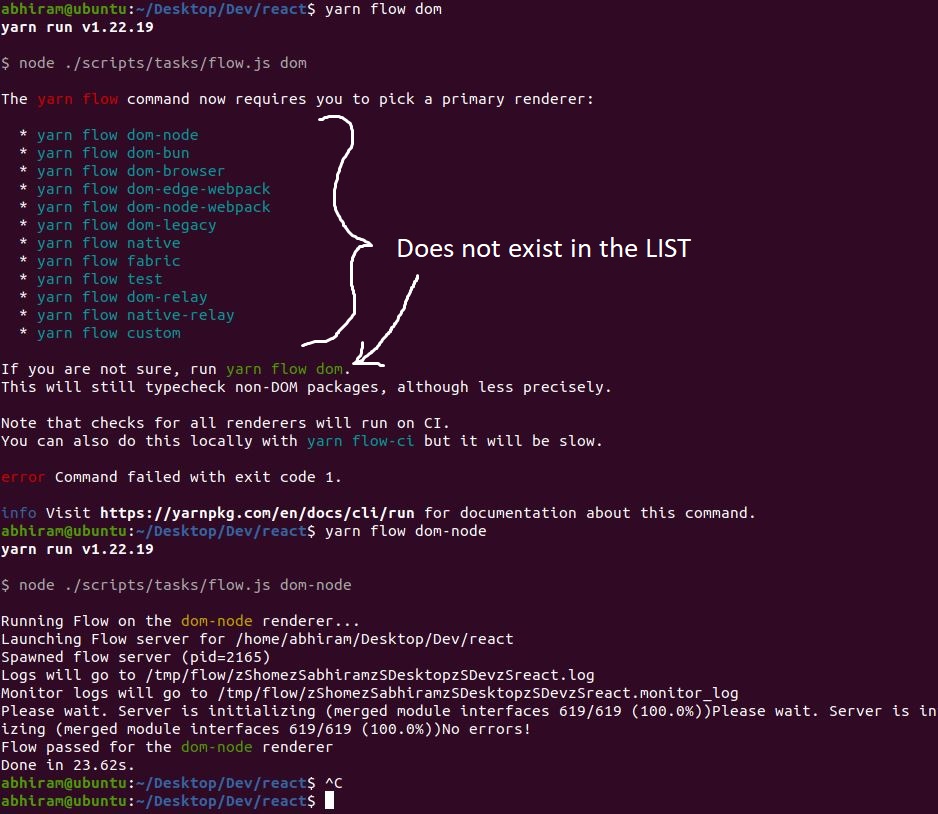
The `yarn flow` command, as suggested for every PR Submission (Task No.
9), tells us `The yarn flow command now requires you to pick a primary
renderer` and provides a list for the same. However, in at the bottom of
the prompt, it suggests `If you are not sure, run yarn flow dom`. This
command `yarn flow dom` does not exist in the list and thus the command
does nothing and exits with `status code 1` without any flow test.
<!--
Explain the **motivation** for making this change. What existing problem
does the pull request solve?
-->
While trying to submit a different PR for code cleaning, just during
submission I read the PR Guidelines, and while doing `yarn test`, `yarn
lint`, and `yarn flow`, I came across this issue and thought of
submitting a PR for the same.
## How did you test this change?
Since this code change does not change any logic, just the text
information, I only ran `yarn linc` and `yarn test` for the same.
<!--
Demonstrate the code is solid. Example: The exact commands you ran and
their output, screenshots / videos if the pull request changes the user
interface.
How exactly did you verify that your PR solves the issue you wanted to
solve?
If you leave this empty, your PR will very likely be closed.
-->
Here is how the issue currently looks like:
Signed-off-by: abhiram11 <abhiramsatpute@gmail.com>
Co-authored-by: abhiram11 <abhiramsatpute@gmail.com>
Using the `link:` protocol to create a dependency doesn't work when we
edit the `package.json` to lock the version to a specific version. It
didn't really work before neither, it was just that `yarn` installed an
existing `scheduler` dependency from npm instead of using the built one.

So I'm updating all the fixture to use the technique where we copy files
instead.
The `start` convention is a CRA convention but nobody else of the modern
frameworks / tools use this convention for a file watcher and dev mode.
Instead the common convention is `dev`. Instead `start` is for running a
production build that's already been built.

---------

Co-authored-by: Sebastian Silbermann <silbermann.sebastian@gmail.com>
This splits out the Edge and Node implementations of Flight Client into
their own implementations. The Node implementation now takes a Node
Stream as input.

I removed the bundler config from the Browser variant because you're
never supposed to use that in the browser since it's only for SSR.
Similarly, it's required on the server. This also enables generating a
SSR manifest from the Webpack plugin. This is necessary for SSR so that
you can reverse look up what a client module is called on the server.

I also removed the option to pass a callServer from the server. We might
want to add it back in the future but basically, we don't recommend
calling Server Functions from render for initial render because if that
happened client-side it would be a client-side waterfall. If it's never
called in initial render, then it also shouldn't ever happen during SSR.
This might be considered too restrictive.

~This also compiles the unbundled packages as ESM. This isn't strictly
necessary because we only need access to dynamic import to load the
modules but we don't have any other build options that leave
`import(...)` intact, and seems appropriate that this would also be an
ESM module.~ Went with `import(...)` in CJS instead.
> All notifications of mutations that have already been detected, but
not yet reported to the observer, are discarded. To hold on to and
handle the detected but unreported mutations, use the takeRecords()
method.
>    -- ([Mozilla docs for disconnect](

https://developer.mozilla.org/en-US/docs/Web/API/MutationObserver/disconnect))

Fizz external runtime needs to process mutation records (representing
potential Fizz instructions) before calling `disconnect()`. We currently
do not do this (and might drop some instructions).
We should never use any logic beyond declarations in the module scope,
including conditions, because in a cycle that can lead to problems.

More importantly, the compiler can't safely reorder statements between
these points which limits the optimizations we can do.
## Summary

In rollup v1.19.4, The "treeshake.pureExternalModules" option is
deprecated. The "treeshake.moduleSideEffects" option should be used
instead, see
https://github.com/rollup/rollup/blob/v1.19.4/src/Graph.ts#L130.

## How did you test this change?

ci green
I found this while working to ensure that we always lower all operands to
temporaries. This works:

```javascript

// the whole computation of x is memoized in one block, bc of the mutation after
the phi

let x;

if (cond) {

x = someObj();

} else {

x = someObj();

}

mutate(x);

```

However, if you alias either of the operands, we lose the mutation:

```javascript

let x;

if (cond) {

const y = someObj(); // OOPS this gets independently memoized

x = y;

} else {

x = someObj();

}

mutate(x);

```

The core issue is that InferMutableRanges does not take into account mutation of
phis. ~~My first thought is that we need an additional, outer fixpoint iteration
loop to flow mutation back "up" to phi operands~~

edit: there was a much easier fix, we need to alias phi operands and phi id
within the existing fixpoint iteration. See follow-up PR which fixes.
It's confusing to new contributors, and me, that you're supposed to use
`yarn build-combined` for almost everything but not fixtures.

We should use only one build command for everything.

Updated fixtures to use the folder convention of build-combined.
This is a precursor to validating that all identifiers are defined - we need to
know about gobals and module declarations, so this PR adds the ability to
configure a Set<string> of defined globals. The default list is inspired by the
globals that prepack defines, which just comes from the spec definition.
Updates BuildHIR to produce LoadGlobal instructions for references to globals.
Note that this breaks our previous strategy of finding hook calls: that relied
on looking at the callee of a CallExpression and checking its name, which relied
on the callee not being lowered to a temporary. By lowering the name (eg
`useState`) to a temporary first, we now no longer see the name at the callsite.

Thankfully @gsathya solved this for us already by teaching type inference about
hooks, and more generally implementing type inference. I updated this so that we
infer the type of a LoadGlobal if the name is a hook: the type inference picks
this up and propagates the type forward correctly. So now, all places that
needed to check for a hook can just look at the type and everything works.

This is much more robust than before - you can now reassign a hook to a local
variable and we'll still detect that when you call it, you're calling a hook.
Adds a new `LoadGlobal` InstructionValue variant which will be used to represent
identifiers that refer to globals. We don't construct this value type yet.
Updates the babel plugin so that environment options — including custom hook
definitions — can be passed in through the plugin:

* Renames `CompilerFlags` => `PluginOptions` since they are specific to the
babel plugin, and are no longer just flags.

* Moves the definition of `useFreeze()` out of the builtin hook list and instead
passes it when our unit tests configure the plugin.
InferReferenceEffects needs to be able to pass around the function's
Environment, but there is already a local class with that name. It's confusing
to have two "environment" concepts in one file, so this PR renames that local
class to the more appropriate `InferenceState` and renames local variables and
updates comments accordingly.
 Lauren Tan
 mofeiZ
 Josh Story
 Sebastian Markbåge
 Mengdi Chen
 Sophie Alpert
 Joe Savona
 Andrew Clark

 Abhiram Satputeandabhiram11

 Samuel Susla
 chenpeng
 Glenn 'devalias' GrantandSebastian Markbage
 Ming Ye
 BIKI DAS



