Fixes#13777
As part of #11927 we introduced a regression by adding onclick handler
to the React root. This causes the whole React tree to flash when tapped
on iOS devices (for reasons I outlined in
https://github.com/facebook/react/issues/12989#issuecomment-414266839).
To fix this, we should only apply onclick listeners to portal roots. I
verified that my proposed fix indeed works by checking out our DOM
fixtures and adding regression tests.
Strangely, I had to make changes to the DOM fixtures to see the behavior
in the first place. This seems to be caused by our normal sites (and
thus their React root) being bigger than the viewport:
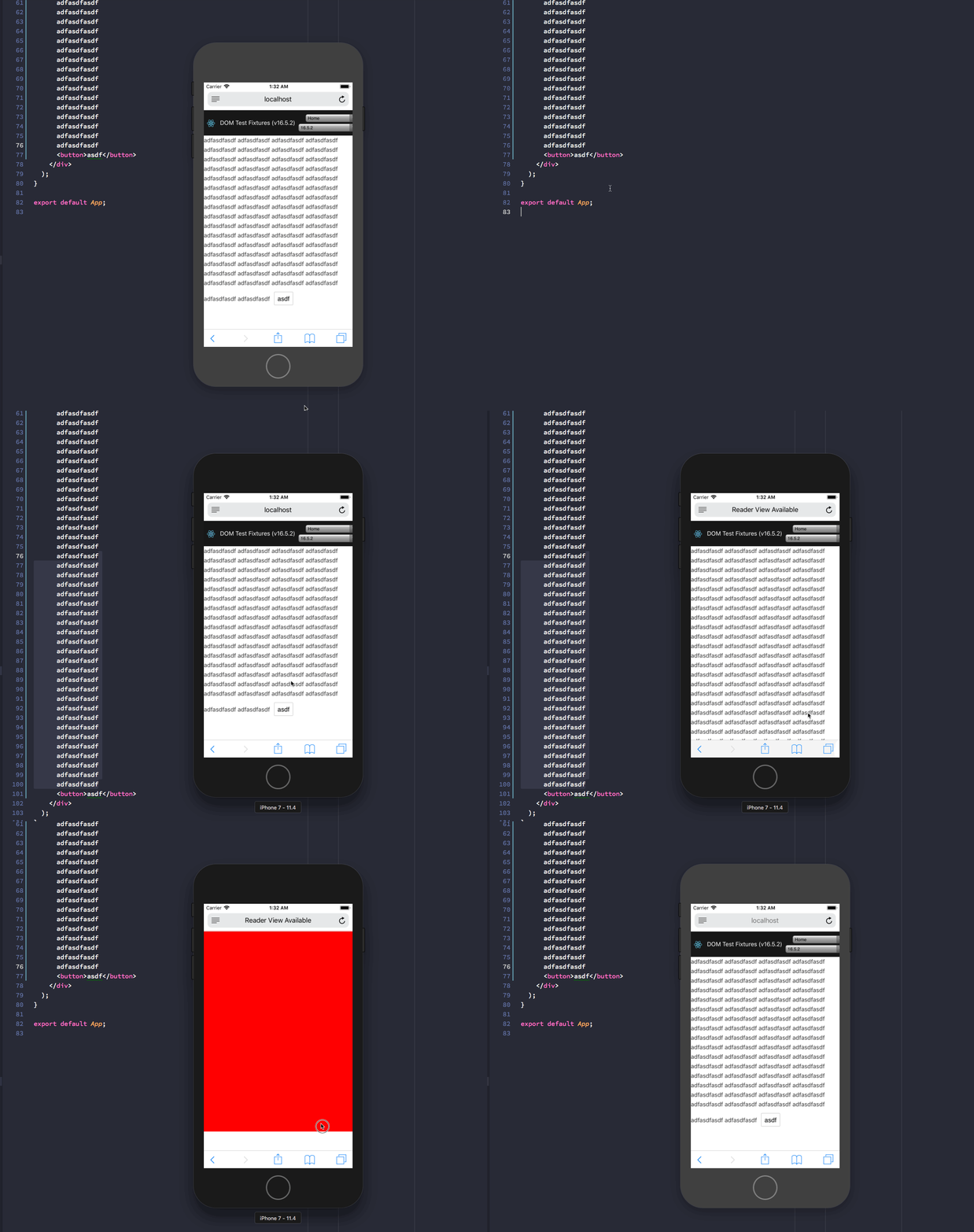
An alternative approach to finding out if we're appending to a React
root would be to add a third parameter to `appendChildToContainer` based
on the tag of the parent fiber.
* [scheduler] Eagerly schedule rAF at beginning of frame

Eagerly schedule the next animation callback at the beginning of the
frame. If the scheduler queue is not empty at the end of the frame, it
will continue flushing inside that callback. If the queue *is* empty,
then it will exit immediately. Posting the callback at the start of the
frame ensures it's fired within the earliest possible frame. If we
waited until the end of the frame to post the callback, we risk the
browser skipping a frame and not firing the callback until the frame
after that.

* Re-name scheduledCallback -> scheduledHostCallback
Previously, we were emptying root.pendingInteractionMap and permanently losing those interactions when applying an unrelated update to a tree that has no scheduled work that is waiting on promise resolution. (That is, one that is showing a fallback and waiting for the suspended content to resolve.)

The logic I'm leaving untouched with `nextRenderIncludesTimedOutPlaceholder` is *not* correct -- what we want is instead to know if *any* placeholder anywhere in the tree is showing its fallback -- but we don't currently have a better replacement, and this should unblock tracing with suspense again.
This package uses `process.env.NODE_ENV` but does not transform its usage during bundling like the rest of the React libraries do. This causes issues when `process` is not defined globally.
* Jest + test renderer helpers for concurrent mode

Most of our concurrent React tests use the noop renderer. But most
of those tests don't test the renderer API, and could instead be
written with the test renderer. We should switch to using the test
renderer whenever possible, because that's what we expect product devs
and library authors to do. If test renderer is sufficient for writing
most React core tests, it should be sufficient for others, too. (The
converse isn't true but we should aim to dogfood test renderer as much
as possible.)

This PR adds a new package, jest-react (thanks @cpojer). I've moved
our existing Jest matchers into that package and added some new ones.

I'm not expecting to figure out the final API in this PR. My goal is
to land something good enough that we can start dogfooding in www.

TODO: Continue migrating Suspense tests, decide on better API names

* Add additional invariants to prevent common errors

- Errors if user attempts to flush when log of yields is not empty
- Throws if argument passed to toClearYields is not ReactTestRenderer

* Better method names

- toFlushAll -> toFlushAndYield
- toFlushAndYieldThrough ->
- toClearYields -> toHaveYielded

Also added toFlushWithoutYielding

* Fix jest-react exports

* Tweak README
`--save` is on by default as of [npm 5](https://blog.npmjs.org/post/161081169345/v500), and `npm install aphrodite` is functionally equivalent to `npm install --save aphrodite` now
* Removed the enableGetDerivedStateFromCatch feature flag (aka permanently enabled the feature)
* Forked/copied ReactErrorBoundaries to ReactLegacyErrorBoundaries for testing componentDidCatch
* Updated error boundaries tests to apply to getDerivedStateFromCatch
* Renamed getDerivedStateFromCatch -> getDerivedStateFromError
* Warn if boundary with only componentDidCatch swallows error
* Fixed a subtle reconciliation bug with render phase error boundary
* pure

A higher-order component version of the `React.PureComponent` class.
During an update, the previous props are compared to the new props. If
they are the same, React will skip rendering the component and
its children.

Unlike userspace implementations, `pure` will not add an additional
fiber to the tree.

The first argument must be a functional component; it does not work
with classes.

`pure` uses shallow comparison by default, like `React.PureComponent`.
A custom comparison can be passed as the second argument.

Co-authored-by: Andrew Clark <acdlite@fb.com>
Co-authored-by: Sophie Alpert <sophiebits@fb.com>

* Warn if first argument is not a functional component
Added some tests for the non-DOM version of Scheduler that is used
as a fallback, e.g. Jest. The tests use Jest's fake timers API:

- `jest.runAllTimers(ms)` flushes all scheduled work, as expected
- `jest.advanceTimersByTime(ms)` flushes only callbacks that expire
within the given milliseconds.

These capabilities should be sufficient for most product tests. Because
jest's fake timers do not override performance.now or Date.now, we
assume time is constant. This means Scheduler's internal time will not
be aligned with other code that reads from `performance.now`. For finer
control, the user can override `window._sched` like we do in our tests.
We will likely publish a Jest package that has this built in.
All of these features are based on features of React's internal
scheduler. The eventual goal is to lift as much as possible out of the
React internals into the Scheduler package.

Includes some renaming of existing methods.

- `scheduleWork` is now `scheduleCallback`
- `cancelScheduledWork` is now `cancelCallback`


Priority levels
---------------

Adds the ability to schedule callbacks at different priority levels.
The current levels are (final names TBD):

- Immediate priority. Fires at the end of the outermost currently
executing (similar to a microtask).
- Interactive priority. Fires within a few hundred milliseconds. This
should only be used to provide quick feedback to the user as a result
of an interaction.
- Normal priority. This is the default. Fires within several seconds.
- "Maybe" priority. Only fires if there's nothing else to do. Used for
prerendering or warming a cache.

The priority is changed using `runWithPriority`:

```js
runWithPriority(InteractivePriority, () => {
  scheduleCallback(callback);
});
```


Continuations
-------------

Adds the ability for a callback to yield without losing its place
in the queue, by returning a continuation. The continuation will have
the same expiration as the callback that yielded.


Wrapped callbacks
-----------------

Adds the ability to wrap a callback so that, when it is called, it
receives the priority of the current execution context.
* fix updateWrapper causing re-render textarea, even though their data has not changed

* fix updateWrapper causing re-render textarea, even though their data, prettier-all

* minor changes to updateWrapper, add test
* Do not bind topLevelType to dispatch

A previous change made it such that all top level event types
correspond to their associated native event string values. This commit
eliminates the .bind attached to dispatch and fixes a related flow
type.

* Add note about why casting event.type to a topLevelType is safe

* Move interactiveUpdates comment to point of assignment
* Refactor Schedule, remove React-isms

Once the API stabilizes, we will move Schedule this into a separate
repo. To promote adoption, especially by projects outside the React
ecosystem, we'll remove all React-isms from the source and keep it as
simple as possible:

- No build step.
- No static types.
- Everything is in a single file.

If we end up needing to support multiple targets, like CommonJS and ESM,
we can still avoid a build step by maintaining two copies of the same
file, but with different exports.

This commit also refactors the implementation to split out the DOM-
specific parts (essentially a requestIdleCallback polyfill). Aside from
the architectural benefits, this also makes it possible to write host-
agnostic tests. If/when we publish a version of Schedule that targets
other environments, like React Native, we can run these same tests
across all implementations.

* Edits in response to Dan's PR feedback
* Added UMD_PROFILING type to react-dom and scheduling package. Added UMD shim to schedule package.
* Added new schedule umd prod+prof bundle to API test
* Enhance dev warnings for forwardRef render function

- For 0 parameters: Do not warn because it may be due to usage of the
  arguments object.

- For 1 parameter: Warn about missing the 'ref' parameter.

- For 2 parameters: This is the ideal. Do not warn.

- For more than 2 parameters: Warn about undefined parameters.

* Make test cases for forwardRef warnings more realistic

* Add period to warning sentence
 Philipp
 Andrew Clark
 plievone
 Sophie Alpert
 Dan Abramov
 Michael Ridgway
 Andrew Clark
 Spencer Davies
 Andrew Clark
 Heaven
 Brian Vaughn
 Joe Cortopassi

 Timothy Yung
 Dominic Gannaway
 Brian Ng
 Sergei Startsev
 Maksim Markelov
 Brian Vaughn
 Alexey Raspopov
 Nathan Hunzaker
 Jérôme Steunou
 Andres Rojas
