Summary:
Remove these warnings until the methods in ScrollResponder have been moved into ScrollView, so that unactionable warnings aren't firing.

Changelog:
[General][Removed] Remove console warnings for innerViewNode/Ref in ScrollView

Reviewed By: TheSavior

Differential Revision: D20850624

fbshipit-source-id: ce90988e204c3cc3b93536842ec3caa12cf6994e
Summary:
I'm using RNN, which embeds RN view inside native view controllers.

On iOS 13, a modal view controller is "floating" and is offset from the top of the screen.

This causes the calculation of inset in `KeyboardAvoidingView` incorrect as it mixes local view controller coordinate space, with keyboard's screen coordinate space.

## Changelog

[iOS] [Fixed] - Fixed `KeyboardAvoidingView` inset in embedded views (i.e modal view controllers on iOS 13)
Pull Request resolved: https://github.com/facebook/react-native/pull/27607

Test Plan:
1. Tested before and after in a simple view controller (should stay the same)
2. Tested before and after in a modal view controller (should be offset before, and fixed after)
3. Repeated no. 2 with each device rotation (upsideDown, landscapeLeft, landscapeRight)

Reviewed By: cpojer

Differential Revision: D20812231

Pulled By: TheSavior

fbshipit-source-id: fbd72739fb7152655028730e284ad26ff4a5da73
Summary:
The newly added console warnings in D19304480 are adding a lot of warning noise due to missed infra callsites. Those callsites need to be updated before these warnings can be added.

Changelog:
[Removed] Remove console warnings from ScrollView methods

Reviewed By: rickhanlonii

Differential Revision: D20700917

fbshipit-source-id: cb618ee3a291d26e1942e4f91bbc02dee41fb78b
Summary:
Have ScrollView use forwardRef so that the host component methods like `measure` and `measureLayout` are available without having to call `getNativeScrollRef`. Instead, you can use `<ScrollView ref={myRef} />` and directly call all methods of ScrollView and host components on `myRef`.

Previous usage:
```
const myRef = React.createRef<React.ElementRef<typeof ScrollView>>();
<ScrollView ref={myRef} />

const innerViewRef = myRef.current.getNativeScrollRef();

innerViewRef.measure();
```
New usage:
```
const myRef = React.createRef<React.ElementRef<typeof View>>();
<ScrollView ref={myRef} />

// now, myRef.current can be used directly as the ref
myRef.current.measure();
myRef.current.measureLayout();

// Additionally, myRef still has access to ScrollView methods
myRef.current.scrollTo(...);
```

Changes:

* Added deprecation warnings to ScrollView methods `getNativeScrollRef`, `getScrollableNode`, and `getScrollResponder`
* Added the forwardRef call to create `ForwardedScrollView` - this takes in `ref` and passes it into the class ScrollView as `scrollViewRef`.
* Forwarded the ref to the native scroll view using `setAndForwardRef`.
* Added statics onto `ForwardedScrollView` so that `ScrollView.Context` can still be accessed.
* Added type `ScrollViewImperativeMethods`, which lists the public methods of ScrollView.
* Converted all public methods of ScrollView to arrow functions. This is because they need to be bound to the forwarded ref.
* Bound all public methods of ScrollView to the forwarded ref in the `setAndForwardRef` call.
* Flow typed the final output (ForwardedScrollView) as an abstract component that takes in the props of the `ScrollView` class, and has all methods of both the inner host component (`measure`, `measureLayout`, etc) and the public methods (`scrollTo`, etc).

Changes to mockScrollView:
* Changed mockScrollView to be able to mock the function component instead of a class component
* Updated necessary tests

Changelog:
[General] [Changed] - Make ScrollView use forwardRef

Reviewed By: TheSavior

Differential Revision: D19304480

fbshipit-source-id: 6c359897526d9d5ac6bc6ab6d5f9d82bfc0d8af4
Summary:
This gets us on the latest Prettier 2.x:
https://prettier.io/blog/2020/03/21/2.0.0.html

Notably, this adds support for TypeScript 3.8,
which introduces new syntax, such as `import type`.

Reviewed By: zertosh

Differential Revision: D20636268

fbshipit-source-id: fca5833d003804333a05ba16325bbbe0e06d6c8a
Summary:
When passing an object to contentOffset that doesn't have `y` prop set it causes the following error:

```
 Error: AnimatedValue: Attempting to set value to undefined

This error is located at:
    in ScrollView (at src/index.js:638)
...
```

This happens since a runtime check was added to the `AnimatedValue` constructor. (a3aaa471ec)

According to flow types the object passed to contentOffset should always contain both x and y props but since it worked before when y is undefined I think its fine to patch the runtime behaviour defensively, especially since the code change is simple.

## Changelog

[General] [Fixed] - Fix Animated Value initialized with undefined in ScrollView
Pull Request resolved: https://github.com/facebook/react-native/pull/28349

Test Plan: Tested that the crash no longer reproduces when passing an empty object to contentOffset.

Reviewed By: cpojer

Differential Revision: D20601664

Pulled By: hramos

fbshipit-source-id: b098a2dd1e702f995a9a92fa6e4e9a204187dac4
Summary:
add support to the android implementation of the Picker component for setting the background color.

Changelog: [Android] [Added] - Support item background color in Dialog Picker

Differential Revision: D20566131

fbshipit-source-id: d693b40803fa1051ec955c5728994c820fecd9e9
Summary:
A few recent imports have explicitly added ".js" to the end of their path. This prevents Metro from resolving platform-specific JS files, e.g. "Foo.android.js" or "Foo.windows.js" instead of "Foo.js".

React Native Windows provides its own implementation of files in a few cases where stock React Native will share them between Android and iOS. We hope to reduce/eliminate these long term, but requiring explicit ".js" files currently breaks us in a couple of places where we have custom implementations.

This change is a quick regex replace of ES6 and CommonJS imports in 'Libraries/" to eliminate ".js".

## Changelog

[General] [Fixed] - Do not explicitly include ".js" in Library imports
Pull Request resolved: https://github.com/facebook/react-native/pull/28311

Test Plan: I haven't done any manual validation of this, but `flow-check` should catch any issues with this during CI.

Reviewed By: cpojer

Differential Revision: D20486466

Pulled By: TheSavior

fbshipit-source-id: 31e1ccc307967417d7d09c34c859f0b2b69eac84
Summary:
Allow JS to keep track of mostRecentEventCount and pass it into each event or prop update. We really don't want to separately keep track of that data.

In non-Fabric, the ShadowNode will keep track of the mostRecentEventCount associated to prop updates. In Fabric, that happens on the C++ ShadowNode.

Changelog: [Internal] Simplification to TextInput native state

Reviewed By: mdvacca

Differential Revision: D20374573

fbshipit-source-id: 385fba6ec69a071c78832a686b397699a6c55d67
Summary:
Pull Request resolved: https://github.com/facebook/react-native/pull/28058

I'm taking the first step towards supporting iOS 13 UIScene APIs and modernizing React Native not to assume an app only has a single window. See discussion here: https://github.com/facebook/react-native/issues/25181#issuecomment-505612941

The approach I'm taking is to take advantage of `RootTagContext` and passing it to NativeModules so that they can identify correctly which window they refer to. Here I'm just laying groundwork.

- [x] `Alert` and `ActionSheetIOS` take an optional `rootTag` argument that will cause them to appear on the correct window
- [x] `StatusBar` methods also have `rootTag` argument added, but it's not fully hooked up on the native side — this turns out to require some more work, see: https://github.com/facebook/react-native/issues/25181#issuecomment-506690818
- [x] `setNetworkActivityIndicatorVisible` is deprecated in iOS 13
- [x] `RCTPerfMonitor`, `RCTProfile` no longer assume `UIApplicationDelegate` has a `window` property (no longer the best practice) — they now just render on the key window

Next steps: Add VC-based status bar management (if I get the OK on https://github.com/facebook/react-native/issues/25181#issuecomment-506690818 ), add multiple window demo to RNTester, deprecate Dimensions in favor of a layout context, consider adding hook-based APIs for native modules such as Alert that automatically know which rootTag to pass

## Changelog

[Internal] [Changed] - Modernize Modal to use RootTagContext
[iOS] [Changed] - `Alert`, `ActionSheetIOS`, `StatusBar` methods now take an optional `surface` argument (for future iPadOS 13 support)
[iOS] [Changed] - RCTPresentedViewController now takes a nullable `window` arg
[Internal] [Changed] - Do not assume `UIApplicationDelegate` has a `window` property
Pull Request resolved: https://github.com/facebook/react-native/pull/25425

Test Plan:
- Open RNTester and:
- go to Modal and check if it still works
- Alert → see if works
- ACtionSheetIOS → see if it works
- StatusBar → see if it works
- Share → see if it works

Reviewed By: PeteTheHeat

Differential Revision: D16957751

Pulled By: hramos

fbshipit-source-id: ae2a4478e2e7f8d2be3022c9c4861561ec244a26
Summary:
I propose this change because we (and a lot of other people, I'd guess) pass an `async` function as a parameter to `onRefresh`. Because the `async` function returns a `promise`, flow is reporting an error. I think the type checking here can be relaxed either all the way to `any` (because RN does not care here what we return) or to `void | Promise<void>` to account for async functions.

looking at https://github.com/facebook/react-native/commit/fb7b2d353356f67a3149c19ad733d46ec6842767#diff-a9c5687ae65236ba3e7f34bfdcdec81d seems like the second is preferred

## Changelog

[General] [changed] - relax RefreshControl's onRefresh flow typing
Pull Request resolved: https://github.com/facebook/react-native/pull/28167

Test Plan: * flow passes

Reviewed By: hramos

Differential Revision: D20196529

Pulled By: TheSavior

fbshipit-source-id: bb5a314bcfb5fb9c8ab71eccb449f1322aeebacb
Summary:
This Pull Request implements the PlatformColor proposal discussed at https://github.com/react-native-community/discussions-and-proposals/issues/126.   The changes include implementations for iOS and Android as well as a PlatformColorExample page in RNTester.

Every native platform has the concept of system defined colors. Instead of specifying a concrete color value the app developer can choose a system color that varies in appearance depending on a system theme settings such Light or Dark mode, accessibility settings such as a High Contrast mode, and even its context within the app such as the traits of a containing view or window.

The proposal is to add true platform color support to react-native by extending the Flow type `ColorValue` with platform specific color type information for each platform and to provide a convenience function, `PlatformColor()`, for instantiating platform specific ColorValue objects.

`PlatformColor(name [, name ...])` where `name` is a system color name on a given platform.  If `name` does not resolve to a color for any reason, the next `name` in the argument list will be resolved and so on.   If none of the names resolve, a RedBox error occurs.  This allows a latest platform color to be used, but if running on an older platform it will fallback to a previous version.
 The function returns a `ColorValue`.

On iOS the values of `name` is one of the iOS [UI Element](https://developer.apple.com/documentation/uikit/uicolor/ui_element_colors) or [Standard Color](https://developer.apple.com/documentation/uikit/uicolor/standard_colors) names such as `labelColor` or `systemFillColor`.

On Android the `name` values are the same [app resource](https://developer.android.com/guide/topics/resources/providing-resources) path strings that can be expressed in XML:
XML Resource:
`@ [<package_name>:]<resource_type>/<resource_name>`
Style reference from current theme:
`?[<package_name>:][<resource_type>/]<resource_name>`
For example:
- `?android:colorError`
- `?android:attr/colorError`
- `?attr/colorPrimary`
- `?colorPrimaryDark`
- `android:color/holo_purple`
- `color/catalyst_redbox_background`

On iOS another type of system dynamic color can be created using the `IOSDynamicColor({dark: <color>, light:<color>})` method.   The arguments are a tuple containing custom colors for light and dark themes. Such dynamic colors are useful for branding colors or other app specific colors that still respond automatically to system setting changes.

Example: `<View style={{ backgroundColor: IOSDynamicColor({light: 'black', dark: 'white'}) }}/>`

Other platforms could create platform specific functions similar to `IOSDynamicColor` per the needs of those platforms.   For example, macOS has a similar dynamic color type that could be implemented via a `MacDynamicColor`.   On Windows custom brushes that tint or otherwise modify a system brush could be created using a platform specific method.

## Changelog

[General] [Added] - Added PlatformColor implementations for iOS and Android
Pull Request resolved: https://github.com/facebook/react-native/pull/27908

Test Plan:
The changes have been tested using the RNTester test app for iOS and Android.   On iOS a set of XCTestCase's were added to the Unit Tests.

<img width="924" alt="PlatformColor-ios-android" src="https://user-images.githubusercontent.com/30053638/73472497-ff183a80-433f-11ea-90d8-2b04338bbe79.png">

In addition `PlatformColor` support has been added to other out-of-tree platforms such as macOS and Windows has been implemented using these changes:

react-native for macOS branch: https://github.com/microsoft/react-native/compare/master...tom-un:tomun/platformcolors

react-native for Windows branch: https://github.com/microsoft/react-native-windows/compare/master...tom-un:tomun/platformcolors

iOS
|Light|Dark|
|{F229354502}|{F229354515}|

Android
|Light|Dark|
|{F230114392}|{F230114490}|

{F230122700}

Reviewed By: hramos

Differential Revision: D19837753

Pulled By: TheSavior

fbshipit-source-id: 82ca70d40802f3b24591bfd4b94b61f3c38ba829
Summary:
We will soon be enforcing that flow suppressions will only apply when on an error's primary location ([post](https://fb.workplace.com/groups/179614562644215/permalink/559286354677032/)). This diff uses the codemod created in D20008770 to move all suppression comments to their primary locations in the  `xplat/js` flow root, and deletes suppression comments that are not on any primary locations.

This diff was generated with:
```
~/fbsource/fbcode/flow/packages/flow-dev-tools/bin/tool suppression-primary-locations --json-file ~/www/errors.json  ~/fbsource/xplat/js
hg st -n | xargs grep -l -P '@(partially-)?generated' | xargs hg revert
hg st -n | xargs grep -l 'format' | xargs prettier --write
```

Changelog: [Internal]

bypass-lint

Reviewed By: dsainati1

Differential Revision: D20122544

fbshipit-source-id: d94e409aadb18bb399a1ddbf9f3f2494fe4fb54c
Summary:
Use codegen'd ViewCommands added in previous diff as a replacement for setNativeProps.

Changelog: [Internal]

Reviewed By: mdvacca

Differential Revision: D18619298

fbshipit-source-id: 08069e828e92ac3cca9813bbcdca99d99fb50883
Summary:
The migration from classy to functional component partially broke controlled TextInput selections. This fixes it.

The nuance is that even though we have "event counters" sent from native, "onChange" and "onChangeSelection" are separate events;
so even if you receive new text and a new native event counter, your selection may be out-of-date. Incrementing the event counter
when sending selection events breaks text updates; and adding another native event counter seems like overkill. Instead, in JS, we statefully
keep track of (1) the native event counter, (2) whether or not the selection has been updated for that event counter.

Changelog: [internal]

Reviewed By: mdvacca

Differential Revision: D18867152

fbshipit-source-id: c569ecd03ce0042d6feb5fa8af4c756588607a09
Summary:
We recently updated React Native's docs site to have its own domain reactnative.dev and needed to update the URLs in the source code

CHANGELOG:
[INTERNAL]

Reviewed By: hramos

Differential Revision: D20072842

fbshipit-source-id: 1970d9214c872a6e7abf697d99f8f5360b3b308e
Summary:
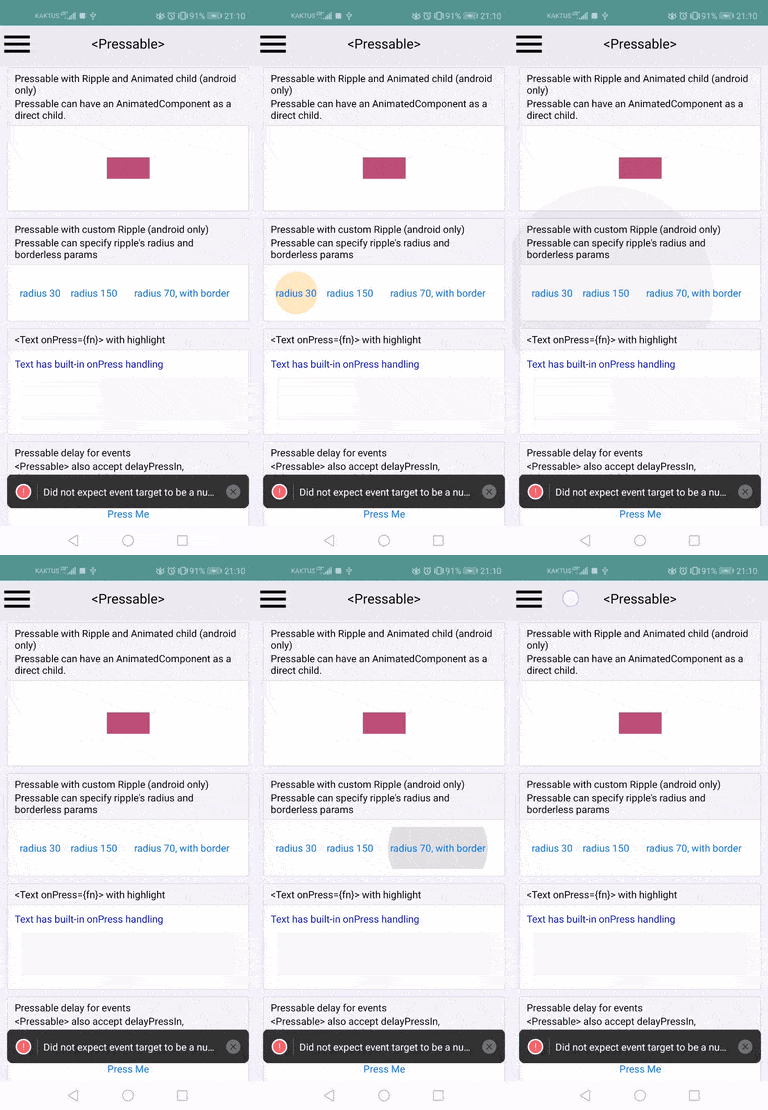
*Pressable* is a component which is intended to replace the Touchable* components such as *TouchableWithoutFeedback* and *TouchableOpacity*. The motivation is to make it easier to create custom visual touch feedback so that React Native apps are not easily identified by the “signature opacity fade” touch feedback.

We see this component as eventually deprecating all of the existing Touchable components.

Changelog:
[Added][General] New <Pressable> Component to make it easier to create touchable elements

Reviewed By: yungsters

Differential Revision: D19674480

fbshipit-source-id: 765d657f023caea459f02da25376e4d5a2efff8b
Summary:
motivation: there are cases where one'd like to control the radius of the ripple effect that's present on TouchableNativeFeedback - in my case, I want to make sure that both icons and text have the same ripple appearance, but that's currently not possible as far as I can tell.
Currently (afaik) the only way to set (upper) ripple limits is by specifying width, height and border radius ( + `overflow: hidden`), and this works well for icons which can usually be bounded by a square, but not for text which can have rectangular shape.
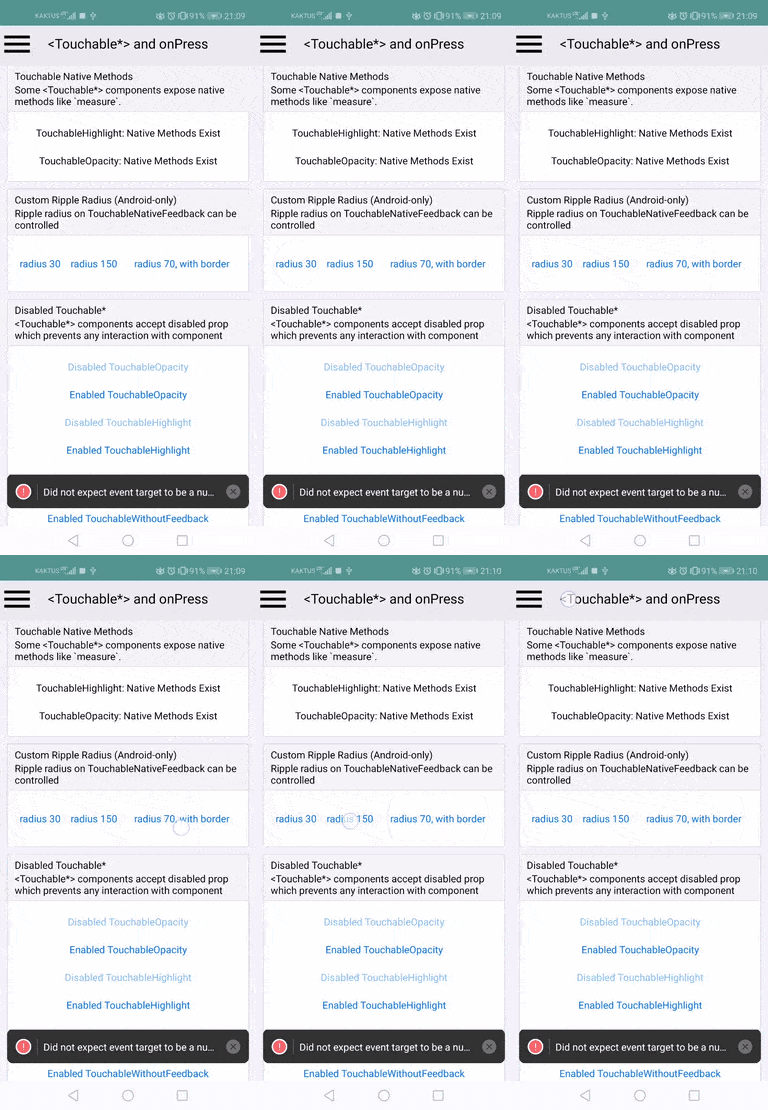
This PR adds `rippleRadius` parameter to `SelectableBackground()`, `SelectableBackgroundBorderless()` and `Ripple()` static functions present on `TouchableNativeFeedback`. It can make the ripple smaller but also larger. The result looks like this:
added to RNTester:

difference from the other ripples:

I'm ofc open to changing the api if needed, but I'm not sure there's much space for manoeuvring. While I was at it, I did a slight refactor of the class into several smaller, more focused methods.
It's possible that in some cases, this might help to work around this issue https://github.com/facebook/react-native/issues/6480.
## Changelog
[Android] [Added] - allow setting custom ripple radius on TouchableNativeFeedback
Pull Request resolved: https://github.com/facebook/react-native/pull/28009
Test Plan: I tested this locally using RNTester
Reviewed By: TheSavior
Differential Revision: D20004509
Pulled By: mdvacca
fbshipit-source-id: 10de1754d54c17878f36a3859705c1188f15c2a2
Summary:
The [PlatformColor PR](https://github.com/facebook/react-native/pull/27908) is currently open to implement the [PlatformColor proposal](react-native-community/discussions-and-proposals#126).   When that PR was imported into Facebooks internal builds it was found that the change to the `processColor()` function to return an opaque type or `number` instead of just `number` breaks internal components.

This PR is a simplification of the PlatformColor PR only changing the return type of `processColor()` from `?number` to `?number | NativeColorType` where `NativeColorType` is just an empty but opaque type.   This will allow changes to be made to these internal components but with less risk than the larger PR.

## Changelog

[General] [Changed] - Add NativeColorType opaque type to normalizeColor() ahead of PlatformColor PR
Pull Request resolved: https://github.com/facebook/react-native/pull/28040

Test Plan: Flow checks, Jest test, iOS unit tests, iOS integration tests, and manual testing performed on RNTester for iOS and Android.

Differential Revision: D19860205

Pulled By: TheSavior

fbshipit-source-id: 799662c6621d3974158b375ccccfa136982c43b4
Summary:
Make iOS use Commands instead of UIManager.{focus,blur}. This makes these apis compatible with Fabric and paper at the same time.

Changelog:
[Internal] Switch iOS focus/blur calls to use new commands

Reviewed By: mdvacca

Differential Revision: D19458995

fbshipit-source-id: 8c4aacd41941f54a887aeec1a17d9ce0b6878ab1
Summary:
This makes Android dispatch focus/blur through the Fabric view manager when running in Fabric.

Changelog:
[Internal] Switch Android focus/blur calls to use new commands

Reviewed By: JoshuaGross, mdvacca

Differential Revision: D19458362

fbshipit-source-id: 23e1d989ec55bc8abff4279e259f4b6c953ac0a3
Summary:
TextInput’s `InputAccessoryView` was using a [deprecated] prop-type as a Flow type, which TheSavior asked me to fix [here](https://github.com/alloy/rn2dts/commit/6ba4b28a22d8c0bd346996d78743016eaae707e1#r37343692).

## Changelog

[iOS] [Fixed] - Fixes the `InputAccessoryView.backgroundColor` prop’s typing to use `ColorValue`.
Pull Request resolved: https://github.com/facebook/react-native/pull/28105

Test Plan:
Passes:

```bash
yarn flow-check-ios
```

Differential Revision: D19956401

Pulled By: TheSavior

fbshipit-source-id: 0c16f292b0143e83235a23712a0a7a11b8317f4e
Summary:
This class is no longer used by the core and thus can be removed.

It isn't exposed as part of our public API so this is technically not a breaking change, although it may still cause people trouble if they are reaching into internals. It is expected that people will use forwardRef instead of this class.

I will follow up this diff with a removal from the ReactNativeRenderer as well.

Changelog:
[Internal] Remove ReactNative.NativeComponent from React Native

Reviewed By: JoshuaGross

Differential Revision: D19888400

fbshipit-source-id: 78da51e6c0edf9d8706395d376c3bfe75dabda03
Summary:
Right now, people are calling `getInnerViewNode` and `getInnerViewRef` to get the ref of the `View` within `ScrollView`. Instead, this change adds a prop to `ScrollView` to give people direct access to that `View` if they need it.

Previous usage:
```
const myRef = React.createRef<React.ElementRef<typeof ScrollView>>();

<ScrollView ref={myRef} />

const innerViewRef = myRef.current.getInnerViewRef();

innerViewRef.measure();

```

New usage:
```
const myRef = React.createRef<React.ElementRef<typeof View>>();

<ScrollView innerViewRef={myRef} />

// now, myRef.current can be used directly as the ref
myRef.current.measure();
```

Changelog:
[Changed][General] ScrollView: Deprecate getInnerViewNode and getInnerViewRef methods. Use innerViewRef={myRef} prop instead.

Reviewed By: TheSavior

Differential Revision: D19713191

fbshipit-source-id: 3304cb94a253dafb458ef49d6331e0e432693431
Summary:
Added description for rejectResponderTermination prop for the TextInput, which seemed to have been deleted.
Descriptions are taken from https://github.com/facebook/react-native/pull/16755/files

## Changelog

[Internal] [Added] - Add description for rejectResponderTermination prop for TextInput
Pull Request resolved: https://github.com/facebook/react-native/pull/28001

Test Plan: This PR only changes comment, which has no effect on actual function.

Differential Revision: D19820886

Pulled By: TheSavior

fbshipit-source-id: 5cbaafcbae0bdbf6932ef9c7c0c1a75cd6d8794e
Summary:
React is way better than it used to be...

Changelog: [Internal]

Reviewed By: zackargyle, lunaleaps

Differential Revision: D19421772

fbshipit-source-id: db82b68a0c2f31e9ef7e1875fd9e4bf27ef6295a
Summary:
All of our other JS view configs are gated by the `RN$Bridgeless` flag. This one has been behind a DEV flag instead. We've been using it in DEV for a long time now, so it's probably ok to be in prod, but I figured it's better to just be consistent with the rest of the native components, since we only need this for bridgeless.

Changelog: [Internal]

Reviewed By: TheSavior

Differential Revision: D19669902

fbshipit-source-id: bd28cf84947bfe298efd95ae07e38c2bf4e45091
Summary: `requireNativeComponent` redboxes in bridgeless mode because there is no UIManager. This adds a handwritten view config to avoid using UIManager.

Reviewed By: ejanzer

Differential Revision: D19624044

fbshipit-source-id: 5ae68f63068a131a305754003154ee0cf0f1be46
Summary:
In case when Platform is different from Android or iOS, ScrollView initialised RCTScrollView two times, which caused a crash. It looks for me that default option is obsolete and can be united with iOS one to fix this issue.

## Changelog:
[Internal] [Fixed] - Fixed crash during ScrollView initialisation if Platform.OS is not iOS or Android

Reviewed By: ejanzer

Differential Revision: D19623046

fbshipit-source-id: 84f8a46ea24b463aa6aae761f4386ab7e4e95f9b
Summary:
When I was testing React Native 0.62-rc.1, I noticed that console was showing a warning for Require Cycle as shown in image below

This is because ScrollResponder was importing `ScrollView` to get the `typeof ScrollView`.
I've made an export for ScrollView type in `ScrollView` so that Require cycle warning will not show up.
## Changelog
[General] [Fixed] - Remove Require cycle warning.
Pull Request resolved: https://github.com/facebook/react-native/pull/27851
Differential Revision: D19577644
Pulled By: cpojer
fbshipit-source-id: 257b9421a91244d69394375102cfbe683326bba2
Summary:
Hand-writing a JS view config for AndroidTextInputNativeComponent.

This diff was generated by adding logging to `getNativeComponentAttributes`. Diff preview: https://our.intern.facebook.com/intern/diff/view-version/96875488/

Changelog: [Internal]

Reviewed By: mdvacca

Differential Revision: D19456328

fbshipit-source-id: b2d5abd2fde380be182b95881c335d24481343f1
Summary: Changelog: [Fix] Fix status bar color not updating when navigating between two screens with the same status bar color.

Reviewed By: RSNara

Differential Revision: D19439424

fbshipit-source-id: 44388f1f94c87c12102471d72183bb6c152a46b6
Summary:
Fabric doesn't support setNativeProps, so we are using view commands instead.

Changelog: [Internal]

Reviewed By: mdvacca

Differential Revision: D18044169

fbshipit-source-id: d5f199b930244d02f174ea8a7ef732e9a8ef2476
Summary:
As a part of the migration from setNativeProps in Fabric and Paper, we are replacing it by view commands in the RefreshControl component on Android.

Changelog: [Internal]

Reviewed By: mdvacca

Differential Revision: D18475450

fbshipit-source-id: ad89547fada3444f725fd9b00e8482cfc8f4d7fc
Summary:
As a part of the migration from setNativeProps in Fabric and Paper, we are replacing it by view commands in the Checkbox component on Android.

Changelog: [Internal]

Reviewed By: mdvacca

Differential Revision: D18451749

fbshipit-source-id: 49d786ef3383df95b10260ba2b7f68489ad31789
 jiggag
 Vojtech Novak
 Kacie Bawiec
 Daniel Cohen Gindi
 Michael Bolin
 Janic Duplessis
 Eddie Dugan
 Jesse Katsumata
 Nick Gerleman
 Joshua Gross
 Logan Daniels
 radex
radex
 Tom Underhill
 Hans Halverson
 Rachel Nabors
 Eli White
 Eloy Durán
 Spencer Ahrens
 Emily Janzer
 Peter Argany
 Arthur Kushka
 Mike Vitousek
 Nikita Shanin
 Samuel Susla
 Rajat Gupta
 Oleksandr Melnykov