Summary:
We need to get rid of findNodeHandle calls so migrating scrollResponderScrollNativeHandleToKeyboard to take a ref to a host component.

I made this change with Flow, and tested by rendering UserJobApplicationForm

Reviewed By: mdvacca

Differential Revision: D17099280

fbshipit-source-id: 96af692006aace2c206f268f5416984b00f8a438
Summary:
The merge of https://github.com/facebook/react-native/issues/25451 added `xcshareddata` to the .gitignore file in `template`. Two xcscheme files in the `xcschemes` subfolder were still left in the template and should have been removed at the same time.

The project opens and builds fine without the xcscheme files both from command line and in Xcode.

## Changelog

[iOS] [Changed] - Remove ignored iOS schemes from template
Pull Request resolved: https://github.com/facebook/react-native/pull/26471

Test Plan:
Generate new project, remove files, verify that project builds, and opens correctly in Xcode.

Please review karanjthakkar satya164 kelset

Differential Revision: D17491748

Pulled By: cpojer

fbshipit-source-id: 391545293c2d09d52f78f56cd91cef5dcf036a9a
Summary:
This PR is extracts and reuses ANDROIDX_TEST_VERSION, and is part of Gradle script refactoring effort.

## Changelog

[Android] [Changed] - extract and reuse ANDROIDX_TEST_VERSION
Pull Request resolved: https://github.com/facebook/react-native/pull/26487

Differential Revision: D17488766

Pulled By: mdvacca

fbshipit-source-id: f1968ffc403074d78d792eb5cc773cc6366ad2d1
Summary:
This diff splits up the current `createTimer` method (which is used for setTimeout, setInterval, etc.) into two methods, `createTimer` and `createAndMaybeCallTimer`. The latter is what's used by the existing Timing native module, and it preserves the existing behavior of this function.

What's the difference? The current implementation of createTimer makes some assumptions about how it's called - namely, that it's called from JS asynchronously (using the bridge). Right now when you create a timer from JS, the JSTimers module passes in the timestamp for when the timer was created; in the native `createTimer`, we compare this timestamp to the current time, and if we find the timer has already expired, we immediately invoke the callback.

Presumably this is done because we don't know how much time has elapsed since when the timer was scheduled in JS, and we want to make sure that it's called as soon as possible. Of course, this also means that `setTimeout(0)` will be immediately invoked, too, without waiting for the next frame.

This all sounds fine, until we take a look at immediates. Immediates are currently implemented entirely in JS, and are called by the JS bridge; before returning control to native, we flush the immediates queue.

This means that the current behavior is: 1) `setImmediate()` is always invoked before `setTimeout(0)`; 2) `setTimeout(0)` is invoked as soon as possible, before the next frame.

However, this changes with bridgeless RN. With bridgeless RN, the native module methods are being replaced by C++ host functions, which are called synchronously. So if we keep the current logic in JavaTimerManager (where it checks if the timer has already expired), then `setTimeout(0)` will be invoked **before** immediates are called.

So the change that I'm making for bridgeless RN is to always wait until the next frame before calling timers. This preserves the order of immediates/timers, although it does mean that `setTimeout(0)` will no longer be called as soon as possible. Of the two options, this seems preferable.

Reviewed By: PeteTheHeat

Differential Revision: D17403144

fbshipit-source-id: 8230f6ebe56aa20bfcf2325177c7812bc8e9c2ec
Summary:
In Windows, if you clicked on a Switch component to toggle it, you could see it "shimmy" back and forth once before settling. The native Switch ends up toggling three times every time it's invoked.

`Switch.js` prevents the native switch from toggling to the new value by explicitly setting the switch to `this.props.value` when it receives an `onChange` event. The re-setting of the value wasn't fast enough to prevent the `Switch` from starting to toggle, causing the visual shimmy.

The solution is taken from `TextInput`. `TextInput.js` stores `_lastNativeText` when it receives an `onChange` event. In `componentDidUpdate`, it puts `this.props.text` back on the native textbox if the value of `this.props.text` isn't the same as `_lastNativeText`, which is how it ensures that it is a controlled component. Porting this to the `Switch` results in only one toggle happening per invoke, removing the shimmy, while preserving the controlled component behavior.

This bug is not visible on Android or iOS, only Windows, however the code causing the bug was in `Switch.js` and it seems reasonable to avoid changing the value of the native switch excessively.

## Changelog

[General] [Fixed] - Fix excessive toggles on the Switch component
Pull Request resolved: https://github.com/facebook/react-native/pull/26496

Test Plan: Used RNTester on Android and iOS to test the Switch component and made sure that all scenarios behave as expected visually. Also ensured through the debugger that the value of the native switch is only being changed once, instead of three times.

Reviewed By: TheSavior

Differential Revision: D17468905

Pulled By: JoshuaGross

fbshipit-source-id: 92bf511510306968c3573ee4eed6df009850fd77
Summary:
This change restores the possibility of injecting custom root views via ReactAcitivtyDelegate. It has been used by react-native-gesture-handler library in order to replace default root view with a one that'd route touch events to gesture-handler internal pipeline.

The regression happened in d0792d4b8a where new `ReactDelegate` was introduced to provide support for rendering react native views in both Android fragments and activities. As a part of that change the logic responsible for creating root view has been moved from `ReactActivityDelegate` to `ReactDelegate` rendering `ReactActivityDelegate.createRootView` unused – that is there is no code path that leads to this method being called. Instead `ReactDelegate.createRootView` method has been added which now plays the same role. The custom root view injection was relying on overwriting that method and hence the method is no longer referenced overwriting it has no effect. Following the logic migration out of `ReactActivityDelegate` into `ReactDelegate` we could potentially now start overwriting methods of `ReactDelegate`. However when working with Android's activities in React Native we can only provide an instance of `ReactActivityDelegate` and in my opinion it does not make too much sense to expose also a way to provide own instance of `ReactDelegate`.

The proposed fix was to route `ReactDelegate.createRootView` to call `ReactActivityDelegate.createRootView` and this way regaining control over root view creation to `ReactActivityDelgate`. The change of the behavior has been implemented by subclassing `ReactDelegate` directly from `ReactActivityDelegate` and hooking the aforementioned methods together. Thanks to this approach, the change has no effect on `ReactDelegate` being used directly from fragments or in other scenarios where it is not being instantiated from `ReactActivityDelegate`.

This fixes an issue reported in https://github.com/kmagiera/react-native-gesture-handler/issues/745 and discussed on 0.61 release thread: https://github.com/react-native-community/releases/issues/140#issuecomment-532235945

## Changelog

[Internal] [Fixed] - Allow for custom root view to be injected via ReactActivityDelegate
Pull Request resolved: https://github.com/facebook/react-native/pull/26495

Test Plan:
1. Run RNTester, take layout snapshot, see the react root view being on the top of view hierarchy.
2. Run gesture-handler Example app (or some other app that overwrites ReactActivityDelegate.createRootView method), on layout snapshot see custom root view being used.

Differential Revision: D17482966

Pulled By: mdvacca

fbshipit-source-id: 866f551b8b077bafe1eb9e34e5dccb1240fa935e
Summary:
The next step to making our existing timers logic usable outside of the context of the native module. This diff removes the bridge access through ReactContext in JavaTimerManager, and instead relies on a delegate that implements the JSTimers interface. I'm reusing the JSTimers interface for convenience even though it extends JavaScriptModule, which I don't plan on using for bridgeless RN.

Also changing from ReadableArray to ReadableNativeArray so that it can be directly accessed from C++.

Reviewed By: PeteTheHeat

Differential Revision: D17282188

fbshipit-source-id: 5c5e0b12a2250334e96885c220feb52146e57c83
Summary:
Decoupling the logic for managing timers from the native module interface in TimingModule. I'm doing this so we can more easily share this logic with bridgeless RN, which won't use a native module for timers but instead will define the bindings with JSI.

This diff just moves things around and doesn't change any of the behavior.

Reviewed By: PeteTheHeat

Differential Revision: D17282187

fbshipit-source-id: ef54254dd0c7e2f6e294e9ae5a7d4b010f98de2e
Summary: Most of our other native modules end in 'module', so let's update Timing to match.

Reviewed By: RSNara

Differential Revision: D17260848

fbshipit-source-id: 808b4d370a7036a247724fda5ab7210ac985476b
Summary:
If you try to use ART components with fabric, their transform is causes crash (stack trace P108110438). You can see this crash if you use RCTVideo component in fabric and tap video to reveal slider.

The cause of crash is mismatch of formats between what is expected for transform and what is being sent.

In this diff we add a check to see whether the configuration is of expected type.

Reviewed By: shergin

Differential Revision: D17181838

fbshipit-source-id: c4f3c920281a2e7f58ff0ffe1d0ec2af8249a16c
Summary:
To help cache Pods artifacts for Sandcastle test run, create a `__generated__` dir under RNTester/Pods, which will contain the normally-top-level files produced by `pod install`. The files will then be symlinked by the script.

allow-large-files

Reviewed By: axe-fb

Differential Revision: D17470686

fbshipit-source-id: 50e4c57e913e2884eed27db94c50181fe4632133
Summary: This diff fixes two issues with the JNI integration of YogaLogger#log. (1) The YogaLogger class descriptor was missing a semicolon. This causes a ClassNotFoundException whenever you try to call the log method from C++. (2) The C++ signature for the class was using YogaNodeJNIBase as an arg but the Java signature was using YogaNode. This causes a MethodNotFoundException whenever you try to call the method after fixing problem 1.

Reviewed By: astreet

Differential Revision: D17439957

fbshipit-source-id: be3c16512558050265565b3688fb09a7da31b9b2
Summary: These subdirs are generated by CocoaPods, they shouldn't be checked in normally. Note that this must be explicitly listed for FB-CI compatibility.

Reviewed By: axe-fb

Differential Revision: D17469656

fbshipit-source-id: 05b023d3f0fa72ddd7cb301cdaf03eabd4f9a4d8
Summary: Removed Flipper deps from RNTester for now, since it's not compatible with FB CI yet.

Reviewed By: axe-fb

Differential Revision: D17465404

fbshipit-source-id: 581f113506dc9dbd345c404a802eb1b622f68ab7
Summary: This was already deprecated, but without a message.

Reviewed By: zackargyle, ejanzer

Differential Revision: D17180347

fbshipit-source-id: 44aa5d1821e56f7600033e82062c4661fe663471
Summary:
This is a easy change in ReactEventEmitter that refactors the TAG used by this class to log events.
This is a follow up of D17422611

Reviewed By: makovkastar

Differential Revision: D17437034

fbshipit-source-id: 9974a244b24b04315c6a328696954b7acf7efbfd
Summary:
Reland https://github.com/facebook/react-native/pull/24767

The commit had to be reverted because it caused a crash when using remote debugging in chrome. This is normal since jsi is not available in that environment. The crash was caused by `jsContext.get()` being 0, then being dereferenced later in c++. We can simply skip initializing the blob collector in this case.

This also includes the fix from https://github.com/facebook/react-native/issues/25720 to fix a crash when using hermes.

## Changelog

[Android] [Fixed] - Release underlying resources when JS instance is GC'ed on Android
Pull Request resolved: https://github.com/facebook/react-native/pull/26155

Test Plan:
Test using RN tester with jsc and hermes
Test remote debugging

Reviewed By: mdvacca, fred2028

Differential Revision: D17072644

Pulled By: makovkastar

fbshipit-source-id: 079d1d43501e854297fbbe586ba229920c892584
Summary:
React Native components need a mechanism to specify their value to assistive technologies. This PR adds the notion of accessibilityValueDescription-- a property which either contains a textual description of a component's value, or for range-based components, such as sliders and progress bars, it contains range information (minimum, current, and maximum).

On iOS, the range-based info if present is converted into a percentage and added to the accessibilityValue property of the UIView. If text is present as part of the accessibilityValueDescription, it is used instead of the range-based information.

On Android, any range-based information in accessibilityValueDescription is exposed in the AccessibilityNodeInfo's RangeInfo. Text which is part of accessibilityValueDescription is appended to the content description.

## Changelog

[GENERAL] [Change] - add accessibilityValuedescription property.
Pull Request resolved: https://github.com/facebook/react-native/pull/26169

Test Plan: Added two new accessibility examples to RNTester, one which uses text and another which uses range-based info in accessibilityValueDescription. Verified that they both behave correctly on both Android and iOS.

Differential Revision: D17444730

Pulled By: cpojer

fbshipit-source-id: 1fb3252a90f88f7cafe1cbf7db08c03f14cc2321
Summary:
ReactAndroid Gradle was failing mysteriously with error below, because it was trying to read values from **android** when it wasn't configured completely.

```java
extensionSupplier.get()!!.compileSdkVersion must not be null
```

or

```java
compileSdkVersion is not specified.
```

It is happening because **buildReactNdkLib** task was created and configured eagerly. So this PR changes some tasks to be configured lazily, and reads values from **android** when ready. Also remove ANDROID_NDK variable check because android gradle plugin doing it automatically.

## Changelog

[Android] [Changed] - lazily configure ReactAndroid gradle tasks
Pull Request resolved: https://github.com/facebook/react-native/pull/26314

Test Plan: ./gradlew ReactAndroid:tasks run without errors, while master throws exception.

Differential Revision: D17177945

Pulled By: cpojer

fbshipit-source-id: c7a165092157d2059f946da70b801d1a475d4b8c
Summary:
Remove YogaNode.create() from the abstract class after we made sure nothing uses it anymore
This is the final stage to make `YogaNode` a pure class without JNI references

Reviewed By: SidharthGuglani

Differential Revision: D17280571

fbshipit-source-id: bd0eb138f7a6a9de8988fc0a7b90badbf635dac5
Summary:
Split YogaConfig into the same way YogaNode is split today.

Into an abstract class defining the interface, and actual JNI implementation

Reviewed By: SidharthGuglani

Differential Revision: D17266404

fbshipit-source-id: 3d5d6aa65c55cfa61d47c662d140cdce6dcb0ea1
Summary: This function was deprecated in Dec 2016. It has no callsites at FB and should be deleted.

Reviewed By: zackargyle, ejanzer

Differential Revision: D17180174

fbshipit-source-id: de3ab78c469220b629ef7f6773d60507959f6db6
Summary:
The files autogenerated by `scripts/generate-rncore.sh` aren't to be committed. This pull request adds them to the repo's `.gitignore`

## Changelog

[Internal] [Changed] - Add codegen generated files to gitignore
Pull Request resolved: https://github.com/facebook/react-native/pull/26479

Test Plan: The files generated by `generate-rncore.sh` are no longer added when you run `git add .`

Differential Revision: D17439794

Pulled By: TheSavior

fbshipit-source-id: 54a2e07aefc5fd187ba5eb8de0c2cd8b69ee4053
Summary:
This pull request makes the following changes to the script `scripts/generate-rncore.js`:

 * Adds a missing argument to the call of `generate-tests.js`
 * Ran `chmod +x generate-rncore.sh` so the script is executable

## Changelog

[Internal] [Fixed] - Updated `generate-rncore.sh` for recent versions of codegen
Pull Request resolved: https://github.com/facebook/react-native/pull/26477

Test Plan: `(cd scripts && ./generate-rncore.sh)` works perfectly now.

Differential Revision: D17439772

Pulled By: TheSavior

fbshipit-source-id: 141efc54aa45aa38dc537f65e425959666f33b3a
Summary:
The concept of `EventBeat::Owner` was introduced in D17128549, this diff implements some missing pieces of that.

After the change, AsyncEventEmitter will check the existence of the "owner" (which is EventDispatcher) which guarantees that the rest of the pipeline is still alive (the validity of Runtime is guaranteed by RuntimeExecutor separately).

The overall workflow is described in D17128549.

Reviewed By: JoshuaGross

Differential Revision: D17410738

fbshipit-source-id: a1ae8e09600546874cdc7c622b3d884b71c5b48d
Summary:
This pull request makes properties of events' Flow types in `AndroidTextInputNativeComponent` be `$ReadOnly`.

This will make them more compatible with the callback types in `TextInput`.

## Changelog

[Internal] [Changed] - Made properties of events' Flow types in `AndroidTextInputNativeComponent` readonly
Pull Request resolved: https://github.com/facebook/react-native/pull/26469

Test Plan:
`yarn flow-check-ios` and `yarn flow-check-android` both pass.

No regressions to running `scripts/generate-rncore.sh` have been noted.

Differential Revision: D17435579

Pulled By: TheSavior

fbshipit-source-id: 92e6c0623c4dd3fe06ebfb22dc73916bf5917bcc
Summary:
This diff forces ReactEventEmitter to use RCTEventEmitter as default event emitter class. This is necessary because of T54134149.
This is a temporary fix until we find the root cause of T54134149

Reviewed By: JoshuaGross

Differential Revision: D17422611

fbshipit-source-id: 159b216434c79466427b7b1a2b0f71f466b0f606
Summary:
This diff changes how we apply default text attributes to backed text input.
The original change in https://github.com/facebook/react-native/pull/23585 that introduced the `reactTextAttributes` field in for RCTBackedTextInputViewProtocol was great! Thank you Wu zhongwuzw !
However, there is one detail that needs to be changed.
RCTBackedTextInputViewProtocol is designed to only abstract complexity of iOS text input components (UITextView and UITextField); it intentionally does not have any React-specific fields or types. Adding a field `RCTTextAttributes *reactTextAttributes;` violates this principle and make it hard to reuse this functionality in the new Fabric-powered TextInput.

This diff changes the type of this prop from `RCTTextAttributes` to `NSDictionary<NSAttributedStringKey,id> *`  (exact same type that UITextView and UITextField use).

Reviewed By: cpojer

Differential Revision: D17408501

fbshipit-source-id: 65f2bba119ccc30f22e87c28d0f8ea6f731cd365
Summary:
Merging react-native-windows to 0.60 - the visual studio compiler seems to take issue with the existing code

## Changelog

[Internal] [Fixed] - Build fix for react-native-windows (MSVC)
Pull Request resolved: https://github.com/facebook/react-native/pull/26462

Test Plan:
No real change, just making compilers happy.

### Side Note
We'll want this change cherry-pickered to RN 0.60 and RN 0.61 so users of react-native-windows dont have to use our fork of react-native.

Reviewed By: mhorowitz

Differential Revision: D17406081

Pulled By: TheSavior

fbshipit-source-id: bc056e1a545c6478fdcbd5645f3a8dea657162c8
Summary:
Expose native pointer thru an interface function for YogaConfig (its package private to `com.facebook.yoga` namespace),
This way we can make later on YogaConfig a pure abstract class.

Plus, it makes sure external users don't modify the pointer

Reviewed By: SidharthGuglani

Differential Revision: D17266401

fbshipit-source-id: f39b488cea0b73bc3578bb3aa90ab00139bf9271
Summary:
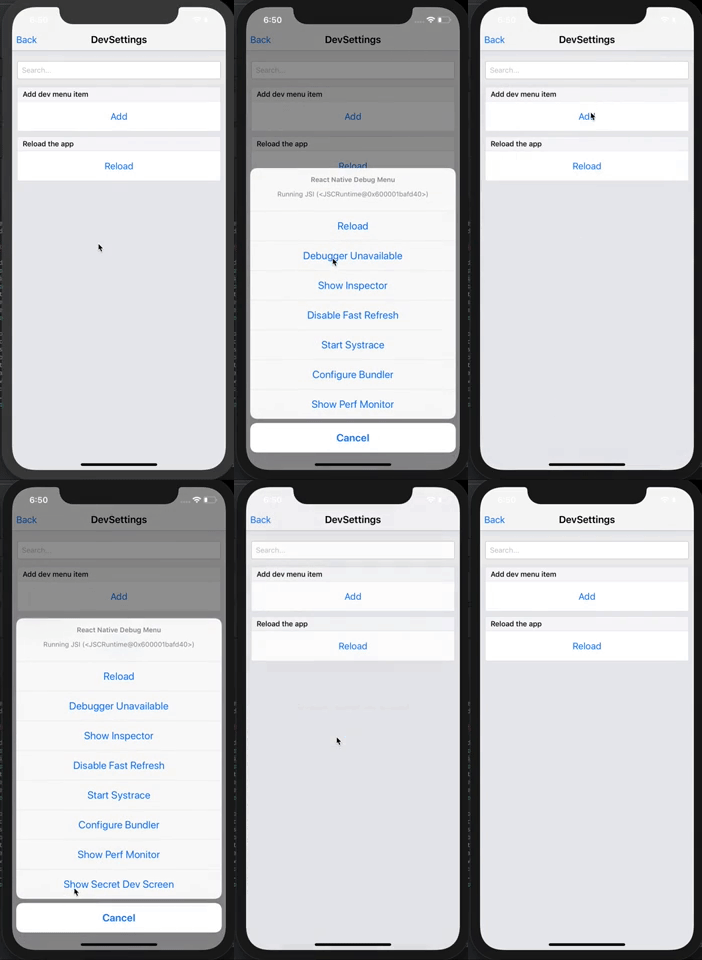
I wanted to configure the RN dev menu without having to write native code. This is pretty useful in a greenfield app since it avoids having to write a custom native module for both platforms (and might enable the feature for expo too).
This ended up a bit more involved than planned since callbacks can only be called once. I needed to convert the `DevSettings` module to a `NativeEventEmitter` and use events when buttons are clicked. This means creating a JS wrapper for it. Currently it does not export all methods, they can be added in follow ups as needed.
## Changelog
[General] [Added] - Export the DevSettings module, add `addMenuItem` method
Pull Request resolved: https://github.com/facebook/react-native/pull/25848
Test Plan:
Tested in an app using the following code.
```js
if (__DEV__) {
DevSettings.addMenuItem('Show Dev Screen', () => {
dispatchNavigationAction(
NavigationActions.navigate({
routeName: 'dev',
}),
);
});
}
```
Added an example in RN tester
Differential Revision: D17394916
Pulled By: cpojer
fbshipit-source-id: f9d2c548b09821c594189d1436a27b97cf5a5737
Summary: This is just a minor fix to D17380360. Basically, we want to make sure that callbacks can only be called once on the ObjC side.

Reviewed By: fkgozali

Differential Revision: D17403852

fbshipit-source-id: b0d2bbd539daef4837a345bc2953dd9687b3147b
Summary: Looks like a comma was missing due to merge conflicts. Fixed it here.

Reviewed By: RSNara

Differential Revision: D17381571

fbshipit-source-id: 107e420414e471e2689c6ee6aacd98dce4f4c036
Summary: There is a race condition between tearing down the bridge vs CallbackWrapper invoking the wrapped jsi::Function. This means the wrapper can be stale and unsafe to access after the bridge dies. To avoid unsafe access, let's clean it up properly using weak ref.

Reviewed By: RSNara

Differential Revision: D17380360

fbshipit-source-id: f91ce75d945bf8ed0b141c593bcc674ff465aa8c
Summary:
`getHeapInfo` was creating and return a `jsi::Object`. This object was not being traced
when API tracing was turned on.
This resulted in a bug in synth traces, an object was being acted upon without its creation source
being logged.
In order to prevent this, change the API of `getHeapInfo` to no longer return any objects, or modify other heap
contents.

This is preferable to having `TracingRuntime` attempt to mimic the operations of two different implementations.

## Changelog:

[Internal] [Changed] - Changed `jsi::Instrumentation::getHeapInfo` to use a `std::unordered_map`

Reviewed By: mhorowitz

Differential Revision: D17273235

fbshipit-source-id: f69860dcc524c2cf501746a41dbac20b4db8c456
Summary:
This diff improves on D17244061 by moving the `Jni::JniLocalScope` to earlier on in `JavaTurboModule::invokeJavaMethod`. The problem with D17244061 was two-fold:
1. It completely ignored the local references created by just calling `getConstants()`. So, you could spam `getConstants()` and still get an overflow.
2. The capacity was incorrect. Basically, two things happen when you call `PushLocalFrame`. One, we push an actual Jni frame onto a stack somewhere in the dvm: https://fburl.com/f16wfrxi, https://fburl.com/jhpha563. Popping off this stack is  how the local references are cleared when we call `PopLocalFrame`. Two, we do a check to make sure that we can support at least `capacity` more local references: https://fburl.com/jucvew8j. The max is 512. The problem before was that, I was just using the argument count for the capacity. This was inaccurate because we create many `jclass` objects, and several misc. intermediate java objects when we invoke `JavaTurboModule::invokeJavaMethod`. So, I've refined the calculation of capacity to be a bit more accurate. This should make sure that capacity check works, which should help us fail faster if our local reference count approaches 512.

Reviewed By: shergin

Differential Revision: D17337354

fbshipit-source-id: 45574bae4748c52d8f919c1480b9a0936d970628
Summary: I think this array is copied when we call the function over the JNI, and that we need to free the local copy we make.

Reviewed By: mdvacca

Differential Revision: D17377077

fbshipit-source-id: 82fe4ec89e95335a329f4ce562441561dbe88693
Summary:
This diff refactors ReactEventEmitter to not use the method ReactContext.getJSModule()
Since the initialization of events is performed by UIManagerModule or FabricUIManager classes we don't need to use JSModules as part of this class

Reviewed By: ejanzer

Differential Revision: D17176948

fbshipit-source-id: 6915a74b486851fbeda24f779d97873df22fd79b
Summary:
When installing pods for RNTester with `bundle run pod install` this file is generated and can be ignored.

## Changelog

[Internal] [Fixed] - Add `Gemfile.lock` to gitignore
Pull Request resolved: https://github.com/facebook/react-native/pull/26430

Test Plan: N/A

Differential Revision: D17370307

Pulled By: PeteTheHeat

fbshipit-source-id: 7d5eff0604ec9e979f8aa605f68af1656365ffb7
Summary:
Currently on iOS 13 the app will crash if you:
- Open the share sheet
- Tap something like messages or photos
- Cancel the dialog
- Perform any other action

This is because `shareController.completionWithItemsHandler` is called when the dialog box is canceled and currently `failureCallback` or `successCallback` will always be called. In the situation above, `activityError` is `nil` so `successCallback` will be called even though `completed` is false. This leaves us in a state where the callback has been invoked but the ShareSheet is still active, meaning the success or error callback will be invoked again, leading to the crash.

This PR adds a check to make sure `completed` is true before calling `successCallback`. This way `successCallback` will only be called when the user has successfully completed an action and the ShareSheet is closed.

## Changelog

[iOS] [Fixed] - Fix crash in RCTActionSheetManager.m on iOS 13
Pull Request resolved: https://github.com/facebook/react-native/pull/26429

Test Plan:
- Saved an image successfully
- Opened and dismissed the `Photos` dialog multiple times without crashing

Differential Revision: D17369712

Pulled By: PeteTheHeat

fbshipit-source-id: 228b696243cd39fad1fa134f4412d95d845b1bc5
Summary: The packages all migrated to `react-native-community`, this diff updates the package names in the error messages.

Reviewed By: rubennorte

Differential Revision: D17343259

fbshipit-source-id: 8539f41410ec59f5ea4f40fd1a6235bfb03eee19
 Eli White
 Frieder Bluemle
 Dulmandakh
 Emily Janzer
 Janic Duplessis
 Ruriko Araki
 Krzysztof Magiera
 Samuel Susla
 Kevin Gozali
 Uts Sikder
 Alexander Kawrykow
 David Vacca
 Amir Shalem
 sunnylqm
 Marc Mulcahy
 empyrical
 Valentin Shergin
 Gabriel Furini
 REDMOND\acoates
 Ramanpreet Nara
 Ram N
Ram N
 Riley Dulin
 Joshua Gross
 Nikhil Saxena
 Tom Targosz
 Christoph Nakazawa


