The protocol will be used to tag rules that may or may not require
SourceKit depending on its configuration. I only expect this to be used
for custom rules as utility to help transition to a fully SwiftSyntax
based approach.
Ideally, SwiftLintCore would some day only contain components
that are needed to define rules. Consequently, it would be the
only bundle required to import for (external) rule development.
Over the years, SwiftLintFramework had become a fairly massive monolith,
containing over 400 source files with both core infrastructure and
rules.

Architecturally, the rules should rely on the core infrastructure but
not the other way around. There are two exceptions to this:
`custom_rules` and `superfluous_disable_command` which need special
integration with the linter infrastructure.

Now the time has come to formalize this architecture and one way to do
that is to move the core SwiftLint functionality out of
SwiftLintFramework and into a new SwiftLintCore module that the rules
can depend on.

Beyond enforcing architectural patterns, this also has the advantage of
speeding up incremental compilation by skipping rebuilding the core
functionality when iterating on rules.

Because the core functionality is always useful when building rules, I'm
opting to import SwiftLintCore in SwiftLintFramework as `@_exported` so
that it's implicitly available to all files in SwiftLintFramework
without needing to import it directly.

In a follow-up I'll also split the built-in rules and the extra rules
into their own modules. More modularization is possible from there, but
not planned.

The bulk of this PR just moves files from `Source/SwiftLintFramework/*`
to `Source/SwiftLintCore/*`. There are some other changes that can't be
split up into their own PRs:

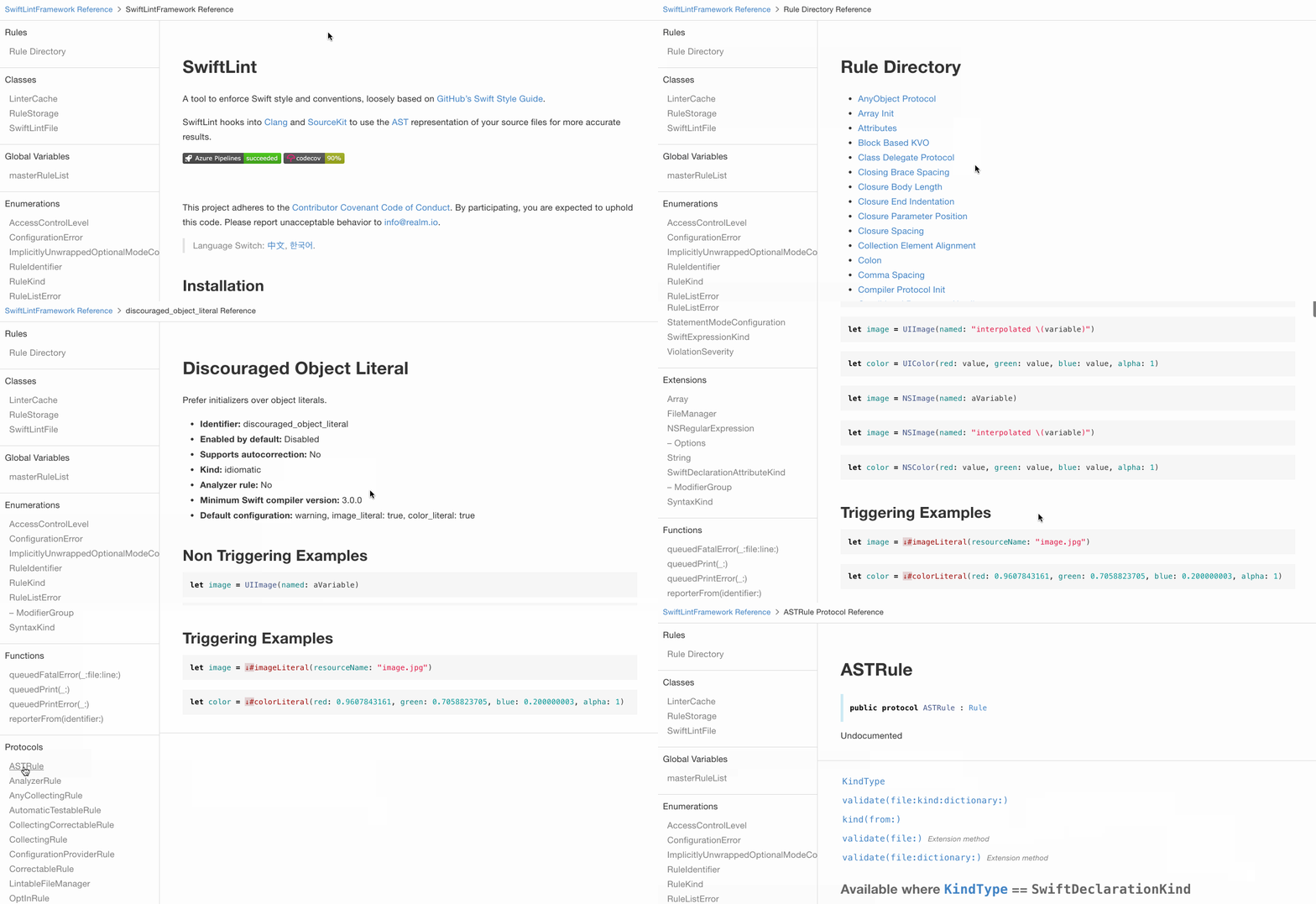
* Change jazzy to document the SwiftLintCore module instead of
  SwiftLintFramework.
* Change imports in unit tests to reflect where code was moved to.
* Update `sourcery` make rule to reflect where code was moved to.
* Create a new `coreRules` array and register those rules with the
  registry. This allows the `custom_rules` and
  `superfluous_disable_command` rule implementations to remain internal
  to the SwiftLintCore module, preventing more implementation details
  from leaking across architectural layers.
* Move `RuleRegistry.registerAllRulesOnce()` out of the type declaration
  and up one level so it can access rules defined downstream from
  SwiftLintCore.
The option can be used if an example has mainly been added as another test case, but is not suitable
as a user example. User examples should be easy to understand. They should clearly show where and
why a rule is applied and where not. Complex examples with rarely used language constructs or
pathological use cases which are indeed important to test but not helpful for understanding can be
hidden from the documentation with this option.
While browsing the rules documentation, I noticed **many** rules were both in the Default Rules and in the Opt In Rules section.

After looking into it, the docs of the `drop(while predicate: (Element) throws -> Bool` function states:

A closure that takes an element of the sequence as its argument and returns true if the element should be skipped or false if it should be included. **Once the predicate returns false it will not be called again.**

This caused the `defaultRuleDocumentations` array to contain almost all `ruleDocumentation`.
* Add Example wrapper in order to display test failures inline when running in Xcode.
* Stop using Swift 5.1-only features so we can compile on Xcode 10.2.
* Wrap strings in Example.
* Add Changelog entry.
* Wrap all examples in Example struct.
* Better and more complete capturing of line numbers.
* Fix broken test.
* Better test traceability.
* Address or disable linting warnings.
* Add documentation comments.
* Disable linter for a few cases.
* Limit mutability and add copy-and-mutate utility functions.
* Limit scope of mutability.
 JP Simard
 Martin Redington
 Danny Mösch
 Vasiliy Kattouf
 Ethan Wong
 Natan Rolnik
 Benny Wong
 Paul Taykalo
 Zev Eisenberg