This diff adds styling to the compiler options editor. The floating input/output
toggle button on small screens now spans the bottom of the screen, so that it
doesn't block the compiler options.

Height overflows when adjusting screen size are complicated by Monaco Editor and
will be addressed in a later diff.

Test plan:

Start Playground and see the latest look of the compiler options editor beneath
the output section.
## Proper Detection of Out-of-order Functions

The no-use-before-define rule from ESLint has a strange behavior in which it
treats variables differently than functions:

```javascript

function foo() {

return bar(X);

}

const X = null;

function bar(x) {}

```

By default, `bar(x)` has two errors: one because X is used before defined, and
once because `bar` is used before defined. The rule has an option `{variables:
false}` which only enables validation when the variable is from the same "scope"
as the reference, the net result of which is it means it doesn't report spurious
errors such as X being undefined. There is _also_ a `{functions: false}` option,
but for some reason that doesn't work the same way, it just turns off all
validation of references that came from functions. So enabling that option would
suppress the (spurious) error on invoking `bar()` above, but causes the rule to
miss invalid code such as:

```

function foo() {

return bar();

function bar() {}

}

```

This PR adds a fork of the rule that makes `{functions: false}` behave similarly
to `{variables: false}`, which should help avoid some of the spurious errors i
saw internally. The rule is exported from Forget itself, which will make it
easier to consume internally, in tests, and in the playground.

## Targeting the validation to Forget functions

Even with the above, there are still some false positives coming from code such
as:

```javascript

const x = foo();

function foo() {}

```

This PR changes codegen to ensure that the output of a function _always_ has the
body starting with 'use forget'. The ESLint rule then only looks at function
declarations/expressions whose body starts with that expression. The new unit
test confirms that the validation finds invalid reorderings even on functions
that weren't explicitly tagged as 'use forget'.
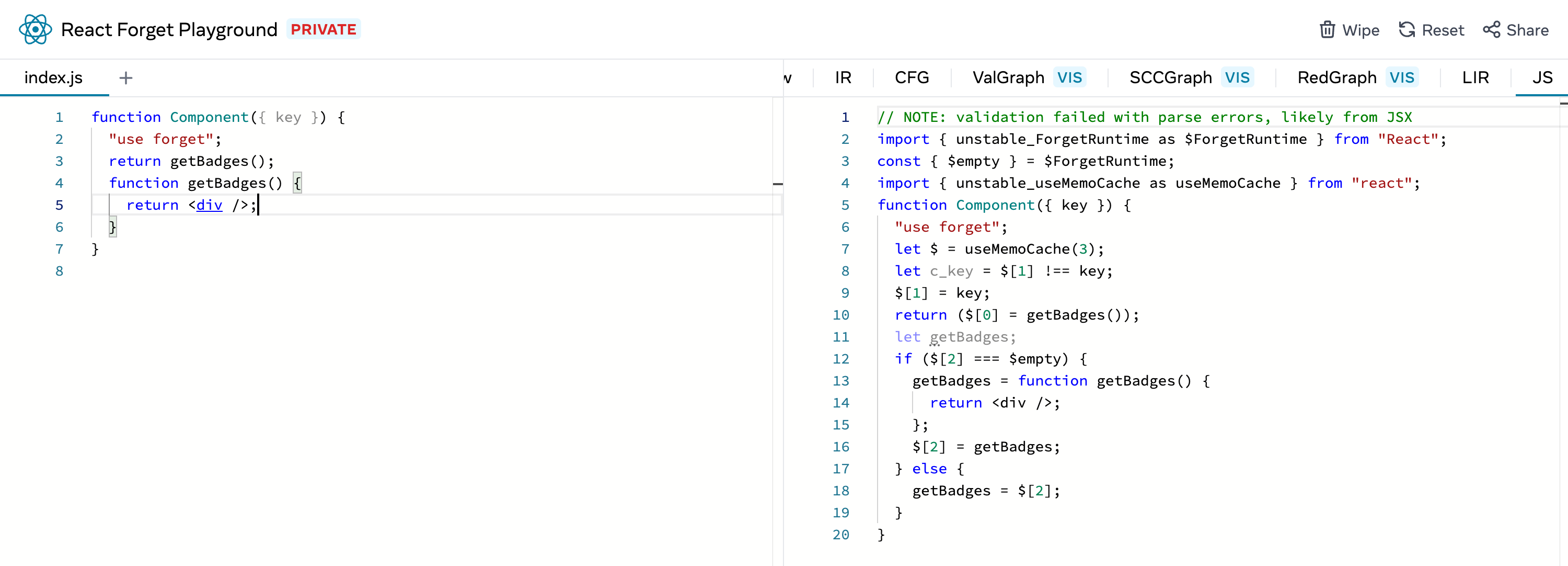
ESLint's default parser doesn't support any non-standard syntax, which includes
JSX. So when I added the ESLint validation step to the playground, it meant that
valid examples containing JSX still reported "invalid output". I tried to use an
alternative parser, but I couldn't figure out the right webpack incantations to
make `@babel/eslint-parser` or `hermes-eslint` work. I even tried recreating
some of their code to avoid problematic imports, no dice.

Instead this PR:

* No longer uses the `postCodegenValidator` step, and runs the validation on the
output after compilation completes. This is better anyway since we can see the
output *and* the error messages

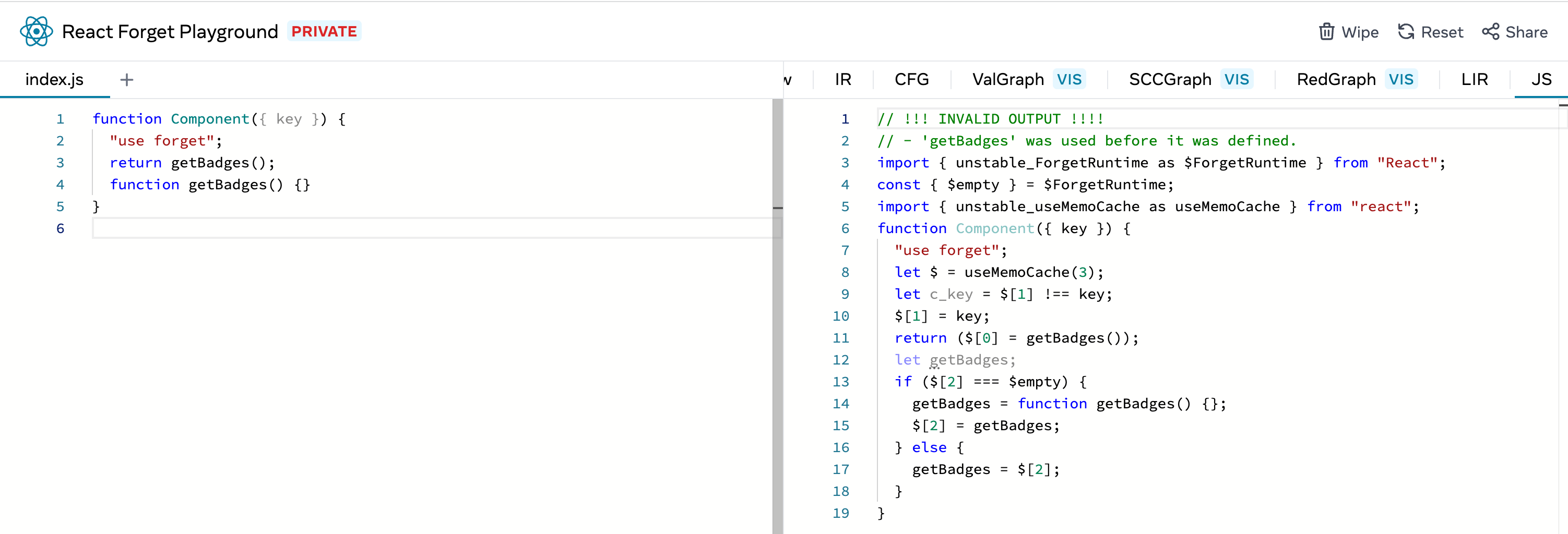
* Shows rule violations as an "Invalid output" comment

* Shows parser errors as a note (mostly to indicate that the validation step
couldn't run, there could still be no-use-before-define violations that weren't
found)

Invalid example:

<img width="1502" alt="Screen Shot 2022-10-21 at 9 50 23 AM"
src="https://user-images.githubusercontent.com/6425824/197249007-1ec244a0-6dfe-4ec6-a0d0-60302efd86bd.png">

Sample example but with some JSX:

<img width="1500" alt="Screen Shot 2022-10-21 at 9 50 39 AM"
src="https://user-images.githubusercontent.com/6425824/197249030-e68ba968-4101-47c7-a148-f548f84f375c.png">
#686 added an option to validate generated code after transformation and adds an
ESLint-based validator function to transform-test. Unfortunately it isn't super
easy to wire up ESLint for use in a browser: traditionally the ESLint project
specifically did _not_ support browser builds, but they recently have relaxed
this because they added a browser playground on their website. There isn't
official support, but the [playground
repo](https://github.com/eslint/playground/blob/f3b1f78cc1c06dadfe7bb50c6c0f913c0d23670d/webpack.config.js)
has a webpack config that, when combined with requiring a specific file, allows
making things work in a browser.

I tried using this directly in our playground app but Next's default webpack
config doesn't work. So I created a separate package, playground-validator,
which exports a webpack-built version of `eslint.Linter`. Then the playground
can consume that, and everything works:

## Test Plan 👀

Confirmed that a known problematic example displays the validation message in
playground (both locally and on the preview deployment):

<img width="1500" alt="Screen Shot 2022-10-20 at 12 22 59 PM"
src="https://user-images.githubusercontent.com/6425824/197041265-966ffda2-a3d0-450e-8fc4-fd1a7ca06e1a.png">
Some prior [microbenchmarking](https://jsbench.me/7ol98ws520/1) showed that a
for loop outperformed `fill` (which is about ~60% slower). This is the same
approach we use in the latest useMemoCache PR
This is a new module that holds:

- the `useMemoCache` stub (hopefully to be deleted next week)

- various helpers that can be imported by the compiler, e.g. the dispatcher
guard `$startLazy`

- skipped the implementation of `makeReadOnly` for now as there's already
multiple copies and I wanted to avoid typescript in this file for now to make
the build easier (i.e. no build)
I didn't make this an option as it's unclear we'll really need this. We can
always add an option later, I think.

This is the name that's available on facebook.com at the moment.
 Robert Zhang
 Joseph Savona
 Lauren Tan
 Jan Kassens
 mofeiZ
 Mofei Zhang
 Xuan Huang (黄玄)