ESLint's default parser doesn't support any non-standard syntax, which includes
JSX. So when I added the ESLint validation step to the playground, it meant that
valid examples containing JSX still reported "invalid output". I tried to use an
alternative parser, but I couldn't figure out the right webpack incantations to
make `@babel/eslint-parser` or `hermes-eslint` work. I even tried recreating
some of their code to avoid problematic imports, no dice.

Instead this PR:

* No longer uses the `postCodegenValidator` step, and runs the validation on the
output after compilation completes. This is better anyway since we can see the
output *and* the error messages

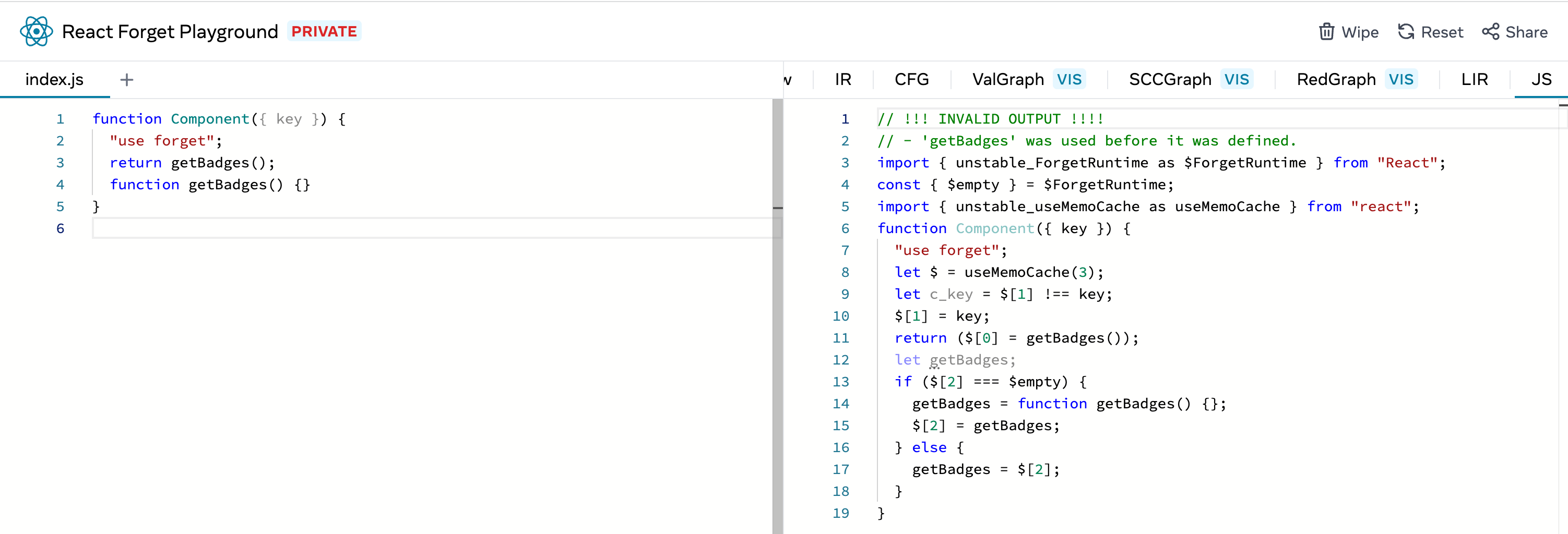
* Shows rule violations as an "Invalid output" comment

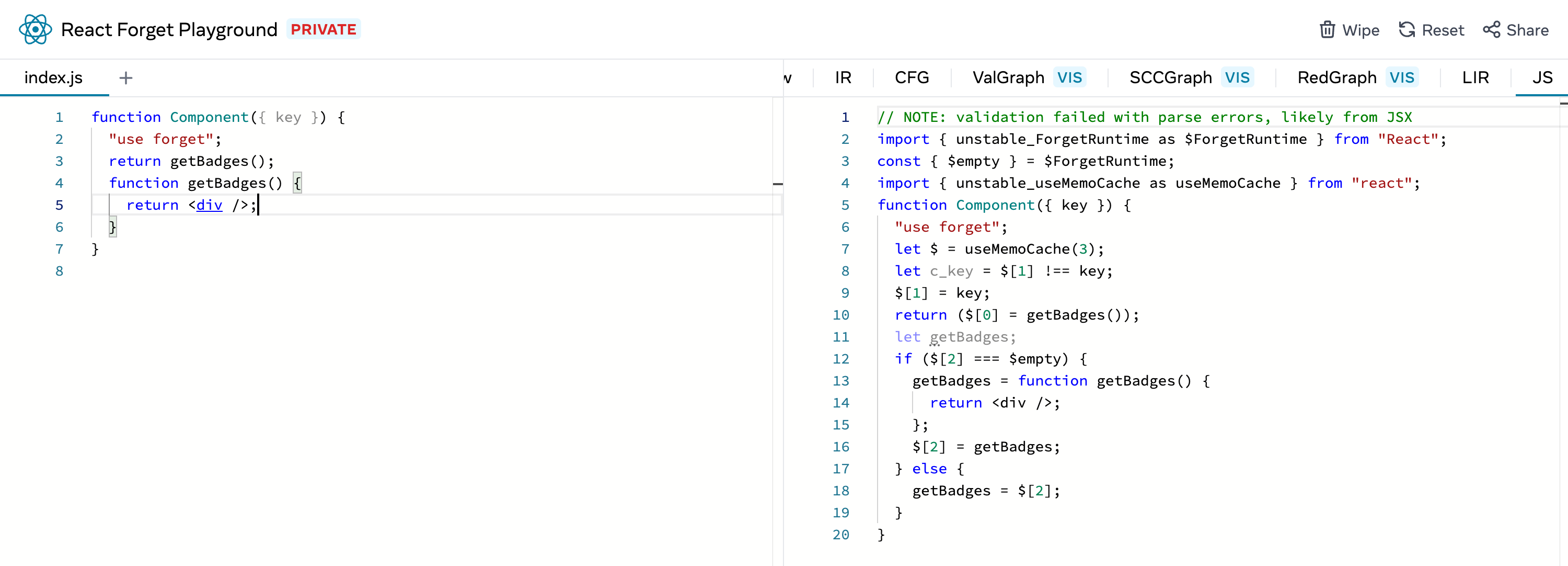
* Shows parser errors as a note (mostly to indicate that the validation step
couldn't run, there could still be no-use-before-define violations that weren't
found)

Invalid example:

<img width="1502" alt="Screen Shot 2022-10-21 at 9 50 23 AM"
src="https://user-images.githubusercontent.com/6425824/197249007-1ec244a0-6dfe-4ec6-a0d0-60302efd86bd.png">

Sample example but with some JSX:

<img width="1500" alt="Screen Shot 2022-10-21 at 9 50 39 AM"
src="https://user-images.githubusercontent.com/6425824/197249030-e68ba968-4101-47c7-a148-f548f84f375c.png">
#686 added an option to validate generated code after transformation and adds an
ESLint-based validator function to transform-test. Unfortunately it isn't super
easy to wire up ESLint for use in a browser: traditionally the ESLint project
specifically did _not_ support browser builds, but they recently have relaxed
this because they added a browser playground on their website. There isn't
official support, but the [playground
repo](https://github.com/eslint/playground/blob/f3b1f78cc1c06dadfe7bb50c6c0f913c0d23670d/webpack.config.js)
has a webpack config that, when combined with requiring a specific file, allows
making things work in a browser.

I tried using this directly in our playground app but Next's default webpack
config doesn't work. So I created a separate package, playground-validator,
which exports a webpack-built version of `eslint.Linter`. Then the playground
can consume that, and everything works:

## Test Plan 👀

Confirmed that a known problematic example displays the validation message in
playground (both locally and on the preview deployment):

<img width="1500" alt="Screen Shot 2022-10-20 at 12 22 59 PM"
src="https://user-images.githubusercontent.com/6425824/197041265-966ffda2-a3d0-450e-8fc4-fd1a7ca06e1a.png">
Some prior [microbenchmarking](https://jsbench.me/7ol98ws520/1) showed that a
for loop outperformed `fill` (which is about ~60% slower). This is the same
approach we use in the latest useMemoCache PR
This is a new module that holds:

- the `useMemoCache` stub (hopefully to be deleted next week)

- various helpers that can be imported by the compiler, e.g. the dispatcher
guard `$startLazy`

- skipped the implementation of `makeReadOnly` for now as there's already
multiple copies and I wanted to avoid typescript in this file for now to make
the build easier (i.e. no build)
I didn't make this an option as it's unclear we'll really need this. We can
always add an option later, I think.

This is the name that's available on facebook.com at the moment.
 Joseph Savona
 Lauren Tan
 Jan Kassens
 mofeiZ
 Mofei Zhang

 Xuan Huang (黄玄)andFacebook GitHub Bot