Follow up to #15861.

Turns out you can't set `!important` using a normal property assignment.
You have to use `style.setProperty`.

Maybe Andrew *should* just learn CSS.

IE9 doesn't support `style.setProperty` so we'll fall back to setting
`display: none` without `important`, like we did before #15861 Our
advice for apps that need to support IE9 will be to avoid using
`!important`. Which seems like good advice in general, but IANACSSE.

Tested on FB and using our Suspense DOM fixture.
Suspended nodes are hidden using an inline `display: none` style. We do
this instead of removing the nodes from the DOM so that their state is
preserved when they are shown again.

Inline styles have the greatest specificity, but they are superseded by
`!important`. To prevent an external style from overriding React's, this
commit changes the hidden style to `display: none !important`.

MaYBE AnDREw sHOulD JusT LEArn Css

I attempted to write a unit test using `getComputedStyle` but JSDOM
doesn't respect `!important`. I think our existing tests are sufficient
but if we were to decide we need something more robust, I would set up
an e2e test.
* Import Scheduler directly, not via host config

We currently schedule asynchronous tasks via the host config. (The host
config is a static/build-time dependency injection system that varies
across different renderers — DOM, native, test, and so on.) Instead of
calling platform APIs like `requestIdleCallback` directly, each renderer
implements a method called `scheduleDeferredCallback`.

We've since discovered that when scheduling tasks, it's crucial that
React work is placed in the same queue as other, non-React work on the
main thread. Otherwise, you easily end up in a starvation scenario where
rendering is constantly interrupted by less important tasks. You need a
centralized coordinator that is used both by React and by other
frameworks and application code. This coordinator must also have a
consistent API across all the different host environments, for
convention's sake and so product code is portable — e.g. so the same
component can work in both React Native and React Native Web.

This turned into the Scheduler package. We will have different builds of
Scheduler for each of our target platforms. With this approach, we treat
Scheduler like a built-in platform primitive that exists wherever React
is supported.

Now that we have this consistent interface, the indirection of the host
config no longer makes sense for the purpose of scheduling tasks. In
fact, we explicitly do not want renderers to scheduled task via any
system except the Scheduler package.

So, this PR removes `scheduleDeferredCallback` and its associated
methods from the host config in favor of directly importing Scheduler.

* Missed an extraneous export
* Replace SSR fallback content with new suspense content

* The three states of a Dehydrated Suspense

This introduces three states for dehydrated suspense boundaries

Pending - This means that the tree is still waiting for additional data or
to be populated with its final content.

Fallback - This means that the tree has entered a permanent fallback state
and no more data from the server is to be expected. This means that the
client should take over and try to render instead. The fallback nodes will
be deleted.

Normal - The node has entered its final content and is now ready to be
hydrated.

* Rename retryTimedOutBoundary to resolveRetryThenable

This doesn't just retry. It assumes that resolving a thenable means that
it is ok to clear it from the thenable cache.

We'll reuse the retryTimedOutBoundary logic separately.

* Register a callback to be fired when a boundary changes away from pending

It's now possible to switch from a pending state to either hydrating
or replacing the content.
* Basic partial hydration test

* Render comments around Suspense components

We need this to be able to identify how far to skip ahead if we're not
going to hydrate this subtree yet.

* Add DehydratedSuspenseComponent type of work

Will be used for Suspense boundaries that are left with their server
rendered content intact.

* Add comment node as hydratable instance type as placeholder for suspense

* Skip past nodes within the Suspense boundary

This lets us continue hydrating sibling nodes.

* A dehydrated suspense boundary comment should be considered a sibling

* Retry hydrating at offscreen pri or after ping if suspended

* Enter hydration state when retrying dehydrated suspense boundary

* Delete all children within a dehydrated suspense boundary when it's deleted

* Delete server rendered content when props change before hydration completes

* Make test internal

* Wrap in act

* Change SSR Fixture to use Partial Hydration

This requires the enableSuspenseServerRenderer flag to be manually enabled
for the build to work.

* Changes to any parent Context forces clearing dehydrated content

We mark dehydrated boundaries as having child work, since they might have
components that read from the changed context.

We check this in beginWork and if it does we treat it as if the input
has changed (same as if props changes).

* Wrap in feature flag

* Treat Suspense boundaries without fallbacks as if not-boundaries

These don't come into play for purposes of hydration.

* Fix clearing of nested suspense boundaries

* ping -> retry

Co-Authored-By: sebmarkbage <sebastian@calyptus.eu>

* Typo

Co-Authored-By: sebmarkbage <sebastian@calyptus.eu>

* Use didReceiveUpdate instead of manually comparing props

* Leave comment for why it's ok to ignore the timeout
* Avoid importing Scheduler directly

The reconciler should not depend directly on Scheduler. This adds it to
the host config for the renderer instead.

(Except for `scheduler/tracing` imports, which are used only by the
profiling build. I've left those imports as-is, though I'm open to
directing those through the host config, too.)

* Make throwaway root id longer to appease Brian
Whenever we do this, Rollup needs to materialize this as an object.
This causes it to also add the Babel compatibility property which is
unnecessary bloat. However, since when we use these, we leak the object
this often also deopts any compiler optimizations.

If we really need an object we should export default an object.

Currently there is an exception for DOMTopLevelEventTypes since
listing out the imports is a PITA and it doesn't escape so it should
get properly inlined. We should probably move to a different pattern
to avoid this for consistency though.
Setting to null isn't correct; setting to '' is. I opted to use dangerousStyleValue for consistency with the main path that we set things.
Fixes#14114.
Test Plan:
Verified setting to '' works in Chrome and IE11. (Setting to null works in Chrome but not in IE11.)
Check for existence of `setTimeout` and `clearTimeout` in the runtime
before using them, to ensure runtimes without them (like .NET ClearScript)
do not crash just by importing `react-dom`.
* [scheduler] Deadline object -> shouldYield

Instead of using a requestIdleCallback-style deadline object, expose a
method Scheduler.shouldYield that returns true if there's a higher
priority event in the queue.

* Nits
* Store the start time on `updateQueue` instead of `stateNode`

Originally I did this to free the `stateNode` field to store a second
set of children. I don't we'll need this anymore, since we use fragment
fibers instead. But I still think using `updateQueue` makes more sense
so I'll leave this in.

* Use fragment fibers to keep the primary and fallback children separate

If the children timeout, we switch to showing the fallback children in
place of the "primary" children. However, we don't want to delete the
primary children because then their state will be lost (both the React
state and the host state, e.g. uncontrolled form inputs). Instead we
keep them mounted and hide them. Both the fallback children AND the
primary children are rendered at the same time. Once the primary
children are un-suspended, we can delete the fallback children — don't
need to preserve their state.

The two sets of children are siblings in the host environment, but
semantically, for purposes of reconciliation, they are two separate
sets. So we store them using two fragment fibers.

However, we want to avoid allocating extra fibers for every placeholder.
They're only necessary when the children time out, because that's the
only time when both sets are mounted.

So, the extra fragment fibers are only used if the children time out.
Otherwise, we render the primary children directly. This requires some
custom reconciliation logic to preserve the state of the primary
children. It's essentially a very basic form of re-parenting.

* Use `memoizedState` to store various pieces of SuspenseComponent's state

SuspenseComponent has three pieces of state:

- alreadyCaptured: Whether a component in the child subtree already
suspended. If true, subsequent suspends should bubble up to the
next boundary.
- didTimeout: Whether the boundary renders the primary or fallback
children. This is separate from `alreadyCaptured` because outside of
strict mode, when a boundary times out, the first commit renders the
primary children in an incomplete state, then performs a second commit
to switch the fallback. In that first commit, `alreadyCaptured` is
false and `didTimeout` is true.
- timedOutAt: The time at which the boundary timed out. This is separate
from `didTimeout` because it's not set unless the boundary
actually commits.


These were previously spread across several fields.

This happens to make the non-strict case a bit less hacky; the logic for
that special case is now mostly localized to the UnwindWork module.

* Hide timed-out Suspense children

When a subtree takes too long to load, we swap its contents out for
a fallback to unblock the rest of the tree. Because we don't want
to lose the state of the timed out view, we shouldn't actually delete
the nodes from the tree. Instead, we'll keep them mounted and hide
them visually. When the subtree is unblocked, we un-hide it, having
preserved the existing state.

Adds additional host config methods. For mutation mode:

- hideInstance
- hideTextInstance
- unhideInstance
- unhideTextInstance

For persistent mode:

- cloneHiddenInstance
- cloneUnhiddenInstance
- createHiddenTextInstance

I've only implemented the new methods in the noop and test renderers.
I'll implement them in the other renderers in subsequent commits.

* Include `hidden` prop in noop renderer's output

This will be used in subsequent commits to test that timed-out children
are properly hidden.

Also adds getChildrenAsJSX() method as an alternative to using
getChildren(). (Ideally all our tests would use test renderer #oneday.)

* Implement hide/unhide host config methods for DOM renderer

For DOM nodes, we hide using `el.style.display = 'none'`.

Text nodes don't have style, so we hide using `text.textContent = ''`.

* Implement hide/unhide host config methods for Art renderer

* Create DOM fixture that tests state preservation of timed out content

* Account for class components that suspend outside concurrent mode

Need to distinguish mount from update. An unfortunate edge case :(

* Fork appendAllChildren between persistent and mutation mode

* Remove redundant check for existence of el.style

* Schedule placement effect on indeterminate components

In non-concurrent mode, indeterminate fibers may commit in an
inconsistent state. But when they update, we should throw out the
old fiber and start fresh. Which means the new fiber needs a
placement effect.

* Pass null instead of current everywhere in mountIndeterminateComponent
Fixes#13777
As part of #11927 we introduced a regression by adding onclick handler
to the React root. This causes the whole React tree to flash when tapped
on iOS devices (for reasons I outlined in
https://github.com/facebook/react/issues/12989#issuecomment-414266839).
To fix this, we should only apply onclick listeners to portal roots. I
verified that my proposed fix indeed works by checking out our DOM
fixtures and adding regression tests.
Strangely, I had to make changes to the DOM fixtures to see the behavior
in the first place. This seems to be caused by our normal sites (and
thus their React root) being bigger than the viewport:
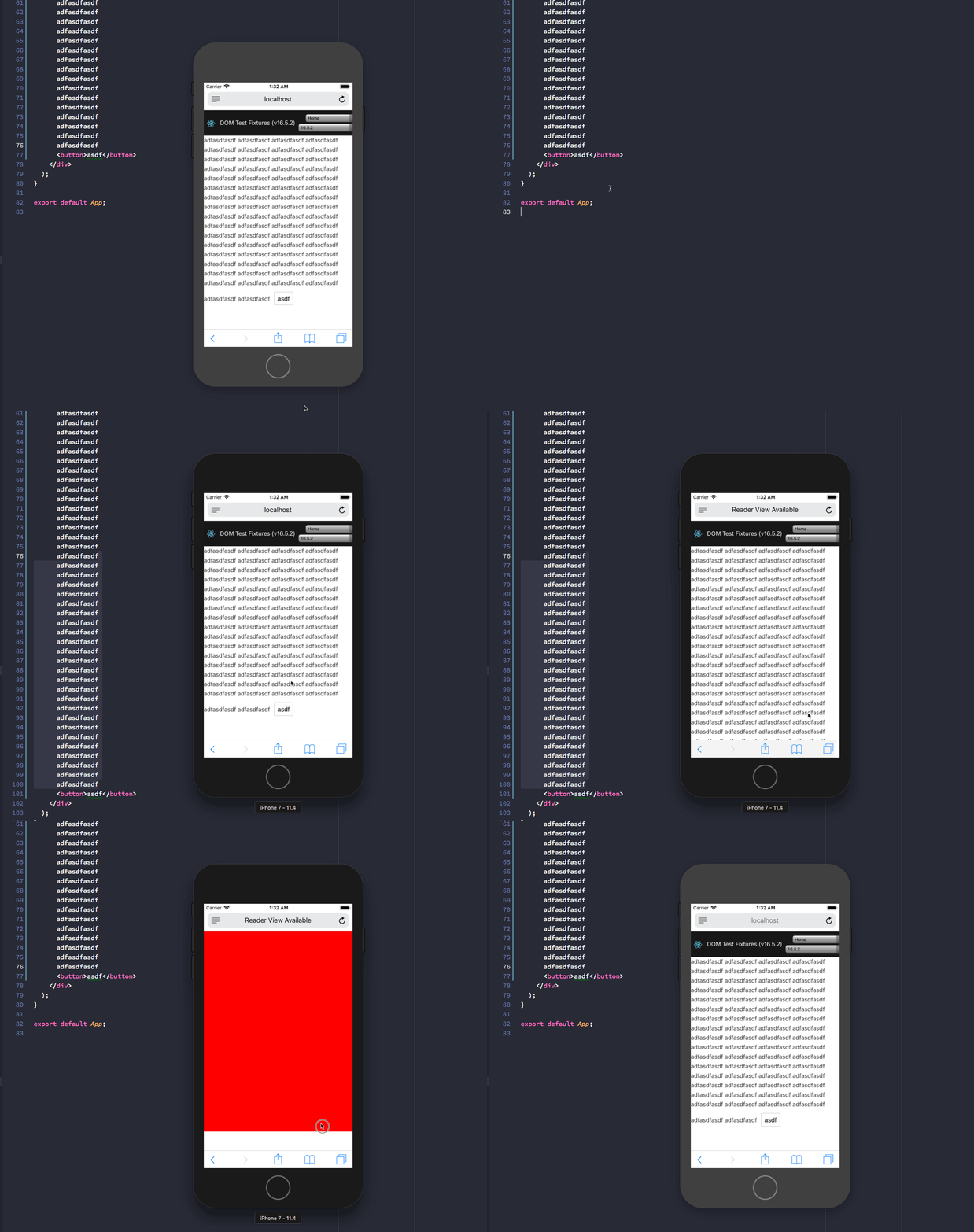
An alternative approach to finding out if we're appending to a React
root would be to add a third parameter to `appendChildToContainer` based
on the tag of the parent fiber.
All of these features are based on features of React's internal
scheduler. The eventual goal is to lift as much as possible out of the
React internals into the Scheduler package.

Includes some renaming of existing methods.

- `scheduleWork` is now `scheduleCallback`
- `cancelScheduledWork` is now `cancelCallback`


Priority levels
---------------

Adds the ability to schedule callbacks at different priority levels.
The current levels are (final names TBD):

- Immediate priority. Fires at the end of the outermost currently
executing (similar to a microtask).
- Interactive priority. Fires within a few hundred milliseconds. This
should only be used to provide quick feedback to the user as a result
of an interaction.
- Normal priority. This is the default. Fires within several seconds.
- "Maybe" priority. Only fires if there's nothing else to do. Used for
prerendering or warming a cache.

The priority is changed using `runWithPriority`:

```js
runWithPriority(InteractivePriority, () => {
  scheduleCallback(callback);
});
```


Continuations
-------------

Adds the ability for a callback to yield without losing its place
in the queue, by returning a continuation. The continuation will have
the same expiration as the callback that yielded.


Wrapped callbacks
-----------------

Adds the ability to wrap a callback so that, when it is called, it
receives the priority of the current execution context.
* Merged interaction-tracking package into react-scheduler
* Add tracking API to FB+www builds
* Added Rollup plugin to strip no-side-effect imports from Rollup bundles
* Re-bundle tracking and scheduling APIs on SECRET_INTERNALS object for UMD build (and provide lazy forwarding methods)
* Added some additional tests and fixtures
* Fixed broken UMD fixture in master (#13512)
* Replace some namespace imports

* Simplify the controlled component injection

* Simplify the batching injection

* Simplify the component tree injection
* Make option children a text content by default
fix#11911
* Apply requested changes
- Remove meaningless comments
- revert scripts/rollup/results.json
* remove empty row
* Update comment
* Add a simple unit-test
* [WIP: no flow] Pass through hostContext
* [WIP: no flow] Give better description for test
* Fixes
* Don't pass hostContext through
It ended up being more complicated than I thought.
* Also warn on hydration
* Prepare placeholders before timing out

While a tree is suspended, prepare for the timeout by pre-rendering the
placeholder state.

This simplifies the implementation a bit because every render now
results in a completed tree.

* Suspend inside an already timed out Placeholder

A component should be able to suspend inside an already timed out
placeholder. The time at which the placeholder committed is used as
the start time for a subsequent suspend.

So, if a placeholder times out after 3 seconds, and an inner
placeholder has a threshold of 2 seconds, the inner placeholder will
not time out until 5 seconds total have elapsed.
* Use local references to global things inside 'scheduler'

**what is the change?:**
See title

**why make this change?:**
We want to avoid initially calling one version of an API and then later
accessing a polyfilled version.

**test plan:**
Run existing tests.

* Shim ReactScheduler for www

**what is the change?:**
In 'www' we want to reference the separate build of ReactScheduler,
which allows treating it as a separate module internally.

**why make this change?:**
We need to require the ReactScheduler before our rAF polyfill activates,
in order to customize which custom behaviors we want.

This is also a step towards being able to experiment with using it
outside of React.

**test plan:**
Ran tests, ran the build, and ran `test-build`.

* Generate a bundle for fb-www

**what is the change?:**
See title

**why make this change?:**
Splitting out the 'schedule' module allows us to load it before
polyfills kick in for rAF and other APIs.

And long term we want to split this into a separate module anyway, this
is a step towards that.

**test plan:**
I'll run the sync next week and verify that this all works. :)

* ran prettier

* fix rebase issues

* Change names of variables used for holding globals
* Extract base Jest config

This makes it easier to change the source config without affecting the build test config.

* Statically import the host config

This changes react-reconciler to import HostConfig instead of getting it through a function argument.

Rather than start with packages like ReactDOM that want to inline it, I started with React Noop and ensured that *custom* renderers using react-reconciler package still work. To do this, I'm making HostConfig module in the reconciler look at a global variable by default (which, in case of the react-reconciler npm package, ends up being the host config argument in the top-level scope).

This is still very broken.

* Add scaffolding for importing an inlined renderer

* Fix the build

* ES exports for renderer methods

* ES modules for host configs

* Remove closures from the reconciler

* Check each renderer's config with Flow

* Fix uncovered Flow issue

We know nextHydratableInstance doesn't get mutated inside this function, but Flow doesn't so it thinks it may be null.
Help Flow.

* Prettier

* Get rid of enable*Reconciler flags

They are not as useful anymore because for almost all cases (except third party renderers) we *know* whether it supports mutation or persistence.

This refactoring means react-reconciler and react-reconciler/persistent third-party packages now ship the same thing.
Not ideal, but this seems worth how simpler the code becomes. We can later look into addressing it by having a single toggle instead.

* Prettier again

* Fix Flow config creation issue

* Fix imprecise Flow typing

* Revert accidental changes
* Rename Scheduler methods more accurately

**what is the change?:**
```
rIC -> scheduleCallback
```
We will later expose a second method for different priority level, name
TBD. Since we only have one priority right now we can delay the
bikeshedding about the priority names.

cIC -> cancelScheduledCallback
This method can be used to cancel callbacks scheduled at any priority
level, and will remain named this way.

why make this change?:
Originally this module contained a polyfill for requestIdleCallback
and cancelIdleCallback but we are changing the behavior so it's no
longer just a polyfill. The new names are more semantic and distinguish
this from the original polyfill functionality.

**test plan:**
Ran the tests

**why make this change?:**
Getting this out of the way so things are more clear.

**Coming Up Next:**
- Switching from a Map of ids and an array to a linked list for storing
callbacks.
- Error handling

* callback -> work

* update callsites in new places after rebase

* fix typo
 Dominic Gannaway
 Andrew Clark
 Nicolas Gallagher
 Dan Abramov
 Sebastian Markbåge
 Sophie Alpert
 Tiago Nunes
 Andrew Clark
 Philipp
 Andrew Clark
 Héctor Ramos
 Brian Vaughn
 Fredrik Höglund
 Heaven
 Brandon Dail
 Konstantin Yakushin
 Flarnie Marchan
