See the background in #982. This PR reimplements part of InferReactiveScopes,
merging overlapping reactive scopes, but against ReactiveFunction instead of the
HIR.
See the background in #982. This PR reimplements part of InferReactiveScopes,
aligning reactive scopes to block boundaries, but against ReactiveFunction
instead of the HIR.
The primary goal of this stack is to change HIRTreeVisitor to make it easier to
handle value blocks. That's complicated by the fact that the visitor is a
general-purpose visitor, used in several analysis passes including
BuildReactiveFunction (which translates HIR->ReactiveFunction while also
grouping instructions into scopes) and InferReactiveScopes (which is actually
two passes, one to align scopes to block boundaries, one to merge overlapping
scopes). The long-term goal then is as follows:

1. Make BuildReactiveFunction transform HIR->ReactiveFunction but _without_
reactive scopes.

2. Align scopes to block boundaries, but rewritten to operate on
ReactiveFunction

3. Merge overlapping scopes, again rewritten to operate on ReactiveFunction

4. Group statements within ReactiveFunction into ReactiveScopeBlocks (today this
occurs when constructing the ReactiveFunction).

This PR implements 1 and 4. Because the implementation is incomplete this would
break the whole compiler, so for now both versions are still around. By default
compilation uses the old pipeline, but if a feature flag is enabled we use the
new version. The plan is to incrementally fix up the new version of the passes
in this stack, and then cutover: removing the flag and the old version of the
passes.
It's not enough to only update the mutable range of the canonical id created
instead of the phi but we need to update the mutable range of each of the
operands of the phi as well to account for the fact that the phi could've been
mutated later.

The operands are updated only if the phi is mutated later. Otherwise these
operands can be cached in their blocks.

Fixes https://github.com/facebook/react-forget/issues/978
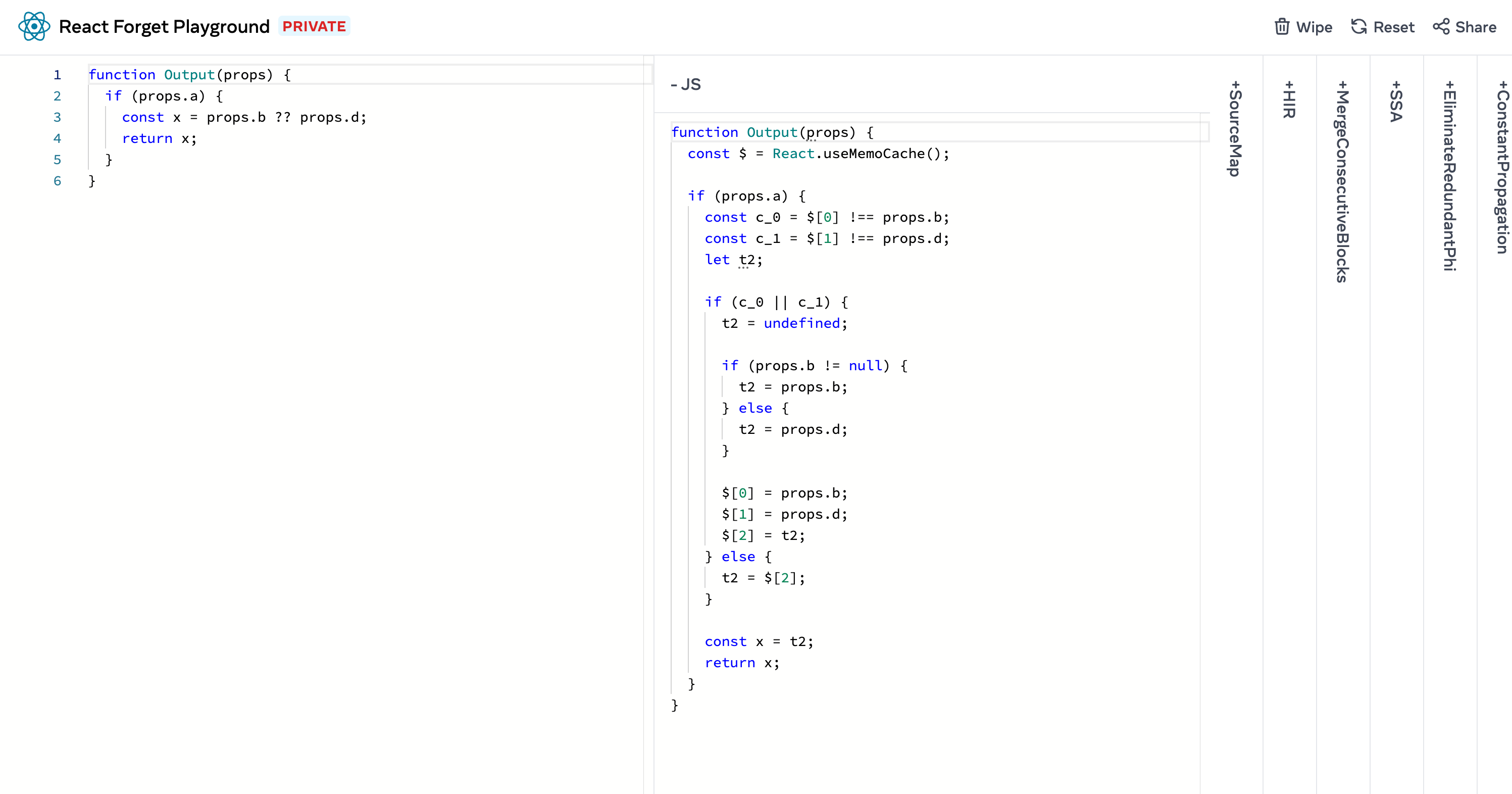
Changes playground to use the modified `run()` function of the compiler, polling
the generator and building up a Map of tabs automatically based on the passes
that the compiler runs. This means tabs are always derived from the current
state of the compiler and we can never forget to add a pass.

<img width="1497" alt="Screen Shot 2023-01-10 at 11 06 03 AM"
src="https://user-images.githubusercontent.com/6425824/211639442-da421f73-e19e-4b63-9f33-0ce5a68cceb7.png">

Note the inclusion of some recently added passes that weren't added to the
playground — which was my fault but only bc i intended to ship this PR soon :-)
Turns CompilerPipeline into two functions:

* `run()` is a generator and yields values that are a disjoint union of either
AST/HIR/ReactiveFunction along with a name for that step. The idea is to use
this in the playground so that it always matches the exact steps for
compilation. I'll update playground in a follow-up.

* `compile()` is ast in, ast out, and uses `run()` under the hood.
Implements constant propagation/constant folding for a conservative subset of
the language. The approach is described in detail in the comments in the file
itself, a key note here is that this pass currently emits what looks like
garbage:

```

// input

const x = 1;

const y = x + 1;

// output

const x = 1;

2; // <---- you'll see a bunch of lines like this

const y = 2;

```

These useless lines occur where previously there was a temporary getting
calculated that was used later (so we saved it until it was used), but now it
isn't used later so we just emit it in-place. Dead code elimination (DCE) can
eliminate these and other useless statements later.

Note that a key motivation for implementing this pass is to reduce memoization
blocks to what is strictly required for dynamic computations. Why memoize at
runtime when we compute at build time?
When we convert a LabeledStatement to HIR we can end up emitting "consecutive"
blocks, ie where there are two blocks such that control flow will always go from
from one block to the other, with no other way to reach the second block but
through the first. Example:

```javascript

label: {

foo();

break label;

}

bar();

```

Converts to

```

bb0:

foo()

goto bb1:

bb1:

bar();

...

```

Ideally in this case we would merge these into a single block:

* When debugging, the extra goto makes it look like there is conditional control
flow when there isn't. If the code is consecutive it's easier to understand that
if it's a single block.

* Conversion from HIR -> AST relies on consecutive code all being in a single
block, so this breaks codegen (we never visit the goto target since all gotos
are assumed to be safe to convert to a break or continue).

This PR adds a failing test case, the next PR fixes it.
Phi operands and Block predecessors currently use a `BasicBlock` reference
rather than the BlockId. This diverges from other places (like terminals) where
we use an id and not a direct object reference. Especially since blocks may get
rewritten or pruned, it's a bit cleaner to use the block id in these places.
Changes `shrink()` and `reversePostorderBlocks()` to modify the HIR in-place
rather than return a new function, for consistency with all our other passes
which mutate in-place (for performance reasons).
shrink visits all the fallthroughs even if they are unreachable so this isn't
the right place to prune unreachable blocks.

This PR moves pruning into a separate pass.
Supports computed properties (as LHS and RHS) correctly. Previously we only
handled member expressions where the property was an identifier, and would
incorrect treat `a[b]` the same as `a.b`. Now we correctly distinguish these and
convert `a[b]` as an IndexLoad and `a.b` as a PropertyLoad. Similar for
assignment, `a[b] = c` is an IndexStore. For both IndexLoad and IndexStore we
lower the property to a Place first.
Implements support for array and object de-structuring in variable declarations
and assignment expressions. Note that the code currently makes the overly
optimistic assumption that the RHS is an array or object that can be safely
indexed into. The correct representation would instead treat the RHS as possibly
iterable, but we need to consider the appropriate representation. I think it's
worth landing a first optimistic pass and we can iterate forward, this helps
make it more clear what the ideal representation would have to be and should
make a bunch of examples work. It also allows us to experiment with
representations of, and handling for, scope dependencies that involve computed
property access.
Adds new types for IndexLoad/IndexStore (renamed later in the stack to
ComputedLoad/ComputedStore) which will be used to represent computed property
access/update. The actual lowering to use these is later in the stack.
After the previous PR to change the scope dependency representation,
`Place.memberPath` is now completely unused, this PR deletes that field and all
references. Rejoice!
This is a pre-req to deleting the `Place.memberPath` field. We no longer need
memberPath in the HIR now that we have PropertyStore and PropertyLoad. However,
scope dependencies use memberPath to track the precise fields that a computation
depends upon. This PR changes scopes dependencies to use a new
`ReactiveScopeDependency` type (Place + optional path), which allows the next PR
to remove `Place.memberPath`.
Fixes codegen for chained assignment expressions. Previously each intermediate
assignment would be generated independently _in addition_ to the final chained
expression being emitted. We now emit a single chained expression, almost
exactly matching the input except for expanding from `x += 1` into `x = x + 1`.

There are two key changes:

* Ensuring that assignment expressions always generate an lvalue, which is
necessary for alias analysis to kick in, since it relies on the effect of the
lvalue to know where to look for aliasing.

* The above makes codegen think the entire assignment expression value is a
temporary that can be emitted later, but that isn't true. The new
PruneTemporaryLValue pass nulls out lvalues that are never read later, ensuring
that codegen can eagerly emit the value instead of saving it as a temporary.
Converts assignment expressions where the lvalue is a MemberExpression to use
PropertyStore, rather than creating an lvalue with a member path. The net effect
is that lvalue will always have a null member path.

There are two main cases:

* `x.y = <value>`. We lower <value> to a Place, lower the object of the member
expression to a place (`object)` create a temporary Place for the result of the
assignment, and then create a `PropertyStore <object>, "<property>", <value>`.

* `x.y += <value>` (and similar update-in-place operands). We extract the object
of the member expression, read the current value via a PropertyLoad, compute the
updated value, and store it back with a PropertyStore (each of these goes into
its own temporary).
Adds a `InstructionValue::PropertyStore` variant and the minimal necessary
handling across the passes to get things to compile. Lowering is in the next PR.
…-realsies"

This reverts commit 3c8700cbc7502e56cca8d4bb77a08e1ee747c166.

I'm not sure how this happened but I accidentally hit up + enter on a previous
`ghstack land` command for a different stack and it landed this one.
Infuriating.
For unknown reasons I didn't have the energy to dig into, some Babel Error
objects can't be written to so despite formatting the error message, the
original one would still be used. To get around this I'm just constructing a
fake object with a `name` and `message` so the correctly formatted messages are
used.
This is an incremental step to removing `Place.memberPath`. This PR changes how
we handle MemberExpressions in rvalue position, converting to a new
`PropertyLoad` InstructionValue variant. Example:

```

let x = a.b;

x.y = b.c;

=>

Const tmp1 = PropertyLoad a, 'b';

Const x = Place tmp1;

Const tmp2 = PropertyLoad b, 'c';

Reassign x.y = tmp2

```

That we already recently made a chance to ensure that _if_ the lvalue is a
member expression, that we convert the RHS to a Place. So although `x.y = b.c`
could technically be lowered to a single instruction (with the`b.c` as a
PropertyLoad), we force this to a temporary to ensure that we can independently
memoize the RHS value.

The net result is that the following combinations are possible:

* `x = y`, lvalue identifier, rvalue identifier

* `x.y = y` lvalue member path, rvalue identifier

* `x = y.z` lvalue identifier, rvalue property load

As noted above, `x.y = a.b` no longer occurs (and there's an invariant for this
in one of the passes).

A follow-up PR will add a PropertyStore instruction so that we can remove member
paths in lvalue position too.
@josephsavona had the intuition that we were picking the wrong root in the
previous infinite loop test case, so the fix for this is to force a root to
always be picked. This works because `find` implements path compression (if a <-
b and b <- c, then we can just point a <- c to "flatten" the tree which makes
subsequent `find` operations more efficient since we don't have to follow the
ancestor chain each time), so we're forcing all those unions to pick one parent.

From some googling it looks like the traditional way to implement union is to
call `find` so this should be the "right" way to fix it (?).

I'm also adding a basic unit test for DisjointSet, I think we could revisit
later and see if property testing is worth it but for now I mainly wanted to
capture the regression test as a unit test.
Discovered this by accident modifying Joe's playground example. This seemed to
be triggered in inferReactiveScopeVariables when iterating over the DisjointSet
of scopeIdentifiers. In particular this test case contains a cycle and
DisjointSet.find would never terminate.
The github action was exceeding maximum allowed memory size because we were no
longer grouping messages correctly prior to formatting them in the script. I
think these were introduced when we integrated the Babel plugin into the
preprocessor. This PR strips out filenames from the message so they can be
grouped together again. Also added some light comments

Test plan: manually ran `scripts/test262.sh` and verified that the JSON was
grouped together correctly
 Joe Savona
 Sathya Gunasekaran
 lauren