Disables the recently introduced (#14181) warning for shorthand
CSS property collisions by wrapping in a feature flag. Let's hold off
shipping this until at least the next minor.
This is one of the most insidious quirks of React DOM that people run into. Now we warn when we think an update is dangerous.
We still allow rendering `{background, backgroundSize}` with unchanging values, for example. But once you remove either one or change `background` (without changing `backgroundSize` at the same time), that's bad news. So we warn.
Fixes#6348.
Fixes#13777
As part of #11927 we introduced a regression by adding onclick handler
to the React root. This causes the whole React tree to flash when tapped
on iOS devices (for reasons I outlined in
https://github.com/facebook/react/issues/12989#issuecomment-414266839).
To fix this, we should only apply onclick listeners to portal roots. I
verified that my proposed fix indeed works by checking out our DOM
fixtures and adding regression tests.
Strangely, I had to make changes to the DOM fixtures to see the behavior
in the first place. This seems to be caused by our normal sites (and
thus their React root) being bigger than the viewport:
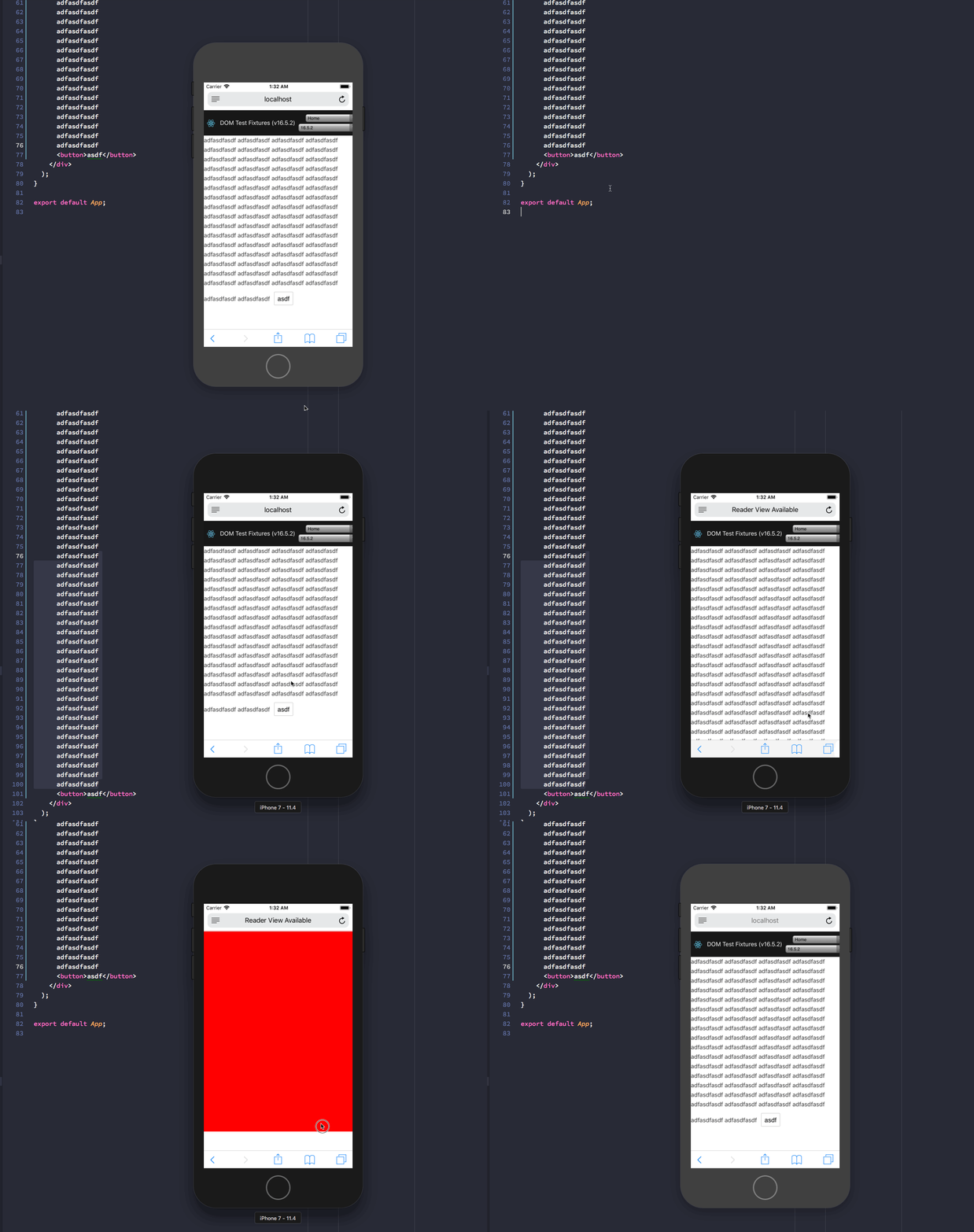
An alternative approach to finding out if we're appending to a React
root would be to add a third parameter to `appendChildToContainer` based
on the tag of the parent fiber.
This is documenting the current order in which events are dispatched
when interacting with native document listeners and other React apps.

For more context, check out #12919.
* Warn when the string "false" is the value of a boolean DOM prop

* Only warn on exact case match for "false" in DOM boolean props

* Warn on string "true" as well as "false" in DOM boolean props

* Clarify warnings on "true" / "false" values in DOM boolean props
* Bump deps to Jest 22

* Prevent jsdom from logging intentionally thrown errors

This relies on our existing special field that we use to mute errors.
Perhaps, it would be better to instead rely on preventDefault() directly.
I outlined a possible strategy here: https://github.com/facebook/react/issues/11098#issuecomment-355032539

* Update snapshots

* Mock out a method called by ReactART that now throws

* Calling .click() no longer works, dispatch event instead

* Fix incorrect SVG element creation in test

* Render SVG elements inside <svg> to avoid extra warnings

* Fix range input test to use numeric value

* Fix creating SVG element in test

* Replace brittle test that relied on jsdom behavior

The test passed in jsdom due to its implementation details.

The original intention was to test the mutation method, but it was removed a while ago.

Following @nhunzaker's suggestion, I moved the tests to ReactDOMInput and adjusted them to not rely on implementation details.

* Add a workaround for the expected extra client-side warning

This is a bit ugly but it's just two places. I think we can live with this.

* Only warn once for mismatches caused by bad attribute casing

We used to warn both about bad casing and about a mismatch.
The mismatch warning was a bit confusing. We didn't know we warned twice because jsdom didn't faithfully emulate SVG.

This changes the behavior to only leave the warning about bad casing if that's what caused the mismatch.
It also adjusts the test to have an expectation that matches the real world behavior.

* Add an expected warning per comment in the same test
* Migrated several additional tests to use new .toWarnDev() matcher

* Migrated ReactDOMComponent-test to use .toWarnDev() matcher

Note this test previous had some hacky logic to verify errors were reported against unique line numbers. Since the new matcher doesn't suppor this, I replaced this check with an equivalent (I think) comparison of unique DOM elements (eg div -> span)

* Updated several additional tests to use the new .toWarnDev() matcher

* Updated many more tests to use .toWarnDev()
* use different eslint config for es6 and es5

* remove confusing eslint/baseConfig.js & add more eslint setting for es5, es6

* more clear way to run eslint on es5 & es6 file

* seperate ESNext, ES6, ES6 path, and use different lint config

* rename eslint config file & update eslint rules

* Undo yarn.lock changes

* Rename a file

* Remove unnecessary exceptions

* Refactor a little bit

* Refactor and tweak the logic

* Minor issues
* Harden tests around init/addition/update/removal of aliased attributes

I noticed some patterns weren't being tested.

* Call setValueForProperty() for null and undefined

The branching before the call is unnecessary because setValueForProperty() already
has an internal branch that delegates to deleteValueForProperty() for null and
undefined through the shouldIgnoreValue() check.

The goal is to start unifying these methods because their separation doesn't
reflect the current behavior (e.g. for unknown properties) anymore, and obscures
what actually happens with different inputs.

* Inline deleteValueForProperty() into setValueForProperty()

Now we don't read propertyInfo twice in this case.

I also dropped a few early returns. I added them a while ago when we had
Stack-only tracking of DOM operations, and some operations were being
counted twice because of how this code is structured. This isn't a problem
anymore (both because we don't track operations, and because I've just
inlined this method call).

* Inline deleteValueForAttribute() into setValueForAttribute()

The special cases for null and undefined already exist in setValueForAttribute().

* Delete some dead code

* Make setValueForAttribute() a branch of setValueForProperty()

Their naming is pretty confusing by now. For example setValueForProperty()
calls setValueForAttribute() when shouldSetAttribute() is false (!). I want
to refactor (as in, inline and then maybe factor it out differently) the relation
between them. For now, I'm consolidating the callers to use setValueForProperty().

* Make it more obvious where we skip and when we reset attributes

The naming of these methods is still very vague and conflicting in some cases.
Will need further work.

* Rewrite setValueForProperty() with early exits

This makes the flow clearer in my opinion.

* Move shouldIgnoreValue() into DOMProperty

It was previously duplicated.

It's also suspiciously similar in purpose to shouldTreatAttributeValueAsNull()
so I want to see if there is a way to unify them.

* Use more specific methods for testing validity

* Unify shouldTreatAttributeValueAsNull() and shouldIgnoreValue()

* Remove shouldSetAttribute()

Its naming was confusing and it was used all over the place instead of more specific checks.
Now that we only have one call site, we might as well inline and get rid of it.

* Remove unnecessary condition

* Remove another unnecessary condition

* Add Flow coverage

* Oops

* Fix lint (ESLint complains about Flow suppression)

* Fix treatment of Symbol/Function values on boolean attributes

They weren't being properly skipped because of the early return.
I added tests for this case.

* Avoid getPropertyInfo() calls

I think this PR looks worse on benchmarks because we have to read propertyInfo in different places.
Originally I tried to get rid of propertyInfo, but looks like it's important for performance after all.

So now I'm going into the opposite direction, and precompute propertyInfo as early as possible, and then just pass it around.
This way we can avoid extra lookups but keep functions nice and modular.

* Pass propertyInfo as argument to getValueForProperty()

It always exists because this function is only called for known properties.

* Make it clearer this branch is boolean-specific

I wrote this and then got confused myself.

* Memoize whether propertyInfo accepts boolean value

Since we run these checks for all booleans, might as well remember it.

* Fix a crash when numeric property is given a Symbol

* Record attribute table

The changes reflect that SSR doesn't crash with symbols anymore (and just warns, consistently with the client).

* Refactor attribute initialization

Instead of using flags, explicitly group similar attributes/properties.

* Optimization: we know built-in attributes are never invalid

* Use strict comparison

* Rename methods for clarity

* Lint nit

* Minor tweaks

* Document all the different attribute types
* Harden tests around init/addition/update/removal of aliased attributes

I noticed some patterns weren't being tested.

* Call setValueForProperty() for null and undefined

The branching before the call is unnecessary because setValueForProperty() already
has an internal branch that delegates to deleteValueForProperty() for null and
undefined through the shouldIgnoreValue() check.

The goal is to start unifying these methods because their separation doesn't
reflect the current behavior (e.g. for unknown properties) anymore, and obscures
what actually happens with different inputs.

* Inline deleteValueForProperty() into setValueForProperty()

Now we don't read propertyInfo twice in this case.

I also dropped a few early returns. I added them a while ago when we had
Stack-only tracking of DOM operations, and some operations were being
counted twice because of how this code is structured. This isn't a problem
anymore (both because we don't track operations, and because I've just
inlined this method call).

* Inline deleteValueForAttribute() into setValueForAttribute()

The special cases for null and undefined already exist in setValueForAttribute().

* Delete some dead code

* Make setValueForAttribute() a branch of setValueForProperty()

Their naming is pretty confusing by now. For example setValueForProperty()
calls setValueForAttribute() when shouldSetAttribute() is false (!). I want
to refactor (as in, inline and then maybe factor it out differently) the relation
between them. For now, I'm consolidating the callers to use setValueForProperty().

* Make it more obvious where we skip and when we reset attributes

The naming of these methods is still very vague and conflicting in some cases.
Will need further work.

* Rewrite setValueForProperty() with early exits

This makes the flow clearer in my opinion.

* Move shouldIgnoreValue() into DOMProperty

It was previously duplicated.

It's also suspiciously similar in purpose to shouldTreatAttributeValueAsNull()
so I want to see if there is a way to unify them.

* Use more specific methods for testing validity

* Unify shouldTreatAttributeValueAsNull() and shouldIgnoreValue()

* Remove shouldSetAttribute()

Its naming was confusing and it was used all over the place instead of more specific checks.
Now that we only have one call site, we might as well inline and get rid of it.

* Remove unnecessary condition

* Remove another unnecessary condition

* Add Flow coverage

* Oops

* Fix lint (ESLint complains about Flow suppression)
* Extract Jest config into a separate file

* Refactor Jest scripts directory structure

Introduces a more consistent naming scheme.

* Add yarn test-bundles and yarn test-prod-bundles

Only files ending with -test.public.js are opted in (so far we don't have any).

* Fix error decoding for production bundles

GCC seems to remove `new` from `new Error()` which broke our proxy.

* Build production version of react-noop-renderer

This lets us test more bundles.

* Switch to blacklist (exclude .private.js tests)

* Rename tests that are currently broken against bundles to *-test.internal.js

Some of these are using private APIs. Some have other issues.

* Add bundle tests to CI

* Split private and public ReactJSXElementValidator tests

* Remove internal deps from ReactServerRendering-test and make it public

* Only run tests directly in __tests__

This lets us share code between test files by placing them in __tests__/utils.

* Remove ExecutionEnvironment dependency from DOMServerIntegrationTest

It's not necessary since Stack.

* Split up ReactDOMServerIntegration into test suite and utilities

This enables us to further split it down. Good both for parallelization and extracting public parts.

* Split Fragment tests from other DOMServerIntegration tests

This enables them to opt other DOMServerIntegration tests into bundle testing.

* Split ReactDOMServerIntegration into different test files

It was way too slow to run all these in sequence.

* Don't reset the cache twice in DOMServerIntegration tests

We used to do this to simulate testing separate bundles.
But now we actually *do* test bundles. So there is no need for this, as it makes tests slower.

* Rename test-bundles* commands to test-build*

Also add test-prod-build as alias for test-build-prod because I keep messing them up.

* Use regenerator polyfill for react-noop

This fixes other issues and finally lets us run ReactNoop tests against a prod bundle.

* Run most Incremental tests against bundles

Now that GCC generator issue is fixed, we can do this.
I split ErrorLogging test separately because it does mocking. Other error handling tests don't need it.

* Update sizes

* Fix ReactMount test

* Enable ReactDOMComponent test

* Fix a warning issue uncovered by flat bundle testing

With flat bundles, we couldn't produce a good warning for <div onclick={}> on SSR
because it doesn't use the event system. However the issue was not visible in normal
Jest runs because the event plugins have been injected by the time the test ran.

To solve this, I am explicitly passing whether event system is available as an argument
to the hook. This makes the behavior consistent between source and bundle tests. Then
I change the tests to document the actual logic and _attempt_ to show a nice message
(e.g. we know for sure `onclick` is a bad event but we don't know the right name for it
on the server so we just say a generic message about camelCase naming convention).
* Move Jest setup files to /dev/ subdirectory

* Clone Jest /dev/ files into /prod/

* Move shared code into scripts/jest

* Move Jest config into the scripts folder

* Fix the equivalence test

It fails because the config is now passed to Jest explicitly.
But the test doesn't know about the config.

To fix this, we just run it via `yarn test` (which includes the config).
We already depend on Yarn for development anyway.

* Add yarn test-prod to run Jest with production environment

* Actually flip the production tests to run in prod environment

This produces a bunch of errors:

Test Suites: 64 failed, 58 passed, 122 total
Tests:       740 failed, 26 skipped, 1809 passed, 2575 total
Snapshots:   16 failed, 4 passed, 20 total

* Ignore expectDev() calls in production

Down from 740 to 175 failed.

Test Suites: 44 failed, 78 passed, 122 total
Tests:       175 failed, 26 skipped, 2374 passed, 2575 total
Snapshots:   16 failed, 4 passed, 20 total

* Decode errors so tests can assert on their messages

Down from 175 to 129.

Test Suites: 33 failed, 89 passed, 122 total
Tests:       129 failed, 1029 skipped, 1417 passed, 2575 total
Snapshots:   16 failed, 4 passed, 20 total

* Remove ReactDOMProduction-test

There is no need for it now. The only test that was special is moved into ReactDOM-test.

* Remove production switches from ReactErrorUtils

The tests now run in production in a separate pass.

* Add and use spyOnDev() for warnings

This ensures that by default we expect no warnings in production bundles.
If the warning *is* expected, use the regular spyOn() method.

This currently breaks all expectDev() assertions without __DEV__ blocks so we go back to:

Test Suites: 56 failed, 65 passed, 121 total
Tests:       379 failed, 1029 skipped, 1148 passed, 2556 total
Snapshots:   16 failed, 4 passed, 20 total

* Replace expectDev() with expect() in __DEV__ blocks

We started using spyOnDev() for console warnings to ensure we don't *expect* them to occur in production. As a consequence, expectDev() assertions on console.error.calls fail because console.error.calls doesn't exist. This is actually good because it would help catch accidental warnings in production.

To solve this, we are getting rid of expectDev() altogether, and instead introduce explicit expectation branches. We'd need them anyway for testing intentional behavior differences.

This commit replaces all expectDev() calls with expect() calls in __DEV__ blocks. It also removes a few unnecessary expect() checks that no warnings were produced (by also removing the corresponding spyOnDev() calls).

Some DEV-only assertions used plain expect(). Those were also moved into __DEV__ blocks.

ReactFiberErrorLogger was special because it console.error()'s in production too. So in that case I intentionally used spyOn() instead of spyOnDev(), and added extra assertions.

This gets us down to:

Test Suites: 21 failed, 100 passed, 121 total
Tests:       72 failed, 26 skipped, 2458 passed, 2556 total
Snapshots:   16 failed, 4 passed, 20 total

* Enable User Timing API for production testing

We could've disabled it, but seems like a good idea to test since we use it at FB.

* Test for explicit Object.freeze() differences between PROD and DEV

This is one of the few places where DEV and PROD behavior differs for performance reasons.
Now we explicitly test both branches.

* Run Jest via "yarn test" on CI

* Remove unused variable

* Assert different error messages

* Fix error handling tests

This logic is really complicated because of the global ReactFiberErrorLogger mock.
I understand it now, so I added TODOs for later.

It can be much simpler if we change the rest of the tests that assert uncaught errors to also assert they are logged as warnings.
Which mirrors what happens in practice anyway.

* Fix more assertions

* Change tests to document the DEV/PROD difference for state invariant

It is very likely unintentional but I don't want to change behavior in this PR.
Filed a follow up as https://github.com/facebook/react/issues/11618.

* Remove unnecessary split between DEV/PROD ref tests

* Fix more test message assertions

* Make validateDOMNesting tests DEV-only

* Fix error message assertions

* Document existing DEV/PROD message difference (possible bug)

* Change mocking assertions to be DEV-only

* Fix the error code test

* Fix more error message assertions

* Fix the last failing test due to known issue

* Run production tests on CI

* Unify configuration

* Fix coverage script

* Remove expectDev from eslintrc

* Run everything in band

We used to before, too. I just forgot to add the arguments after deleting the script.
* Remove inputValueTracking from ReactDOMComponent-test dependency

* prettier

* use node._valueTracker and add some test cases to make sure that value being tracked

* using Object.getOwnPropertyDescriptor to get the tracked value

* move getValueTracker to each test case and use its corresponding prototype

* remove tests and move the value tracker definition before React is imported

* Delete these tests completely
* Update Jest

* Remove hacks for Jest + Workspace integration

They were fixed by https://github.com/facebook/jest/pull/4761.

* Use relative requires in tests relying on private APIs

I changed them to absolute to work around a Jest bug.
The bug has been fixed so I can revert my past changes now.
* Use relative paths in packages/react

* Use relative paths in packages/react-art

* Use relative paths in packages/react-cs

* Use relative paths in other packages

* Fix as many issues as I can

This uncovered an interesting problem where ./b from package/src/a would resolve to a different instantiation of package/src/b in Jest.

Either this is a showstopper or we can solve it by completely fobbidding remaining /src/.

* Fix all tests

It seems we can't use relative requires in tests anymore. Otherwise Jest becomes confused between real file and symlink.
https://github.com/facebook/jest/issues/3830

This seems bad... Except that we already *don't* want people to create tests that import individual source files.
All existing cases of us doing so are actually TODOs waiting to be fixed.

So perhaps this requirement isn't too bad because it makes bad code looks bad.

Of course, if we go with this, we'll have to lint against relative requires in tests.
It also makes moving things more painful.

* Prettier

* Remove @providesModule

* Fix remaining Haste imports I missed earlier

* Fix up paths to reflect new flat structure

* Fix Flow

* Fix CJS and UMD builds

* Fix FB bundles

* Fix RN bundles

* Prettier

* Fix lint

* Fix warning printing and error codes

* Fix buggy return

* Fix lint and Flow

* Use Yarn on CI

* Unbreak Jest

* Fix lint

* Fix aliased originals getting included in DEV

Shouldn't affect correctness (they were ignored) but fixes DEV size regression.

* Record sizes

* Fix weird version in package.json

* Tweak bundle labels

* Get rid of output option by introducing react-dom/server.node

* Reconciler should depend on prop-types

* Update sizes last time
* Move files and tests to more meaningful places

* Fix the build

Now that we import reconciler via react-reconciler, I needed to make a few tweaks.

* Update sizes

* Move @preventMunge directive to FB header

* Revert unintentional change

* Fix Flow coverage

I forgot to @flow-ify those files. This uncovered some issues.

* Prettier, I love you but you're bringing me down
Prettier, I love you but you're bringing me down

Like a rat in a cage
Pulling minimum wage
Prettier, I love you but you're bringing me down

Prettier, you're safer and you're wasting my time
Our records all show you were filthy but fine
But they shuttered your stores
When you opened the doors
To the cops who were bored once they'd run out of crime

Prettier, you're perfect, oh, please don't change a thing
Your mild billionaire mayor's now convinced he's a king
So the boring collect
I mean all disrespect
In the neighborhood bars I'd once dreamt I would drink

Prettier, I love you but you're freaking me out
There's a ton of the twist but we're fresh out of shout
Like a death in the hall
That you hear through your wall
Prettier, I love you but you're freaking me out

Prettier, I love you but you're bringing me down
Prettier, I love you but you're bringing me down
Like a death of the heart
Jesus, where do I start?
But you're still the one pool where I'd happily drown

And oh! Take me off your mailing list
For kids who think it still exists
Yes, for those who think it still exists
Maybe I'm wrong and maybe you're right
Maybe I'm wrong and maybe you're right
Maybe you're right, maybe I'm wrong
And just maybe you're right

And oh! Maybe mother told you true
And there'll always be somebody there for you
And you'll never be alone
But maybe she's wrong and maybe I'm right
And just maybe she's wrong
Maybe she's wrong and maybe I'm right
And if so, here's this song!
 Andrew Clark
 Sophie Alpert
 Philipp
 Héctor Ramos
 Moti Zilberman
 Dan Abramov
 Simen Bekkhus
 Nicole Levy
 Roderick Hsiao
 Brian Vaughn
 Jack Hou
 Raphael Amorim
 Audy Tanudjaja
 Clement Hoang
 Nic Bonetto
