Summary:
Fixes#18474
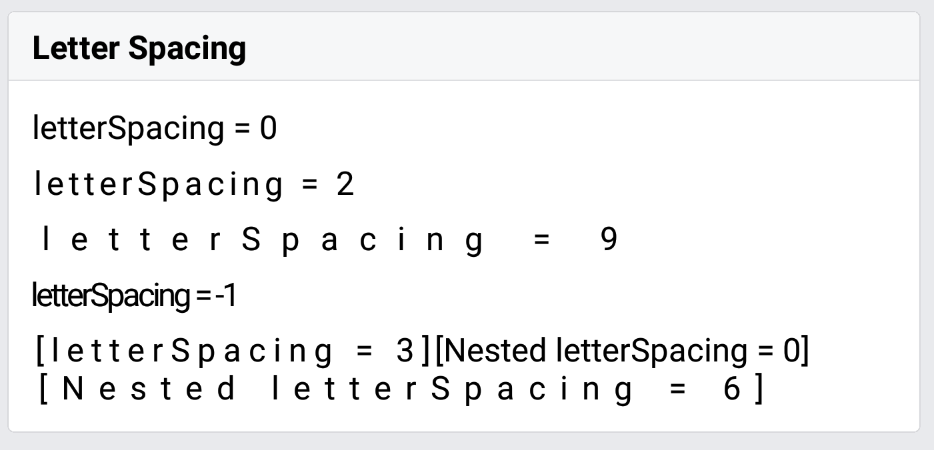
This allows use clip as ellipsize mode for truncated text on android
Added a test to RNTester, so it can be tested from there:
1. Run RNTester project
2. Navigate to `<Text>` tests
3. Scroll down to "Ellipsize mode" examples
4. Check the default behavior being applied when the value is set to "clip"
<!--
Required.
Help reviewers and the release process by writing your own release notes. See below for an example.
-->
[ANDROID] [BUGFIX] [Text] - Prevents android crash due to unsupported "clip" ellipsize mode
<!--
**INTERNAL and MINOR tagged notes will not be included in the next version's final release notes.**
CATEGORY
[----------] TYPE
[ CLI ] [-------------] LOCATION
[ DOCS ] [ BREAKING ] [-------------]
[ GENERAL ] [ BUGFIX ] [ {Component} ]
[ INTERNAL ] [ ENHANCEMENT ] [ {Filename} ]
[ IOS ] [ FEATURE ] [ {Directory} ] |-----------|
[ ANDROID ] [ MINOR ] [ {Framework} ] - | {Message} |
[----------] [-------------] [-------------] |-----------|
EXAMPLES:
[IOS] [BREAKING] [FlatList] - Change a thing that breaks other things
[ANDROID] [BUGFIX] [TextInput] - Did a thing to TextInput
[CLI] [FEATURE] [local-cli/info/info.js] - CLI easier to do things with
[DOCS] [BUGFIX] [GettingStarted.md] - Accidentally a thing/word
[GENERAL] [ENHANCEMENT] [Yoga] - Added new yoga thing/position
[INTERNAL] [FEATURE] [./scripts] - Added thing to script that nobody will see
-->
Closes https://github.com/facebook/react-native/pull/18540
Differential Revision: D7396379
Pulled By: mdvacca
fbshipit-source-id: 6c4b223731143c5081b3d12a3c740d1e375bd586
Summary:
Some files have crept into the repo with the old license header. These are usually from PRs that were opened prior to the re-licensing of the project.

Let the script run, prior to fixing the errant files. The script outputs the following:

```
PATENTS crept into some new files?
 --- /dev/fd/63	2018-03-01 01:42:48.250153746 +0000
+++ /dev/fd/62	2018-03-01 01:42:48.250153746 +0000
@@ -1 +1,9 @@
+Libraries/NativeAnimation/Nodes/RCTTrackingAnimatedNode.h
+Libraries/NativeAnimation/Nodes/RCTTrackingAnimatedNode.m
+ReactAndroid/src/main/java/com/facebook/react/animated/TrackingAnimatedNode.java
+ReactAndroid/src/main/java/com/facebook/react/views/text/CustomLetterSpacingSpan.java
+ReactCommon/yoga/yoga/YGLayout.cpp
+ReactCommon/yoga/yoga/YGLayout.h
+ReactCommon/yoga/yoga/YGStyle.cpp
+ReactCommon/yoga/yoga/YGStyle.h
 scripts/circleci/check_license.sh
Exited with code 1
```

Fix the headers in these files and run the script again. No output, exit code 0.
Closes https://github.com/facebook/react-native/pull/18143

Reviewed By: sophiebits

Differential Revision: D7119356

Pulled By: hramos

fbshipit-source-id: d238e4d4a3ae320a2c8e625c2fa29690057a4814
Summary:
Includes React Native and its dependencies Fresco, Metro, and Yoga. Excludes samples/examples/docs.

find: ^(?:( *)|( *(?:[\*~#]|::))( )? *)?Copyright (?:\(c\) )?(\d{4})\b.+Facebook[\s\S]+?BSD[\s\S]+?(?:this source tree|the same directory)\.$
replace: $1$2$3Copyright (c) $4-present, Facebook, Inc.\n$2\n$1$2$3This source code is licensed under the MIT license found in the\n$1$2$3LICENSE file in the root directory of this source tree.

Reviewed By: TheSavior, yungsters

Differential Revision: D7007050

fbshipit-source-id: 37dd6bf0ffec0923bfc99c260bb330683f35553e
Summary:
There seems to be a rounding error in the android code for line height, so that for some fonts and at some combinations of line height and font size the actual height of the elements seems to be slightly too short.
I've identified one issue that I mentioned here https://github.com/facebook/react-native/issues/10712#issuecomment-359382137 that could at least explain some of the problem. That when the line-height minus the original sum of the absolute value of top and bottom from the metrics, happens to be an odd number, the division by two causes a rounding error of 1, so that the actual line height is 1pt less than it should.
The fix uses floating point division instead of integer division, and rounds (arbitrarily) the negative values up and the positive values down so that the total is still the correct for odd numbers.
It turns out that only ascent and descent is used to give the actual line-height between lines in the same text-element. The top and bottom values are only used for padding the top and bottom of the text. So when the line-height is greater than the font size and the extra padding this PR sets the ascent and descent to the same value as the top and bottom respectively.
I've renamed the shouldIncreaseAllMetricsProportionally test to evenLineHeightShouldIncreaseAllMetricsProportionally and added an extra assertion to check that bottom-top still equals the line height.
Added another test oddLineHeightShouldAlsoWork that is similar but uses an odd number for the line height to test that it still works with odd numbers. This test only uses the sum of the values so that it's indifferent to what value the implementation chooses to round up or down.
Improvement on https://github.com/facebook/react-native/pull/16448
Fix line-height calculation on Android.
| Before | After |
| ------------- |-------------|
|  |  |
(All three columns have font size 16 and lineHeight: 32. The first one is has fixed height 9*32, the second is 9 Text elements, the last is one text element with lots of text limited to 9 lines, so they should be the same height. )
Closes https://github.com/facebook/react-native/pull/17952
Differential Revision: D6980333
Pulled By: hramos
fbshipit-source-id: 0a501358cfbf7f139fca46056d0d972b1daf6ae3
Summary:
ClassCastException fix: getText() returns CharSequence not Spanned.
From the other hand, EditTexts getText method returns Editable which extends Spanned.
This commit fixes two similar bugs one in flat TextView and another in standard TextView.
Also, it removes redundant checks in the ReactEditText.

Application without this change sporadically crashes with the following stack trace:
```
java.lang.ClassCastException: java.lang.String cannot be cast to android.text.Spanned
	at com.facebook.react.views.text.ReactTextView.reactTagForTouch(ReactTextView.java:195)
	at com.facebook.react.uimanager.TouchTargetHelper.getTouchTargetForView(TouchTargetHelper.java:269)
	at com.facebook.react.uimanager.TouchTargetHelper.findTargetTagAndCoordinatesForTouch$58866680(TouchTargetHelper.java:101)
	at com.facebook.react.uimanager.JSTouchDispatcher.handleTouchEvent(JSTouchDispatcher.java:77)
	at com.facebook.react.ReactRootView.dispatchJSTouchEvent(ReactRootView.java:151)
	at com.facebook.react.ReactRootView.onInterceptTouchEvent(ReactRootView.java:127)
	at android.view.ViewGroup.dispatchTouchEvent(ViewGroup.java:2110)

```
Closes https://github.com/facebook/react-native/pull/15452

Differential Revision: D6775986

Pulled By: hramos

fbshipit-source-id: 6de929937cbbb3e7bd98a708a40700f883cbaef0
Summary:
👋 Hello! Thanks for react-native, it’s a great project.

I was digging into the Android implementation in _ReactAndroid_ and noticed a couple typos in the documentation. I went through and tried to fix all the typos I could find using [aspell](http://aspell.net).

Not applicable: these changes are only to comments, and CI should be skipped.

[ANDROID][ENHANCEMENT][*] - Correct comment and docblock typos
Closes https://github.com/facebook/react-native/pull/17049

Differential Revision: D6472182

Pulled By: shergin

fbshipit-source-id: 7e62cab118609596b483d1cf16c3abf651d6753b
Summary:
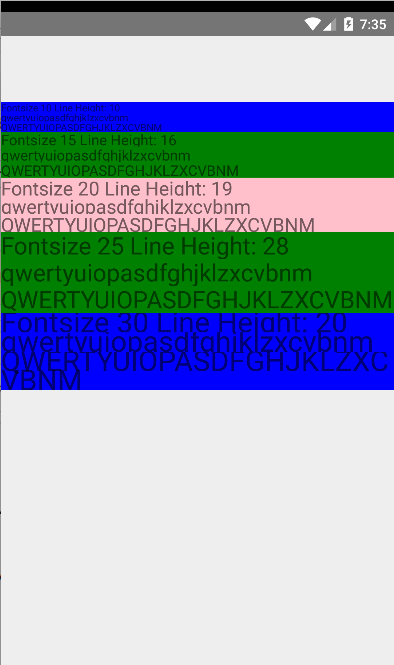
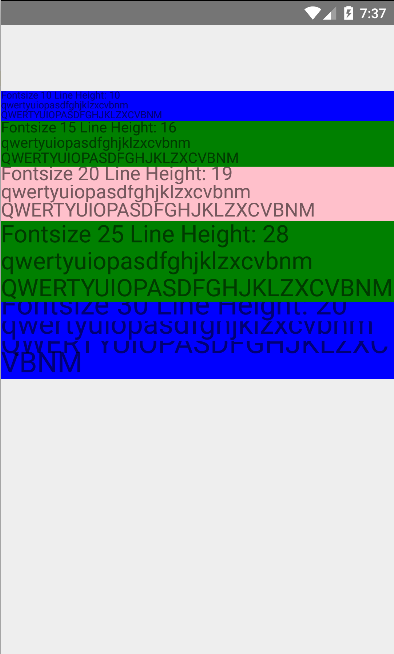
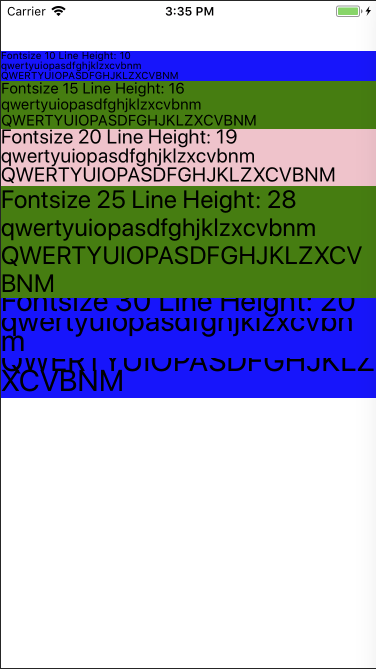
We noticed that on Android the lineHeight behaviour is different from iOS for built in fonts and custom fonts. The problem becomes visible when the lineHeight approaches the fontSize, showing a cut-off on the bottom of the TextView. This issue has been raised before in #10712. There is a mention of a PR with a fix in that issue, which has not been merged yet. This implementation is a less intrusive fix leaving the current lineHeight approach in place and fixing the discrepancy only.
This proposed change prioritises ascent over descent for reduction, making the lineHeight functionality behave identical to iOS.
There is no existing test covering the lineHeight property and its behaviour in the CustomLineHeightSpan. This PR contains new unit tests that covers the various scenario's for the lineHeight calculations.
The original behaviour, before the change can against these unit tests. The case that fails is `shouldReduceAscentThird`, which can be made to succeed on the old code by changing the asserts to:
```
assertThat(fm.top).isEqualTo(-5);
assertThat(fm.ascent).isEqualTo(-5);
assertThat(fm.descent).isEqualTo(-4);
assertThat(fm.bottom).isEqualTo(-4);
```
The unit test succeeds for the current implementation, which has the values for ascent and descent inverted.
Below screenshots show before, after and iOS:
BEFORE
AFTER
iOS
[ANDROID] [BUGFIX] [Text] - Fix the lineHeight behaviour on Android to match iOS
Closes https://github.com/facebook/react-native/pull/16448
Differential Revision: D6221854
Pulled By: andreicoman11
fbshipit-source-id: 7292f0f05f212d79678ac9d73e8a46bf93f1a7c6
Summary:
When we convert nested <Text> components to Spannable object we must enforce the order of spans somehow,
otherwise we will have Spannable object with unpredictable order of spans, which will produce unpredictalbe text layout.
We can do it only using `Spannable.SPAN_PRIORITY` feature because Spannable objects do not maintain the order of spans internally.

We also have to fix this to implement autoexpandable <TextInput>.

Reviewed By: achen1

Differential Revision: D5811172

fbshipit-source-id: 5bc68b869e58aba27d6986581af9fe3343d116a7
Summary:
Abstract class `ReactBaseTextShadowNode` was decoupled from `ReactTextShadowNode` to separate two goals/roles:
 * `ReactBaseTextShadowNode` represents spanned `<Text>` nodes, which can bear text attributes (both `RCTText` and `RCTVirtualText`);
 * `ReactTextShadowNode` represents anchor `<Text>` view in Yoga terms, which can bear layout attributes (`RCTText` and `RCTTextInput`).

`ReactVirtualTextShadowNode` now inherits `ReactBaseTextShadowNode`.
The same architectural changes was applited to view managers.

Why?
 * This is just a better architecture which represents the nature of this objects.
 * Bunch of "negative" logic which turn off excessive features for some suclasses was removed.
 * Memory efficiency.
 * Now we can improve `<TextInput>` component using right inheritance. Yay!

Reviewed By: achen1

Differential Revision: D5715830

fbshipit-source-id: ecc0764a03b5b7586fe77ad31f149cd840f4da41
Summary:
ReactRawTextShadowNode represents "raw" text node (aka textContent), so it cannot have layout or styling, it is just a line of text, a pure string.
So, we must not interit it from HUGE ReactTextShadowNode (which represents <Text> node with ReactRawTextShadowNode instance inside).
We need this change to make future fancy (and valuable from product perspective) refactoring possible. Stay tuned!

Reviewed By: achen1

Differential Revision: D5712961

fbshipit-source-id: 009e48046bdf34ddfd40b93175934969af64b98b
Summary:
Overview -

This PR resolves the issue described in #14606. This PR makes Text components take into account the includeFontPadding property when calculating their size.

Background -

Currently, on Android, when includeFontPadding is set to false, the React Text component does not adjust its height. This makes it difficult to lay out other components at a precise spacing relative to a Text component.

iOS calculates the height of a UILabel based on the font's descent + ascent.

Android lets you choose whether to calculate the height of a TextView based on the font's top + bottom (includeFontPadding=true) or ascent + descent (includeFontPadding=false).

In order for a text component to be the same size on iOS and Android (relative to the rest of the layout in points and dips), one should set includeFontPadding=false on Android - but the React Text component needs to take this property into account when sizing itself for this to work.

Please see this stack overflow post for a visual explanation of the difference between a font's ascent/descent and top/bottom - https://stackoverflow.com/questions/27631736/meaning-of-top-ascent-baseline-descent-bottom-and-leading-in-androids-font

Testing -

Please see the attached screenshots to see the height difference of a Text component with this PR when includeFontPadding is true vs false.

The font I am using has an ascent + descent = em-size so that the height of the Text component will be equal to the font-size for a single line of text. This is to clearly show the additional height that includeFontPadding=true adds to the Text component.

For Text components that are styled in the same way,

When includeFontPadding=true, height = ~29.714 dips
When includeFontPadding=false, height= 24 dips

<img width="342" alt="includefontpaddingtrue" src="https://user-images.githubusercontent.com/1437344/27299391-3eec9de0-54fa-11e7-81d5-d0aeb40e8e27.png">

<img width="346" alt="includefontpaddingfalse" src="https://user-images.githubusercontent.com/1437344/27299401-45c95248-54fa-11e7-98d7-17dd152d3cb8.png">
Closes https://github.com/facebook/react-native/pull/14609

Reviewed By: AaaChiuuu

Differential Revision: D5587602

Pulled By: achen1

fbshipit-source-id: 6d2f12ba72ec7462676645519cd27820279278eb
Summary:
Make android-version accept a decimal
number as lineHeight.

Credits where due, solution was given in this
issue: facebook/react-native#10607

According to the w3 spec the property
line-height should accept decimal values
(and it does on iOS) but the android
version has the wrong data-type for the
shadowed method, resulting in a stacktrace
saying:
com.facebook.react.bridge.UnexpectedNativeTypeException: TypeError:
expected dynamic type `int64', but had type `double'

Setting it to a float makes it accept
decmial values as it should.

* Create an app without this commit and create the same app with this commit:
In both apps:
- Leave line-height undefined. Behavior is unaffected by this commit.
- Set lineHeight to a integer number. Behavior is unaffected by this commit.
- Set lineHeight to a decimal number. Line height is now rendered with decimals in the app with this fix.

* Run android integration tests to see nothing
  else broke.

Sign the [CLA][2], if you haven't already.

Small pull requests are much easier to review and more likely to get merged. Make sure the PR does only one thing, otherwise please split it.

Make sure all **tests pass** on both [Travis][3] and [Circle CI][4]. PRs that break tests are unlikely to be merged.

For more info, see the ["Pull Requests"][5] section of our "Contributing" guidelines.

[1]: https://medium.com/martinkonicek/what-is-a-test-plan-8bfc840ec171#.y9lcuqqi9
[2]: https://code.facebook.com/cla
[3]: https://travis-ci.org/facebook/react-native
[4]: http://circleci.com/gh/facebook/react-native
[5]: https://github.com/facebook/react-native/blob/master/CONTRIBUTING.md#pull-requests
Closes https://github.com/facebook/react-native/pull/13843

Differential Revision: D5152982

Pulled By: shergin

fbshipit-source-id: cda3b72497a6c27d6948b31ec846640a8913775a
Summary:
Inspired by #13191

Creating a test app with spannable `TextView`, and observe the text width/height
Closes https://github.com/facebook/react-native/pull/13203

Differential Revision: D4795809

Pulled By: hramos

fbshipit-source-id: a7c6845abe7472dc7ad2f1f978a20d02fe49eda8
Summary:
Bug in Android https://code.google.com/p/android/issues/detail?id=33868 causes the RN catalyst instrumentation test to fail with

```
java.lang.ArrayIndexOutOfBoundsException: length=253; index=-1
	at android.text.StaticLayout.calculateEllipsis(StaticLayout.java:667)
	at android.text.StaticLayout.out(StaticLayout.java:631)
	at android.text.StaticLayout.generate(StaticLayout.java:423)
	...
```

The fix is to set singleLine to true when there is only one line of text

Reviewed By: AaaChiuuu

Differential Revision: D4562000

fbshipit-source-id: 84248e3982063b767e8b0465effe2321b54a7fa2
Summary:
Fixes#11592
This bug was seen on a Galaxy S4 running Android 4.4.2. On this device, Android's `Layout.getDesiredWidth` method doesn't correctly measure text that contains unicode emoticons. It appears to think the emoticons take up 0 space.
Setting ANTI_ALIAS_FLAG in the TextPaint's constructor instead of setting it later with setFlags works around the Android bug.
**Test plan (required)**
My team uses this fix in our app.
Adam Comella
Microsoft Corp.
Closes https://github.com/facebook/react-native/pull/12690
Differential Revision: D4673649
Pulled By: mkonicek
fbshipit-source-id: 535f371281927bfff5d8b42966496bc8daf30045
Summary:
A copy of https://github.com/facebook/react-native/pull/7791 because of our very imperfect tools that mirror the changes from pull requests in the fb monorepo. The internal Phabricator revision for #7791 is in an 'abandoned' state (by foghina probably because of changing teams) and Phabricator doesn't allow me to claim that revision and merge it. Therefore I'm creating a new one.

(It's not foghina's fault, no one probably knew about this "abandoned Phabricator revision" edge case, don't remember we hit it before.)

Will try to keep attribution (git blame) to rigdern when merging.
Closes https://github.com/facebook/react-native/pull/12448

Differential Revision: D4584743

Pulled By: mkonicek

fbshipit-source-id: 66e5b88134fca1980adc4cd8a2ff17c42e10022c
Summary:
Android has a text API called breakStrategy for controlling how paragraphs are broken up into lines. For example, some modes support automatically hyphenating words so a word can be split across lines while others do not.

One source of complexity is that Android provides different defaults for `breakStrategy` for `TextView` vs `EditText`. `TextView`'s default is `BREAK_STRATEGY_HIGH_QUALITY` while `EditText`'s default is `BREAK_STRATEGY_SIMPLE`.

In addition to exposing `textBreakStrategy`, this change also fixes a couple of rendering glitches with `Text` and `TextInput`. `TextView` and `EditText` have different default values for `breakStrategy` and `hyphenationFrequency` than `StaticLayout`. Consequently, we were using different parameters for measuring and rendering. Whenever measuring and rendering parameters are inconsistent, it can result in visual glitches such as the text taking up too much space or being clipped.

This change fixes these inconsistencies by setting `breakStrategy` and `hyphenat
Closes https://github.com/facebook/react-native/pull/11007

Differential Revision: D4227495

Pulled By: lacker

fbshipit-source-id: c2d96bd0ddc7bd315fda016fb4f1b5108a2e35cf
Summary:
The reason for this change is to implement `allowFontScaling` on the Android's React Native Text component.  Prior to this PR `allowFontScaling` only works for iOS.

The following link contains images of `allowFontScaling` working in Android on small, normal, large, and huge system fonts (from native Android display settings)

http://imgur.com/a/94bF1

The following link is a video of the same thing working on an Android emulator

https://youtu.be/1jTlZhPdj9Y

Here is the sample code snippet driving the video/images
```
render() {
    const size = [12, 14, 16, 18];
    return (
      <View style={{backgroundColor: 'white', flex: 1}}>
        <Text>
          Default size no allowFontScaling prop (default true)
        </Text>
        <Text allowFontScaling={true}>
          Default size allowFontScaling: true
        </Text>
        <Text style={{ marginBottom: 10, }} allowFontScaling={false}>
          Default size allowFontScaling: false
        </Text>

        { size.map(
Closes https://github.com/facebook/react-native/pull/10898

Differential Revision: D4335190

Pulled By: lacker

fbshipit-source-id: 0480809c44983644ff2abfcaf4887569b2bfede5
Summary:
By default Android will put extra space above text to allow for upper-case accents or other ascenders. With some fonts, this can make text look slightly misaligned when centered vertically.

We have found that the effect is very noticeable with certain custom fonts on Android. On iOS the font aligns vertically as expected.

Android exposes a property `includeFontPadding` that will remove this extra padding if set to false. This PR exposes that to JS, and adds it to the documentation and UIExplorer.
Closes https://github.com/facebook/react-native/pull/9323

Differential Revision: D4266713

Pulled By: lacker

fbshipit-source-id: f9711254bc26c09b4586a865f0e95ef4bf77cf3f
 David Vacca
 Taras Tsugrii
 Himabindu Gadupudi
 Tadeu Valentt
 Andrew Chen (Eng)
 Héctor Ramos
 Moti Zilberman
 Sophie Alpert
 Stein Strindhaug
 Sergei Dryganets
 Jonathan Kim
 Jonathan Keljo
 Cory Reed
 Bartol Karuza
 Valentin Shergin
 Misha Greenberg
 Jonas Lundberg
 Aaron Chiu
 Emil Sjolander
 hoangpham95
 Adam Comella
 Michael Bolin
 Martin Konicek
 Satyajit Sahoo
 Steven Goff
 Delyan Kratunov
 Ben Clayton