Summary:
I wrote up a bunch of context for this in response to #27038 by fat. That comment is reproduced here in this commit message. You can see it in it's original contxt here: https://github.com/facebook/react-native/pull/27038
Okay, here is what I think is happening. For context, here is a diagram I have of how focus and blur propagates through the system. This might be interesting to refer back to as you go through the rest of my explanation.
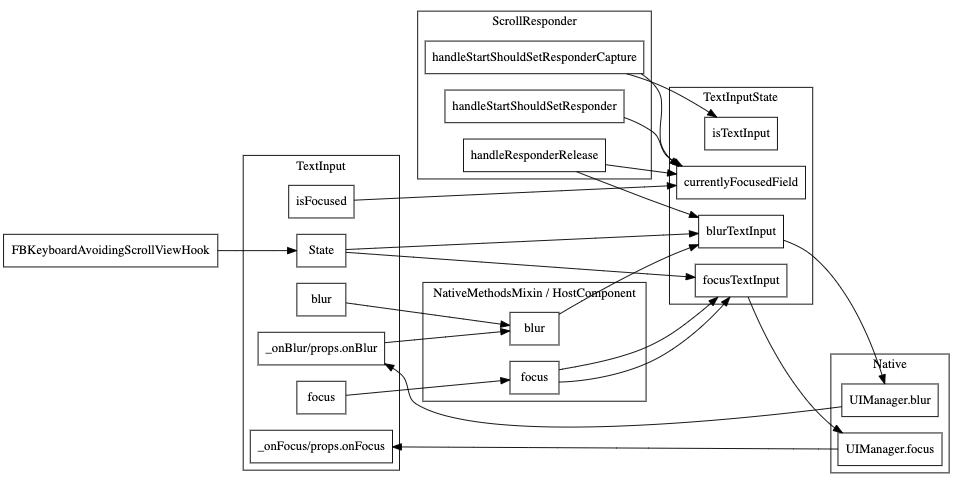
ScrollView's scrollResponder is responsible for blurring text inputs when a touch occurs in the ScrollView but outside of the currently focused TextInput. The code for that is here:
https://github.com/facebook/react-native/blob/6ba2769f0f92ca75fb0eb60ccb8337920a9c31eb/Libraries/Components/ScrollResponder.js#L301-L314
This happens on `scrollResponderHandleResponderRelease` aka, touch up.
It checks for what the currently focused textinput is by calling `TextInputState.currentlyFocusedField()`.
That function is a JS variable that is being updated by calls to `TextInputState.focusTextInput` and `TextInputState.blurTextInput`:
https://github.com/facebook/react-native/blob/6ba2769f0f92ca75fb0eb60ccb8337920a9c31eb/Libraries/Components/TextInput/TextInputState.js#L36-L71
I added some console logs to those methods to see which ones are being called when running your repro (thanks for the repro!). **This is without your fix**
Click on and off:
```
// Click on input 1
focusTextInput input1
TextInput's _onFocus called
// Click on blank space
scrollResponderHandleResponderRelease blur input1
blurTextInput input1
TextInput's _onBlur called
```
Click on input1, then input 2, then off
```
// Click on input 1
focusTextInput input1
TextInput's _onFocus called for input1
// Click on input 2
focusTextInput input2
TextInput's _onBlur called for input1
TextInput's _onFocus called for input2
// Click on blank space
scrollResponderHandleResponderRelease blur input2
blurTextInput input2
TextInput's _onBlur called for input2
```
And now for the bug. Click on input 1, tab to 2, then off
```
// Click on input 1
focusTextInput input1
TextInput's _onFocus called for input1
// Tab to input 2
TextInput's _onBlur called for input1
TextInput's _onFocus called for input2
// Click on blank space
scrollResponderHandleResponderRelease blur input1
blurTextInput input1
```
Notice how `focusTextInput` was never called with input2 in the last example. Since this is the function that sets the `currentlyFocusedField` when we click on the blank space RN is trying to blur the first input instead of the second.
# The root cause
We are tracking the state of which field is focused in JS which has to stay in sync with what native knows is focused. We [listen to _onPress](https://github.com/facebook/react-native/blob/6ba2769f0f92ca75fb0eb60ccb8337920a9c31eb/Libraries/Components/TextInput/TextInput.js#L1103-L1107) and call `TextInputState.focusTextInput` in that handler. However, we don't currently have anything listening to other ways for an input to become focused (like tabbing) so it doesn't end up updating the `currentlyFocusedField`.
We have the same problem with blur that we actually fixed the same way you did here in this PR:
https://github.com/facebook/react-native/blob/6ba2769f0f92ca75fb0eb60ccb8337920a9c31eb/Libraries/Components/TextInput/TextInput.js#L1182-L1189
If you look back at my diagram at the beginning of this post, you'll notice the missing edge from `TextInput._onFocus` to `TextInputState.focusTextInput`. That's the problem. :)
The reason this solution works is because this function **is** the notification from native that an input was focused or blurred. This solution is *fine* because this updates the `currentlyFocusedID` but isn't great because it both sets that value and **calls the native code to focus or blur again**. Luckily the native code doesn't send an event back to JS if you try to blur an already blurred TextInput otherwise we'd have an infinite loop.
# The correct solution
The correct thing would probably be to have all of this tracking in native code and not in JavaScript code. That's a pretty big change though and very out of scope. Something for our team to keep in mind for the future.
A short term term solution would be to refactor `focusTextInput` and `blurTextInput` to pull out the part that sets the `currentlyFocusedID` that we could call from `TextInput` directly from `_onFocus` and `_onBlur`.
# ^This short term term solution is what this commit is doing.
Changelog:
[General][Changed] TextInput no longer does an extra round trip to native on focus/blur
Reviewed By: RSNara
Differential Revision: D18278359
fbshipit-source-id: 417566f25075a847b0f4bac2888f92fbac934096
Summary:
This will allow us to catch cases where we use iOS 10-only APIs on iOS 9

Changelog: [Internal]

Reviewed By: TheSavior, mmmulani

Differential Revision: D18275225

fbshipit-source-id: dc9c515415208db40750be997173ce5bd6eb494f
Summary:
This implementation was replaced in January of 2018 by shergin. I believe everyone should have `RCTVirtualText` at this point, which should make this safe to remove.

Changelog:
[Internal][TextInput] Remove deprecated and unused legacyIOS implementation

Reviewed By: shergin

Differential Revision: D18296981

fbshipit-source-id: b5d5756e7bbc8141f1b826ab07c76a781ab03edc
Summary:
This if statement is older than June 2015. This prop is undocumented, not part of the flow type, not on our public docs, not in the flow type, not in typescript types, and I can't find any blog posts about it.

Changelog:
[Breaking][TextInput] Removing undocumented `inputView` prop. Use children instead.

Reviewed By: yungsters

Differential Revision: D18296894

fbshipit-source-id: 95373d24659e6f06e212095b57e8f6d713323c11
Summary:
I've been working on a new iOS experience with lots of text inputs and this has been driving me a bit nuts…
If you're in a scrollview with `keyboardShouldPersistTaps="handled"` and you tab through your text-inputs, you aren't able to tap outside of a given text-input to blur it (and dismiss the keyboard).
I wrote up a quick explanation and some repo steps here: https://snack.expo.io/BJBcKgrqB
The patch i came up with, after poking around for a little bit seems terrifying - so almost certainly not it. But if it's helpful at all - decided to just got ahead and submit it.
## Changelog
[iOS] [Fixed] - TextInput blur when tabbing in iOS simulator.
Pull Request resolved: https://github.com/facebook/react-native/pull/27038
Test Plan:
I tried to think of a way to test this in jest… but i didn't get very far sorry 😢
I did create a snack here so you can demo the issue: https://snack.expo.io/BJBcKgrqB
I also created two videos…
**Here's the text input not working when i try to blur it after tabbing in simulator**

**Here's it working after I applied this patch**

Thanks!
Differential Revision: D18262867
Pulled By: TheSavior
fbshipit-source-id: 4087f3a27a7e6a146f7f84d7c6e9e8e2b6adc75d
Summary:
We are going to need to change some of these APIs to use refs instead of findNodeHandle. I figured I'd start by adding some tests

Changelog:
[Internal] Adding tests for TextInput

Reviewed By: yungsters

Differential Revision: D17892806

fbshipit-source-id: f59ff99fa4d064239f171acb64a8441e07bb71c1
Summary:
These were being cast to a NativeComponent but that is no longer accurate. `requireNativeComponent` returns the type of `HostComponent` now which is more accurate. We don't need the cast through `any` anymore.

In order to know that I found all the callsites, I ran this command to find these:
```
grep -r "requireNativeComponent" react-native-github -C 5 | grep 'any'
```

Changelog:
[Internal]

Reviewed By: cpojer

Differential Revision: D17864165

fbshipit-source-id: 3774d6d47d7bb0d885cc1a1352f81fec7d3bca0d
Summary:
Deletes the `selectionState` prop from `TextInput`.

It does not provide meaningful value over `onBlur`, `onFocus`, and `selectionState`.

Changelog:
[Breaking][TextInput] Removing `selectionState` prop, use `onBlur`, `onFocus`, and `onUpdate` instead.

Reviewed By: zackargyle, TheSavior

Differential Revision: D17879667

fbshipit-source-id: 03a4e239406932adad898d6d2a092e3bc2e6b064
Summary: Reverts D14176217 so we can do the partial React sync in the next diff which removes this API

Reviewed By: TheSavior

Differential Revision: D17828977

fbshipit-source-id: 7dd98c19890aeee0a153746ce65fd3b148b4ca7b
Summary:
We need to migrate to HostComponent, this is the first batch.

Changelog:
[Internal] Migrate NativeComponentType from codegenNativeComponent to HostComponent

Reviewed By: rickhanlonii

Differential Revision: D17562879

fbshipit-source-id: ce1993b64a79cede3598c89ddff0dadf07fde92f
Summary:
In React Native there are three types of "Native" components.

```
createReactClass with NativeMethodsMixin
```
```
class MyComponent extends ReactNative.NativeComponent
```
```
requireNativeComponent('RCTView')
```

The implementation for how to handle all three of these exists in the React Native Renderer. Refs attached to components created via these methods provide a set of functions such as
```
.measure
.measureInWindow
.measureLayout
.setNativeProps
```

These methods have been used for our core components in the repo to provide a consistent API. Many of the APIs in React Native require a `reactTag` to a host component. This is acquired by calling `findNodeHandle` with any component. `findNodeHandle` works with the first two approaches.

For a lot of our new Fabric APIs, we will require passing a ref to a HostComponent directly instead of relying on `findNodeHandle` to tunnel through the component tree as that behavior isn't safe with React concurrent mode.

The goal of this change is to enable us to differentiate between components created with `requireNativeComponent` and the other types. This will be needed to be able to safely type the new APIs.

For existing components that should support being a host component but need to use some JS behavior in a wrapper, they should use `forwardRef`. The majority of React Native's core components were migrated to use `forwardRef` last year. Components that can't use forwardRef will need to have a method like `getNativeRef()` to get access to the underlying host component ref.

Note, we will need follow up changes as well as changes to the React Renderer in the React repo to fully utilize this new type.

Changelog:
[Internal] Flow type to differentiate between HostComponent and NativeMethodsMixin and NativeComponent

Reviewed By: jbrown215

Differential Revision: D17551089

fbshipit-source-id: 7a30b4bb4323156c0b2465ca41fcd05f4315becf
Summary:
We need to get rid of findNodeHandle calls so migrating scrollResponderScrollNativeHandleToKeyboard to take a ref to a host component.

I made this change with Flow, and tested by rendering UserJobApplicationForm

Reviewed By: mdvacca

Differential Revision: D17099280

fbshipit-source-id: 96af692006aace2c206f268f5416984b00f8a438
Summary:
This pull request makes properties of events' Flow types in `AndroidTextInputNativeComponent` be `$ReadOnly`.

This will make them more compatible with the callback types in `TextInput`.

## Changelog

[Internal] [Changed] - Made properties of events' Flow types in `AndroidTextInputNativeComponent` readonly
Pull Request resolved: https://github.com/facebook/react-native/pull/26469

Test Plan:
`yarn flow-check-ios` and `yarn flow-check-android` both pass.

No regressions to running `scripts/generate-rncore.sh` have been noted.

Differential Revision: D17435579

Pulled By: TheSavior

fbshipit-source-id: 92e6c0623c4dd3fe06ebfb22dc73916bf5917bcc
Summary: It looks like codegen supports string enums as long as defaults are provided. Uncommenting the enums and removing TODOs.

Reviewed By: rickhanlonii

Differential Revision: D17196139

fbshipit-source-id: a076b1a25eb38b23cfd53fd92e8c42f121d08d6b
Summary:
We added the accessibilityState property as a more semantically rich way for components to describe information about their state to accessibility services. This PR removes the old accessibilityStates property.

 <!-- Explain the **motivation** for making this change. What existing problem does the pull request solve? -->

## Changelog

[General] [Change] - Remove accessibilityStates property.
Pull Request resolved: https://github.com/facebook/react-native/pull/26168

Test Plan: Ensure that RNTester accessibility examples function properly on both iOS and Android.

Differential Revision: D17152891

Pulled By: cpojer

fbshipit-source-id: d71d3cf0f2e0846979d2ba104b6c69e4e5725252
Summary: Flow type for AndroidTextInput. This could theoretically be used for the interface codegen in the future, and I did use this to codegen the scaffolding for AndroidTextInput (see previous diffs).

Reviewed By: mdvacca

Differential Revision: D16926831

fbshipit-source-id: d01c2e041efb4151f6091dd0fea191989d133881
Summary: Include AndroidTextInputNativeComponent so we can rely on codegen and flow typing in a future diff.

Reviewed By: TheSavior

Differential Revision: D16903634

fbshipit-source-id: 767d7c854533d641eb7fcb2147bf584621581411
Summary:
The documentation from the Flow types' respective proptypes have been copied over to `TextInput`.

## Changelog

[Internal] [Changed] - Added documentation to TextInput's Flow types
Pull Request resolved: https://github.com/facebook/react-native/pull/26054

Test Plan: `yarn flow-check-ios` and `yarn flow-check-android` both pass.

Differential Revision: D16801435

Pulled By: TheSavior

fbshipit-source-id: 7f3d75ba149259d5bbf719375320e2e325188826
Summary:
This pull request moves `TextInput`'s proptypes to `DeprecatedTextInputPropTypes`. This is in line with what is happening with other components.

## Changelog

[General] [Deprecated] - Moved `TextInput`'s proptypes to `DeprecatedTextInputPropTypes`
Pull Request resolved: https://github.com/facebook/react-native/pull/26042

Test Plan: Flow checks pass.

Differential Revision: D16782322

Pulled By: cpojer

fbshipit-source-id: c5f9caa402c0c5cd878e7fff502d380c7b468cbd
Summary:
Need to add explicit type annotations in these areas to unblock types-first architecture for Flow. These are locations the codemod could not automatically handle.

I'll call out areas I need a close eye on in the comments.

Reviewed By: panagosg7

Differential Revision: D16659053

fbshipit-source-id: 167dd2abe093019b128676426374c1c62cf71e7f
Summary:
We are working to remove constants from the view configs.

On June 21st I modified native to support both numbers and strings. D15911323

Changelog:
[Internal]

Reviewed By: JoshuaGross

Differential Revision: D16697916

fbshipit-source-id: f346f37b2e664c2dd49e2a1308a0517f50284e4d
Summary:
On `textContentType` `newPassword` on ios, there is another property called `passwordRules` on ios 12 that can give hints to the os to generate a password with specific requirements like [here](https://developer.apple.com/password-rules/).
This is useful for apps that have a "register" screen with `emailAddress`/`username` and a `newPassword` fields, to let ios make a password that will satisfy the requirements and not one that might be not accepted after the user presses "register".

## Changelog

[iOS] [Added] - PasswordRules for new password textContentType input fields
Pull Request resolved: https://github.com/facebook/react-native/pull/25407

Test Plan: This is a bit harder, but to test you need to make an app that has associated domains with an apple-app-site-association file on that domain, enable iCloud Keychain on the test device, and then iOS will suggest a password, otherwise you will just get a warning on Xcode saying "Couldn't suggest password because of: blabla".

Differential Revision: D16028684

Pulled By: cpojer

fbshipit-source-id: d22426e07f1db45d1f79f5dad81f1465a9701f0b
Summary:
Add prop showSoftInputOnFocus to TextInput. This fixes#14045. This prop can be used to prevent the system keyboard from displaying at all when focusing an input text, for example if a custom keyboard component needs to be displayed instead.
On Android, currently TextInput always open the soft keyboard when focused. This is because `requestFocus` calls `showSoftKeyboard`, which in turn instructs `InputMethodManager` to show the soft keyboard.
Unfortunately even if we were to define a new input type that extends ReactEditText, there is no way to overcome this issue.
This is because `showSoftKeyboard` is a private method so it can't be overriden. And at the same time `requestFocus` needs to invoke `super.requestFocus` to properly instruct Android that the field has gained focused, so overriding `requestFocus` in a subclass of ReactEditText is also not an option, as when invoking `super.requestFocus` we would end up calling again the one defined in ReactEditText.
So currently the only way of doing this is to basically add a listener on the focus event that will close the soft keyboard immediately after. But for a split second it will still be displayed.
The code in the PR changes `requestFocus` to honor showSoftInputOnFocus as defined in Android TextView, displaying the soft keyboard unless instructed otherwise.
## Changelog
[Android] [Added] - Add showSoftInputOnFocus to TextInput
Pull Request resolved: https://github.com/facebook/react-native/pull/25028
Differential Revision: D15503070
Pulled By: mdvacca
fbshipit-source-id: db4616fa165643d6ef2b3185008c4d279ae08092
Summary:
As currently defined, accessibilityStates is an array of strings, which represents the state of an object. The array of strings notion doesn't well encapsulate how various states are related, nor enforce any level of correctness.

This PR converts accessibilityStates to an object with a specific definition. So, rather than:

<View
...
accessibilityStates={['unchecked']}>

We have:

<View
accessibilityStates={{'checked': false}}>

And specifically define the checked state to either take a boolean or the "mixed" string (to represent mixed checkboxes).

We feel this API is easier to understand an implement, and provides better semantic definition of the states themselves, and how states are related to one another.

## Changelog

[general] [change] - Convert accessibilityStates to an object instead of an array of strings.
Pull Request resolved: https://github.com/facebook/react-native/pull/24608

Differential Revision: D15467980

Pulled By: cpojer

fbshipit-source-id: f0414c0ef6add3f10f7f551d323d82d978754278
Summary: Allows iOS users to prefil from keyboard if they support safari autofill

Differential Revision: D15385599

fbshipit-source-id: 35d8a7a04c44d23d2aa27dffa02035b68818db7a
Summary:
This is the next step in moving RN towards standard path-based requires. All the requires in `Libraries` have been rewritten to use relative requires with a few exceptions, namely, `vendor` and `Renderer/oss` since those need to be changed upstream. This commit uses relative requires instead of `react-native/...` so that if Facebook were to stop syncing out certain folders and therefore remove code from the react-native package, internal code at Facebook would not need to change.

See the umbrella issue at https://github.com/facebook/react-native/issues/24316 for more detail.

[General] [Changed] - Migrate "Libraries" from Haste to standard path-based requires
Pull Request resolved: https://github.com/facebook/react-native/pull/24749

Differential Revision: D15258017

Pulled By: cpojer

fbshipit-source-id: a1f480ea36c05c659b6f37c8f02f6f9216d5a323
Summary:
Per a conversation with TheSavior, in #24538, this adds snapshot tests for all components whose mocks will be addressed in that PR. Shallow and deep snapshots are included.

[General] [Added] - Snapshots
Pull Request resolved: https://github.com/facebook/react-native/pull/24554

Differential Revision: D15062197

Pulled By: cpojer

fbshipit-source-id: 70ddbaa5e6d1d2c0fd1130ab04c458d9c49d0ee8
Summary:
Currently calling native methods on internal react native components throw a warning. I believe this is problematic because _users_ aren't calling native methods on internal components, the _component_ is making the call.

So for instance, if I unmount a component that has a form with a few uses of `TextInput`, which is a perfectly valid test case, my test output will be full of warnings that I can't call `.blur()` in the test renderer environment. That's very misleading, because I didn't, the internal component did. In fact, as far as I can tell, there's not really even anything I can do to stop that call or use the output from it, its all internal. `TextInput` is a black box, and 99% of users writing tests probably won't even know it calls `.blur()` under the hood on unmount.

I want to change these to `jest.fn()` because I think this eliminates a lot of chatter in test output, but also doesn't send users down a rabbit hole of trying to find workarounds that may involve filtering console output, which could potentially lead them to inadvertently filter out real warnings that they should see.

So I'm willing to change the implementation of how I did this, but I don't think its right to warn users that they called a native method when they didn't. If they build a component that calls these methods, I believe it's on them to do something similar to this, and maybe we can make this exposed as a helper that can be used for third party component mocks?

[General] [Changes] - Changed MockNativeMethods for core components to `jest.fn()` instead of function that warns about calling native methods.
Pull Request resolved: https://github.com/facebook/react-native/pull/24337

Differential Revision: D14822126

Pulled By: cpojer

fbshipit-source-id: 2199b8c8da8e289d38823bdcd2c43c82f3f635c9
Summary: Moves a number of requireNativeComponent calls to standalone files to support codegen

Reviewed By: TheSavior

Differential Revision: D14654018

fbshipit-source-id: 349b975cd3a99a9373b2b9b1a19aa311d7c36399
Summary:
@public
This bumps Prettier to v1.16.4
Only format source files were updated.

Reviewed By: mjesun

Differential Revision: D14454893

fbshipit-source-id: 72f9872fe764a79dbf0d9fab9bebb1456b039f2f
Summary:
In API 26, autofill framework was introduced in Android.
Read more about Autofill at https://developer.android.com/guide/topics/text/autofill.

Now, if in case for some text input if developer wants to disable
autofill then he can take help from this `importantForAutoFill` prop
and pass `no` to it.

Also important of auto fill can be configured with this prop, like:
* `auto`: Let the Android System use its heuristics to determine if the view is important for autofill.
* `no`: This view isn't important for autofill.
* `noExcludeDescendants`: This view and its children aren't important for autofill.
* `yes`: This view is important for autofill.
* `yesExcludeDescendants`: This view is important for autofill, but its children aren't important for autofill.

Default value if `auto`.

Read more at: https://developer.android.com/guide/topics/text/autofill-optimize

Changelog:
----------
[Android] [Added] - Add prop to configure `importantForAutofill` in `TextInput`.
Pull Request resolved: https://github.com/facebook/react-native/pull/22763

Differential Revision: D14121242

Pulled By: cpojer

fbshipit-source-id: aa4360480dd19f6dde66f0409d26a41a6a318c94
Summary:
TL;DR: Setting `autoComplete` will allow the system to suggest autofill options for the `<TextInput>` component.

Android Oreo introduced the AutoFill Framework, for secure communication between an app and autofill services (e.g. Password managers). When using `<TextInput>` on Android Oreo+, the system already tries to autofill (based on heuristics), but there is no way to set configuring options or disable.

The quick solution would be to just add the same Android attributes (`autofillHints` & `importantForAutofill`) in React Native TextInput, but that doesn't bond well with the cross-platform nature of the library.

Introduces an `autoComplete` prop based on HTML's `autocomplete` attribute, mapping to Android `autofillHints` & `importantForAutofill` and serving as a proper placeholder for autofill/autocomplete in other platforms:

Also gives you the ability to disable autofill by setting autocomplete="off".
Pull Request resolved: https://github.com/facebook/react-native/pull/21575

Differential Revision: D14102949

Pulled By: hramos

fbshipit-source-id: 7601aeaca0332a1f3ce8da8020dba037b700853a
Summary:
This is a new attempt to get #11251 merged. I just cherry-picked the relevant commits. TextInputs are set to always ignore responder termination requests, which is not desirable when they are enclosed inside a swipeable area like a ListView

Create a TextInput inside a ListView and set the `rejectResponderTermination` prop to false. Otherwise, all TextInputs should have the same behavior they do now.

[IOS] [ENHANCEMENT] [TextInput] - Add `rejectResponderTermination` prop to to TextInput. This enables TextInputs inside Swipeables to function properly.
Pull Request resolved: https://github.com/facebook/react-native/pull/16755

Differential Revision: D7846365

Pulled By: cpojer

fbshipit-source-id: eb21140061ae1f475fbd83fc63a23819e931787d
Summary: In D13408886, I landed a PR that broke the `autoFocus` prop. This diff fixes this prop by partially reveting some of the changes in that diff.

Reviewed By: TheSavior

Differential Revision: D13611258

fbshipit-source-id: 225b9b59b2500cfac092f13c273685aaeb599ab0
Summary:
This removes the use of the legacy context API in `TextInput`.

Nothing in OSS appears to make use of the `focusEmitter`.
Pull Request resolved: https://github.com/facebook/react-native/pull/22220

Reviewed By: TheSavior

Differential Revision: D13408886

Pulled By: RSNara

fbshipit-source-id: 9ae597507ccc26a9bc944a44c1f51b91e73cd637
Summary:
Similar to what was done here https://github.com/facebook/react-native/pull/22376

This allows using things like async functions with text input event props.

Changelog:
----------

[General] [Fixed] - Make TextInput event prop types less strict

Pull Request resolved: https://github.com/facebook/react-native/pull/22673

Reviewed By: TheSavior

Differential Revision: D13492029

Pulled By: hramos

fbshipit-source-id: 84e1a776a7ac1ae7567fbf4105b2be9be330610e
Summary: This is one more step to remove `fbjs` from `react-native-github`. This changes both the internal and external code to use `invariant` from zertosh instead of the copy in fbjs.

Reviewed By: yungsters

Differential Revision: D13195941

fbshipit-source-id: 73564ca1715110e7da9c7ef56dc57374d61377e0
Summary:
Some of the flow types were incomplete. So, I referenced the code in  `~/fbsource/xplat/js/react-native-github/ReactAndroid/src/main/java/com/facebook/react/views/textinput/` and in `~/fbsource/xplat/js/react-native-github/Libraries/Text/TextInput/` to make the flow types more specific.

I also fixed internal breakages. To avoid having to sprinkle `$FlowFixMe`s everywhere, I had to refactor some types, and some code.

Reviewed By: TheSavior

Differential Revision: D13121871

fbshipit-source-id: 9796aafc861544baf52d7ade823ab1be2d3f12d1
Summary:
Related to #22100

Enhance TextInput with callback event types.
This is a first draft and I will need more help on this one. Flow checks are successful now but I am not sure types are accurate though.
Moreover I find my separation approach kind of dirty for callback event types.

- All flow tests succeed.

[GENERAL] [ENHANCEMENT] [TextInput.js] - Flow types
[GENERAL] [ENHANCEMENT] [TextInputExample.android.js] - Fixing Flow types
[GENERAL] [ENHANCEMENT] [TextInputExample.ios.js] - Fixing Flow types
[GENERAL] [ENHANCEMENT] [XHRExampleFetch.js] - Fixing Flow types
Pull Request resolved: https://github.com/facebook/react-native/pull/22250

Reviewed By: TheSavior

Differential Revision: D13104820

Pulled By: RSNara

fbshipit-source-id: 3fbb98d0ec2b62be676f71ae1053933d9c78485e
Summary:
I noticed that the _onBlur method was not exactly similar to the _onFocus one in the TextInput component.

After digging, I found that the blurTextInput method in the TextInputState.js file was call twice in a raw instead of once when the textinput component should blur.

By removing this line, I fix this unecessary multiple call.
Pull Request resolved: https://github.com/facebook/react-native/pull/22156

Reviewed By: TheSavior

Differential Revision: D13105396

Pulled By: RSNara

fbshipit-source-id: 8e83461d8b288d8ee4047bc4a33c4480e193c349




