Summary: These methods are (or should be) only called on the UI thread. Make those assumptions explicit.

Reviewed By: mdvacca

Differential Revision: D17865205

fbshipit-source-id: 9b3acf8f3215a07b1a667ced55e50e99a488de79
Summary: Although `mBinding` is unregistered which means the connection to the JNI-bridged Cxx object can be destructed, we still hold onto the `mBinding` Java object after unregistering. That doesn't seem desirable, I think we should just clear it out here for consistency.

Reviewed By: mdvacca

Differential Revision: D17865206

fbshipit-source-id: 1ad8643c48ba0b2d52620a7b8ebe8a52928648ef
Summary:
Add UI thread assertions and annotations to ReactRootView. Shouldn't have any immediate effect since these methods already call other methods that assert they're on the UI thread. Doing this to hoist assumptions higher up.

Doing some very simple refactoring to the way cleanup happens to ensure aggressive cleanup in more instances.

Reviewed By: shergin

Differential Revision: D17860291

fbshipit-source-id: c87e0336594fa2327271b648eb8340e250235250
Summary: This PR caused a regression with shadows, see https://github.com/facebook/react-native/issues/26544.

Reviewed By: JoshuaGross, mdvacca

Differential Revision: D17809320

fbshipit-source-id: 0c83cd211425622ada0fd8c492f43df0536a4b8a
Summary:
This PR addresses issue https://github.com/facebook/react-native/issues/23870 (`View.getGlobalVisibleRect()` is broken in some use cases)
The issue affects the following Android APIs:
- ViewGroup.getChildVisibleRect()
- View.getGlobalVisibleRect() (Which calls into ViewGroup.getChildVisibleRect)
- View.getLocalVisibleRect() (Which calls into View.getGlobalVisibleRect())
According to Android documentation, View.getGlobalVisibleRect() should provide a rect for a given view that has been clipped by the bounds of all of its parent views up the view hierarchy. It does so through the use of the recursive function ViewGroup.getChildVisibleRect().
Since React Native has a separate clipping mechanism that does not rely on Android UI's clipping implementation, ViewGroup.getChildVisibleRect() is unable to determine that a rect should be clipped if the clipping view is a ReactClippingViewGroup. This resultantly breaks some important use cases for things like testing with Detox, which relies on this functionality to tell when a component is on-screen, as explained in the above referenced issue.
The rationale of the fix is essentially to implement logic analogous to [ViewGroup.getChildVisibleRect()](https://android.googlesource.com/platform/frameworks/base/+/master/core/java/android/view/ViewGroup.java#6176), discarding irrelevant Android clipping modes, and instead testing against the 'overflow' property, restoring the originally intended functionality. This is implemented as an override to ViewGroup.getChildVisibleRect() in the following classes:
- ReactViewGroup
- ReactScrollView
- ReactHorizontalScrollView
Unfortunately, since the public ViewGroup.getChildVisibleRect() API recurses into a `hide` annotated API which cannot be overridden, it was necessary to provide this override in each of the above React Native classes to ensure the superclass implementation would not be called, which would break the recursion.
## Changelog
[Android] [Fixed] - View.getGlobalVisibleRect() clips result rect properly when overflow is 'hidden'
Pull Request resolved: https://github.com/facebook/react-native/pull/26334
Test Plan:
The functionality in question is neither used internally nor exposed by React Native, and thus only affects Android native modules that use the above referenced APIs.
As such, I have primarily performed testing with a forked example project that had been submitted with issue https://github.com/facebook/react-native/issues/23870, originally by d4vidi.
The example project can be found here:
- [Configured to build against RN Master](https://github.com/davidbiedenbach/RNClipVisibilityBugDemo/tree/rn-master)
- [Configured to build against PR branch](https://github.com/davidbiedenbach/RNClipVisibilityBugDemo/tree/fix-23870)
(Original project here: https://github.com/d4vidi/RNClipVisibilityBugDemo)
### Bug in effect:
When built against RN master, it can be observed that fully clipped views are reported as visible, as in the below screenshots.
#### Views inside a ReactViewGroup do not report as clipped

#### Views inside a ReactScrollView do not report as clipped

#### Views inside a ReactHorizontalScrollView do not report clipping properly

### Bug fixed
When built against the PR branch, fully-clipped views no longer report visible.
#### Views inside a ReactViewGroup report clipping properly

#### Views inside a ReactScrollView report clipping properly

#### Views inside a ReactHorizontalScrollView report clipping properly

Reviewed By: mdvacca
Differential Revision: D17782658
Pulled By: yungsters
fbshipit-source-id: 0cd0d385898579a7a8a3e453f6ba681679ebe496
Summary: Oleksandr made the point that making `sDidInit` volatile isn't quite enough because the flag is set at the beginning of the function; it's possible that it will return true while it's still in the process of initializing the bridge. Moving where we set the flag to the end of the function should address the issue.

Reviewed By: JoshuaGross

Differential Revision: D17770128

fbshipit-source-id: 695d3edc582d9dce1884d8698d400dd147ca5cae
Summary: Fabric doesn't support setNativeProps, so we have to use commands instead to set the value of the native component.

Reviewed By: JoshuaGross

Differential Revision: D17736274

fbshipit-source-id: 18c47365926c3c2cfc3551f4b5b6cc72e4162367
Summary: Adding a second exception with a different error message so we can tell how the ViewManagerRegistry was created when it fails to find a view manager.

Reviewed By: rickhanlonii, JoshuaGross

Differential Revision: D17759060

fbshipit-source-id: 4415fa7440395f7e5730d2b77088f16a1a6a819d
Summary: In D17747958 I added a function to check the value of a static variable, but forgot to make sure it was accessed in a thread-safe manner. Adding `volatile` to the flag

Reviewed By: makovkastar

Differential Revision: D17763888

fbshipit-source-id: f227b69de1a0df6493424da3b276529555999f70
Summary: Adding a hook to check if ReactBridge is initialized so we can avoid loading the .so on the main thread.

Reviewed By: fkgozali

Differential Revision: D17747958

fbshipit-source-id: 5969afa57dc1b446c03bc68eaa9e1385fe17c461
Summary:
Currently, horizontal `ScrollViews` don't properly support `removeClippedSubviews`.

This is because the container view, `ReactHorizontalScrollContainerView` extends from regular `ViewGroup` instead of `ReactViewGroup` so doesn't have all the logic around clipping children.

Moreover, the `ReactHorizontalScrollContainerViewManager` doesn't actually support the `removeClippedSubviews` prop

This change:
- Makes  `ReactHorizontalScrollContainerView` extend from `ReactViewGroup` while maintaining the special logic around RTL scrolling
- Factors out a common `ReactClippingViewManager` which will be used to bridge all components which extend `ReactViewGroup` and support clipping. It has the logic for adding/removing children and getting child counts while considering clipped subviews
- `ReactViewManager` now extends this new `ReactClippingViewManager`
- `ReactHorizontalScrollContainerViewManager` also extends `ReactClippingViewManager`

Reviewed By: JoshuaGross

Differential Revision: D17708630

fbshipit-source-id: d257566ee54ad46f6d62f176a657c596bba96aa4
Summary:
Fabric expects the measure method to return the size in density-independent pixels, but getMeasuredWidth and getMeasuredHeight return pixels on Android, so we have to convert these values before returning to C++.

Check the method createUpdateLayoutMountItem in Binding.cpp:

```
local_ref<JMountItem::javaobject> createUpdateLayoutMountItem(
    const jni::global_ref<jobject> &javaUIManager,
    const ShadowViewMutation &mutation) {
     ...

    int x = round(frame.origin.x * pointScaleFactor);
    int y = round(frame.origin.y * pointScaleFactor);
    int w = round(frame.size.width * pointScaleFactor);
    int h = round(frame.size.height * pointScaleFactor);
    auto layoutDirection = toInt(newChildShadowView.layoutMetrics.layoutDirection);
    return updateLayoutInstruction(
        javaUIManager, newChildShadowView.tag, x, y, w, h, layoutDirection);
  }

  return nullptr;
}
```

We are interested in the next two lines:
```
int w = round(frame.size.width * pointScaleFactor);
int h = round(frame.size.height * pointScaleFactor);
```

`frame.size.width` and `frame.size.height` are the values returned from the measure method in Java and they are multiplied by the screen density to get the size in pixels, which means Fabric expects these values to be DIPs.

Reviewed By: shergin

Differential Revision: D17626834

fbshipit-source-id: f9856b5d0796c75c26c84adf11e1652b22a1ddef
Summary:
We use `ViewManager.onMeasure` to perform measurements of Android views and pass the measured size back to Yoga. For Android in order to the report correct dimensions of a View, this View must be created using a Context that has a theme associated with it. Before, `onMeasure` only had ReactApplicationContext passed as the first parameter and ReactSwitch, for example, could not be measured correctly (because it uses the size of the thumb drawable, which is extracted from the current theme). This diff adds surfaceId as the first parameter of `FabricUIManager.measure`, so that we can retrieve ThemedReactContext and pass it to `ViewManager.onMeasure`.

The size of the Switch component is still incorrect, but at least the size reported back to Yoga is the same as in Paper. So there is more investigation necessary why this happens in Fabric. I will investigate and publish another diff with the fix.

Reviewed By: JoshuaGross, shergin

Differential Revision: D17625959

fbshipit-source-id: 48197a61240fb13042bef3e9f5d681acacc702fb
Summary:
In this diff we integrate the Switch component on Android in Fabric. Since the component has a custom measure function, we need to write some C++ to call the measure method in Java.

The component isn't fully functional yet (setNativeProps isn't supported in Fabric) and has some problems with measuring itself. I will fix the component in the next diffs in this stack.

Reviewed By: JoshuaGross

Differential Revision: D17571258

fbshipit-source-id: be4e201495b9b197ddec44ee3484357bfb6225a8
Summary:
Pull Request resolved: https://github.com/facebook/react-native/pull/26623

I noticed the min version was 10. It is actually 9 if we consider users with developer option turned on.

Changelog:
[Android][Fixed] - Updated Appearance module to allow Android 9/P devices.

Differential Revision: D17632656

fbshipit-source-id: 893699ae37ab1cef64fe2547e0f2d6858bf3c48c
Summary: This diff fixes the issue with view paddings in Fabric introduced in D17081799. In Paper setting padding on a view was only supported for Text and TextInput components (see https://fburl.com/codesearch/6r6lu5vd). We want to keep Fabric backwards compatible, so we delegate setting the padding to the view manager instead of setting it directly on the view. In this way we can have a no-op implementation in the base view manager and implement this method only in view managers that support setting padding (ReactTextInputManager and ReactTextViewManager at the moment).

Reviewed By: JoshuaGross

Differential Revision: D17665011

fbshipit-source-id: 38bc56278e002bd34881cfcb9ed79df579f79e28
Summary:
Because of the changes made in Fabric, the order of the execution of some methods in ViewManager has changed. In Paper the following order was guaranteed: `createViewInstance -> addEventEmitters -> updateProperties -> onAfterUpdateTransaction`. But in Fabric, the order is the following: `createViewInstance -> updateProperties -> onAfterUpdateTransaction -> addEventEmitters`. This change can actually break some existing view managers, because they rely on the fact that `addEventEmitters` will be called before `onAfterUpdateTransaction`. Check ReactVideoManager:

```
ReactModule(name = ReactVideoManager.REACT_CLASS)
public class ReactVideoManager extends SimpleViewManager<ReactVideoPlayer>
    implements VideoManagerInterface<ReactVideoPlayer> {
...

  Override
  protected void onAfterUpdateTransaction(ReactVideoPlayer view) {
    super.onAfterUpdateTransaction(view);
    view.commitChanges();
  }

 Override
  protected void addEventEmitters(
      final ThemedReactContext reactContext, final ReactVideoPlayer view) {
    view.setStateChangedListener(
        new ReactVideoPlayer.PlayerStateChangedListener() {
...
}
```

As you can see there is a state change listener registered in `addEventEmitters` and `view.commitChanges()` can actually cause a state change. It means that if `onAfterUpdateTransaction` is executed before `addEventEmitters`, the state change listener will be added after a state change has happened and the event will be missed.

Reviewed By: JoshuaGross

Differential Revision: D17600308

fbshipit-source-id: 044e09e0d64973c8237876311d37c057a1ba384e
Summary: This diff makes the Video component compatible with Fabric on Android.

Reviewed By: JoshuaGross

Differential Revision: D17450815

fbshipit-source-id: 5e47d8cdca96f9fbe72902bac7dd157f7b5fdb1a
Summary: Converting the SourceCode native module to TurboModules. Checking in the Java class generated from the JS spec and extending it in the module implementation.

Reviewed By: fkgozali

Differential Revision: D17586276

fbshipit-source-id: 3d2080f1280791e81a0366d0aab101d960d11157
Summary: This diff adds a method to call whenever a fast refresh happens. Right now this is only useful for reporting.

Reviewed By: cpojer

Differential Revision: D17528033

fbshipit-source-id: 17e82abe7a3e2bab6829de5adecda853fe5335c5
Summary:
This diff adds reloadWithReason to the NativeDevSettings and updates the exposed DevSettings.reload method to send to it if it's available (setting an 'uncategorized' reason if one isn't set.

[General][Feature] Update DevSettings.reload to accept a reason

Reviewed By: RSNara

Differential Revision: D17499343

fbshipit-source-id: e8c9724800f93d3b9a5d2a8fe9f689d51947d39b
Summary: This diff fixes the height of the Slider component in Fabric on Android. Note that the layout is still broken (no padding and the seek bar is misaligned, but it's another issue).

Reviewed By: JoshuaGross

Differential Revision: D17629798

fbshipit-source-id: af8cae909279dc92ee1c80b9be2f5c578972eafc
Summary:
When sliders are adjusted via accessibility, no onSlidingComplete callback is
generated. This causes problems for components which perform behavior in this
callback, and means that such components don't behave properly when adjusted via
accessibility. For example, if an app hosting a volume control slider only commits the volume change to the hardware on onSlidingComplete, it is impossible for a screen reader user to ever actually adjust the volume.

Ensure that sliders call the onSlidingComplete callback after adjusted via
accessibility.

## Changelog

[General] [Fix] - Add onSlidingComplete callbacks when sliders adjusted via a11y.

[CATEGORY] [TYPE] - Message
Pull Request resolved: https://github.com/facebook/react-native/pull/26600

Test Plan: Prior to this change, using the RNTester slider example with a screen reader, the onSlidingComplete callback tests never shows any callbacks when the slider is adjusted. With this change applied, the callback test will show a number of callbacks corresponding to the number of times the slider was adjusted via the screen reader.

Differential Revision: D17661157

Pulled By: cpojer

fbshipit-source-id: a6eedef099c6c1b571b290c329059ac9b69b53dd
Summary:
## Motivation

I have seen a spike in users reporting this error. Unfortunately I did not receive any repros that would confirm this, but my hypothesis is that they ran into situation when `new XYZPackage()` was present in `getPackages()` method and then the CLI kicked in with autolinking and they were left with this incomplete error.

someone more knowledgeable of autolinking should review this.
Pull Request resolved: https://github.com/facebook/react-native/pull/26467

Differential Revision: D17661242

Pulled By: cpojer

fbshipit-source-id: 63dfcd85a0d41d85a0dd52f84ab16cb7ceb64ba2
Summary:
`ReactRootView.startReactApplication` takes a `Bundle` argument called `initialProperties`. This is translated to a `ReadableMap` via `Arguments.fromBundle`. If the bundle contains an array of bundles, this gets translated by `Arguments.fromArray`.

If the bundle was passed from one activity to another via intent extras, however, there is a problem. After the bundle has been marshaled and unmarshaled, the array of `Bundle`s come out the other end as an arrap of `Parcelable`s, although each array element remains a `Bundle`. This results in an "Unknown array type" exception.

This PR fixes this by adding support for `Parcelable` arrays – provided they contain only members of type `Bundle`.

## Changelog

[Android] [Fixed] - Don't throw "Unknown array type" exception when passing serialized bundle arrays in ReactRootView.startReactApplication's initialProperties parameter
Pull Request resolved: https://github.com/facebook/react-native/pull/26379

Test Plan: Added test class `ArgumentsTest`. The test method `testFromMarshaledBundle` fails when used on the old version of `Arguments`.

Differential Revision: D17661203

Pulled By: cpojer

fbshipit-source-id: 63612d78f49bdf9cc53f6f21ae883dba6cebce84
Summary:
In `CatalystInstanceImpl.destroy()`, we require the TurboModuleManager using the [following lines](https://fburl.com/diffusion/a4y6wbft):

```
final JSIModule turboModuleManager =
    ReactFeatureFlags.useTurboModules
        ? mJSIModuleRegistry.getModule(JSIModuleType.TurboModuleManager)
        : null;
```

For some strange reason, even though `ReactFeatureFlags.useTurboModules` is true, the TurboModuleManager isn't registered with mJSIModuleRegistry. I spent some time looking through the code, but I couldn't figure out why. These lines actually aren't necessary, so it's possible to fix the issue by simply working around it, which is what this diff does. We shouldn't have been double requiring the TurboModuleManager anyways, since `CatalystInstance.java` has a method to set the TurboModuleManager, which we call in `ReactInstanceManager.createReactContext`.

## Alternative approach
I could push this diff to the next cut, and instead land a diff that adds debug information to the native crash. At the cost of a week, it may help us figure out why we're seeing the crash. Thoughts? cc fkgozali

Reviewed By: fkgozali

Differential Revision: D17636604

fbshipit-source-id: ecfff593dc6eb4ec4d5e331348b308bc7ab37966
Summary: Details in Task T53266042. AMA users are trying to upload video data of more than 300 MB which is causing spikes of server_err in the web tier. So i added check to retrive videos that have size < 100 MB.

Reviewed By: furdei

Differential Revision: D17544308

fbshipit-source-id: 5a1d1329b6b12656f1617bb8775e303c96d529cb
Summary:
## Description
The C++ lambda that JS invokes to create TurboModules uses `TurboModuleManager`. It is possible for this lambda to outlive the `TurboModuleManager` instance because we delete `TurboModuleManager` on the JS Thread before we schedule the deletion of `CatalystInstanceImpl` object on a neutral third-party background thread. `CatalystInstanceImpl` owns the JS VM instance that owns the C++ lambda.

## [CatalystInstanceImpl.java](https://fburl.com/diffusion/vt4pwjwa)
```
public void destroy() {
  // ...

  getReactQueueConfiguration()
    .getJSQueueThread()
    .runOnQueue(
        new Runnable() {
          Override
          public void run() {
            // We need to destroy the TurboModuleManager on the JS Thread
            if (turboModuleManager != null) {
              turboModuleManager.onCatalystInstanceDestroy();
            }

            getReactQueueConfiguration()
                .getUIQueueThread()
                .runOnQueue(
                    new Runnable() {
                      Override
                      public void run() {
                        // AsyncTask.execute must be executed from the UI Thread
                        AsyncTask.execute(
                            new Runnable() {
                              Override
                              public void run() {
                                // Kill non-UI threads from neutral third party
                                // potentially expensive, so don't run on UI thread

                                // contextHolder is used as a lock to guard against
                                // other users of the JS VM having the VM destroyed
                                // underneath them, so notify them before we reset
                                // Native
                                mJavaScriptContextHolder.clear();

                                mHybridData.resetNative();
                                getReactQueueConfiguration().destroy();
                                Log.d(
                                    ReactConstants.TAG,
                                    "CatalystInstanceImpl.destroy() end");
                                ReactMarker.logMarker(
                                    ReactMarkerConstants.DESTROY_CATALYST_INSTANCE_END);
                              }
                            });
                      }
                    });
          }
        });
    }
  });

  // ...
}
```

The JS thread is also terminated in the neutral third-party thread. Therefore, it should be possible for JS to request a `TurboModule` after `TurboModuleManager` has been destroyed (i.e: JS can try to access memory that was freed). This is why I think we're getting a segfault in T54298358.

## Fix
The fix was to wrap all the member variables of TurboModuleManager we use in `TurboModuleProviderFunctionType` in weak references. This way, we can make sure that the memory is valid before using it.

Reviewed By: fkgozali

Differential Revision: D17539761

fbshipit-source-id: fe527383458a019a4cb9107ec5c3ddd6295ae41c
Summary:
This PR solves bug https://github.com/facebook/react-native/issues/26552 for Android. Allows an app to receive url events through Linking from NFC tags

## Changelog
[Android] [Fixed] - This branch checks also for `ACTION_NDEF_DISCOVERED` intent matches to send the url events
Pull Request resolved: https://github.com/facebook/react-native/pull/26553

Test Plan: Tested the code multiple times with both NFC tags and normal links

Differential Revision: D17589654

Pulled By: cpojer

fbshipit-source-id: 55e854e765a84da5e22ec2cc51d0fe0972254175
Summary: Adding `DoNotStrip` to all the interfaces that extend `JavaScriptModule` to ensure they don't get stripped from release builds (because they have no Java implementors).

Reviewed By: emma0303

Differential Revision: D17534719

fbshipit-source-id: a793764caf17040bf1252be7ec4c72176d6989d4
Summary: Another attempt at D17282188, which got partially reverted in D17505827 due to a crash in release builds.

Reviewed By: RSNara

Differential Revision: D17512419

fbshipit-source-id: a1b0abfed2c4a1f3f02da85e84abee0127b1a7e2
Summary:
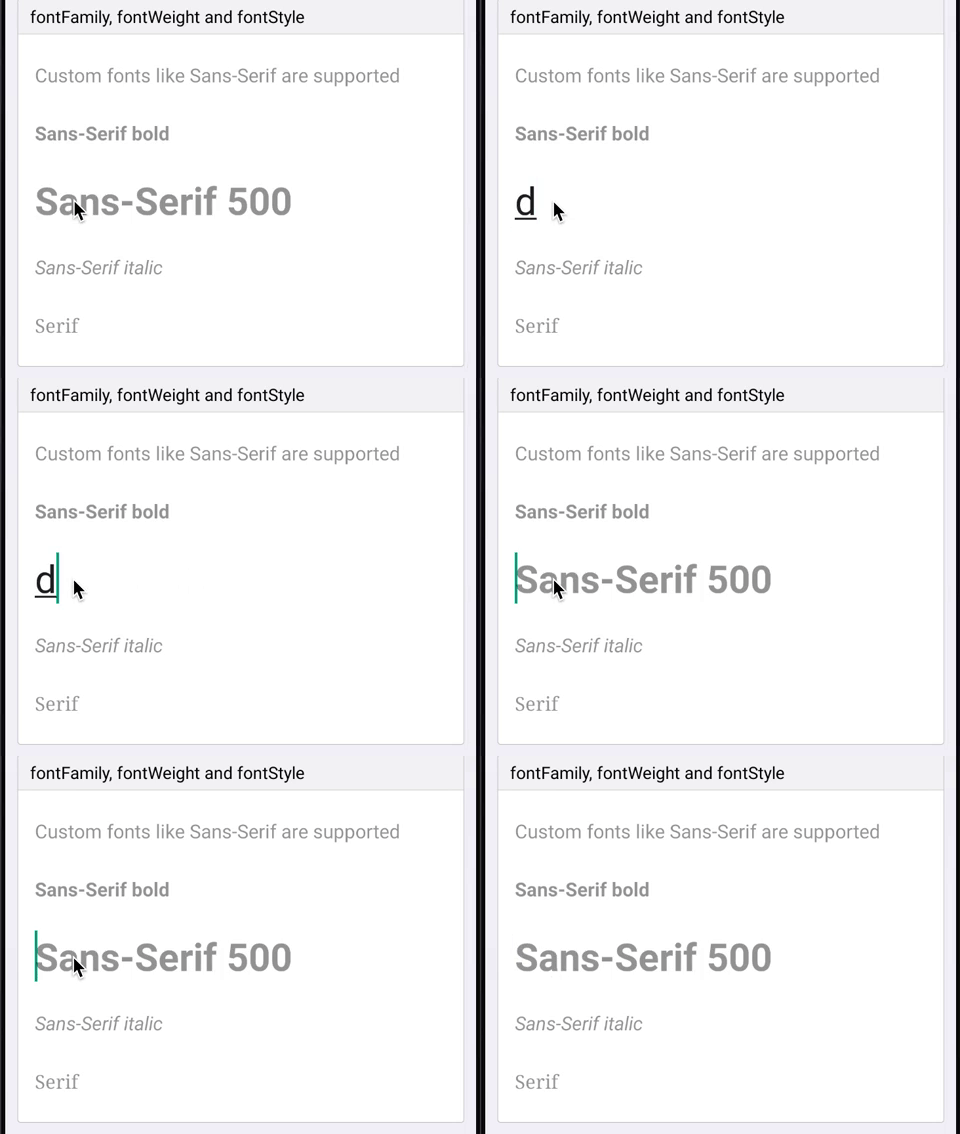
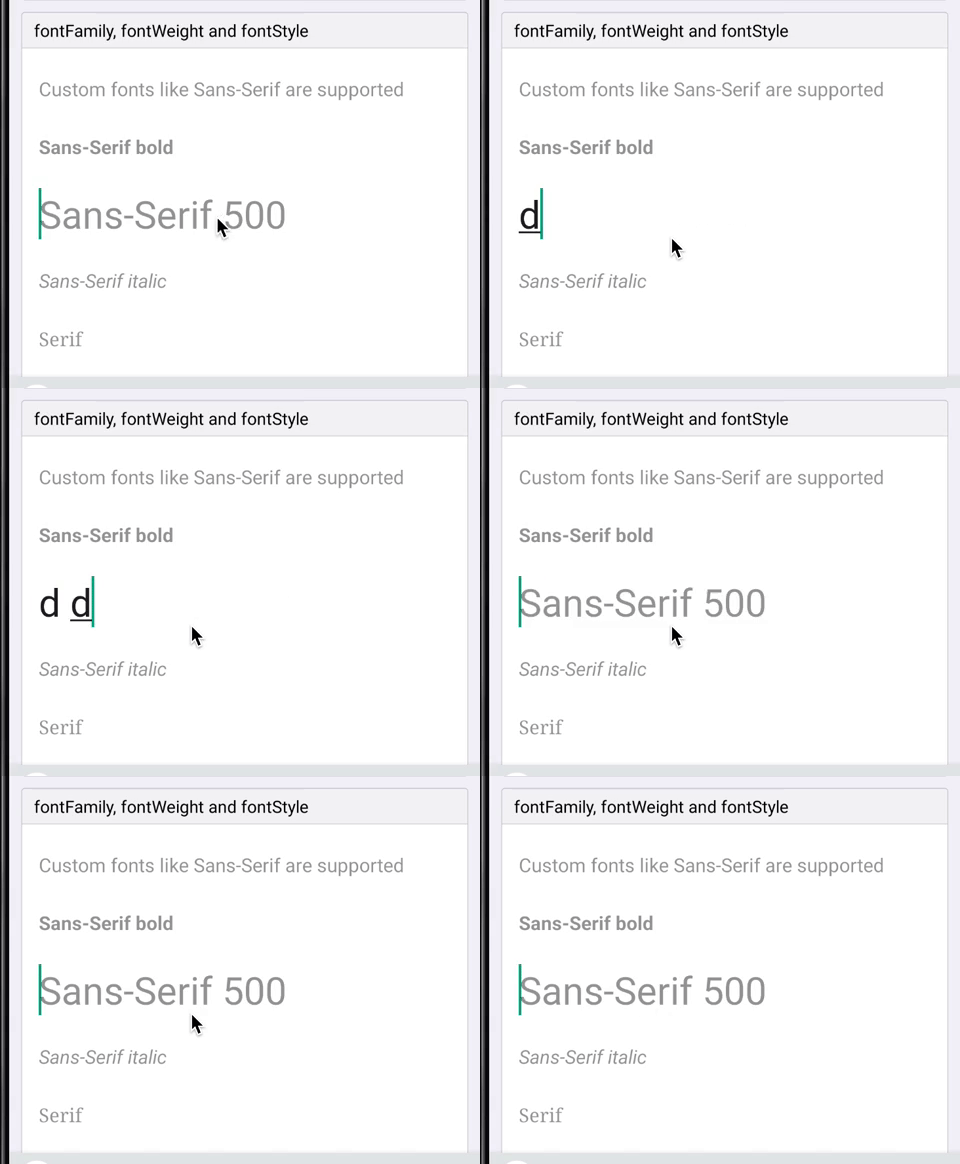
When using a medium (500) font weight on Android the wrong weight is used for the placeholder and for the first few seconds of input (before it gets text back from JS). To fix it I refactored the way we handle text styles (family, weight, style) to create a typeface to be more like the `Text` component.
Since all these 3 props are linked and used to create the typeface object it makes more sense to do it at the end of setting props instead of in each prop handler and trying to recreate the object without losing styles set by other prop handlers. Do do that we now store fontFamily, fontStyle and fontWeight as ivar of the ReactEditText class. At the end of updating prop if any of those changed we recreate the typeface object.
This doesn't actually fix the bug but was a first step towards it. There were a bunch of TODOs in the code to remove duplication between `Text` and `TextInput` for parsing and creating the typeface object. To do that I simply moved the code to util functions in a static class. Once the duplication was removed the bug was fixed! I assume proper support for medium font weights was added for `Text` but not in the duplicated code for `TextInput`.
## Changelog
[Android] [Fixed] - Fix medium font weights for TextInput on Android
Pull Request resolved: https://github.com/facebook/react-native/pull/26434
Test Plan:
Tested in my app and in RNTester that custom styles for both text and textinput all seem to work.
Repro in RNTester:
```js
function Bug() {
const [value, setValue] = React.useState('');
return (
<TextInput
style={[
styles.singleLine,
{fontFamily: 'sans-serif', fontWeight: '500', fontSize: 32},
]}
placeholder="Sans-Serif 500"
value={value}
onChangeText={setValue}
/>
);
}
```
Before:
After:
Reviewed By: mmmulani
Differential Revision: D17468825
Pulled By: JoshuaGross
fbshipit-source-id: bc2219facb94668551a06a68b0ee4690e5474d40
Summary: This diff migrates `ReactSwtichManager` to use the generated `ReactSwtichManagerDelegate` for setting its properties.

Reviewed By: TheSavior

Differential Revision: D17395067

fbshipit-source-id: 1489c5d08cef860030ecbd23ef19bd8de1328d71
Summary: This diff migrates `ReactDrawerLayoutManager` to use the generated `AndroidDrawerLayoutManagerDelegate` for setting its properties.

Reviewed By: mdvacca

Differential Revision: D17343383

fbshipit-source-id: 85cd7ee3531b152da2601048f5e458f5dad73ad6
Summary: This diff migrates `ReactProgressBarViewManager` to use the generated `AndroidProgressBarManagerDelegate` for setting its properties.

Reviewed By: JoshuaGross, mdvacca

Differential Revision: D17315619

fbshipit-source-id: 6293c6fc18567a934b6f3dce9b77abcc408052d8
Summary: This diff migrates `SwipeRefreshLayoutManager` to use the generated `AndroidSwipeRefreshLayoutManagerDelegate`.

Reviewed By: JoshuaGross, mdvacca

Differential Revision: D17225894

fbshipit-source-id: e659d2a9cb5dba42c589559f61a0e98330e21612
Summary: This diff migrates `ReactModalHostManager` to use the generated `ModalHostViewManagerDelegate` for setting its properties.

Reviewed By: mdvacca

Differential Revision: D17205817

fbshipit-source-id: 6724302fd4301f9df92df04fcfb41f0c2c939d9f
Summary: This diff migrates `ReactSliderManager` to use the generated `SliderManagerDelegate` for setting its properties.

Reviewed By: mdvacca

Differential Revision: D17203078

fbshipit-source-id: 726736ef275074ecb799b334342ac64976153e2b
Summary: Fix for crash introduced by D17282188; doesn't cleanly revert, so just reverting this part

Reviewed By: JoshuaGross, RSNara

Differential Revision: D17505827

fbshipit-source-id: 3232285c0f15dabeb819f8806ad35d4ec83a1e53
Summary:
Self explanatory.
1. **Existing:** We create the NativeModules thread in CatalystInstanceImpl.cpp.
2. D17422165: We wrap this thread in a `BridgeNativeCallInvoker`.
3. D17422164: We use `CatalystInstanceImpl::getNativeCallInvokerHolder()` to get a hold of the `BridgeNitiveCallInvoker` in Java.
4. D17422163: From Java, we pass this `CallInvokerHolder` to `TurboModuleManager`'s constructor.
5. **This diff:** `TurboModuleManager` then unwraps the `CallInvoker` from `CallInvokerHolder`, and passes it to all TurboModules in their constructor.

Reviewed By: PeteTheHeat

Differential Revision: D17422160

fbshipit-source-id: c0a76dfe5fdedac2e0e21f7a562bc7588dc190fb
Summary:
In the previous diffs, I:
1. D17422165: Created a `CallInvoker` for the NativeModules thread.
2. D17422164: Exposed this `CallInvoker` via `CatalystInstance.getNativeCallInvokerHolder()`.

In this diff, I:
1. Make TurboModuleManager accept the NativeModules thread `CallInvoker` as a constructor argument.

Reviewed By: PeteTheHeat

Differential Revision: D17422163

fbshipit-source-id: cbaac2fc06f7f726d89e0c545154123ad7410e62
Summary: CatalystInstanceImpl is responsible for creating the NativeModules thread. We therefore expose a method `getNativeCallInvokerHolder()` on this hybrid class to create and give us access to the `CallInvokerHolder` for the NativeModules thread.

Reviewed By: PeteTheHeat

Differential Revision: D17422164

fbshipit-source-id: 316423847518124115643549fa73a8533d493cd0
Summary:
## Motivation
The concept behind JSCallInvoker doesn't necessarily have to apply only to the JS thread. On Android, we need to re-use this abstraction to allow execution of async method calls on the NativeModules thread.

Reviewed By: PeteTheHeat

Differential Revision: D17377313

fbshipit-source-id: 3d9075cbfce0b908d800a366947cfd16a3013d1c
Summary:
This PR removes Java reflection use in ReactDrawerLayoutManager.java because we all use AndroidX and setDrawerElevation is available. Also adds NonNull annotations

## Changelog

[Android] [Changed] - cleanup DrawerLayoutAndroid
Pull Request resolved: https://github.com/facebook/react-native/pull/26497

Test Plan: RNTester is working as expected.

Differential Revision: D17488727

Pulled By: mdvacca

fbshipit-source-id: fd626e3e7aca3965f62c4c82a55c69e81facc61d
Summary:
This diff splits up the current `createTimer` method (which is used for setTimeout, setInterval, etc.) into two methods, `createTimer` and `createAndMaybeCallTimer`. The latter is what's used by the existing Timing native module, and it preserves the existing behavior of this function.

What's the difference? The current implementation of createTimer makes some assumptions about how it's called - namely, that it's called from JS asynchronously (using the bridge). Right now when you create a timer from JS, the JSTimers module passes in the timestamp for when the timer was created; in the native `createTimer`, we compare this timestamp to the current time, and if we find the timer has already expired, we immediately invoke the callback.

Presumably this is done because we don't know how much time has elapsed since when the timer was scheduled in JS, and we want to make sure that it's called as soon as possible. Of course, this also means that `setTimeout(0)` will be immediately invoked, too, without waiting for the next frame.

This all sounds fine, until we take a look at immediates. Immediates are currently implemented entirely in JS, and are called by the JS bridge; before returning control to native, we flush the immediates queue.

This means that the current behavior is: 1) `setImmediate()` is always invoked before `setTimeout(0)`; 2) `setTimeout(0)` is invoked as soon as possible, before the next frame.

However, this changes with bridgeless RN. With bridgeless RN, the native module methods are being replaced by C++ host functions, which are called synchronously. So if we keep the current logic in JavaTimerManager (where it checks if the timer has already expired), then `setTimeout(0)` will be invoked **before** immediates are called.

So the change that I'm making for bridgeless RN is to always wait until the next frame before calling timers. This preserves the order of immediates/timers, although it does mean that `setTimeout(0)` will no longer be called as soon as possible. Of the two options, this seems preferable.

Reviewed By: PeteTheHeat

Differential Revision: D17403144

fbshipit-source-id: 8230f6ebe56aa20bfcf2325177c7812bc8e9c2ec
Summary:
This change restores the possibility of injecting custom root views via ReactAcitivtyDelegate. It has been used by react-native-gesture-handler library in order to replace default root view with a one that'd route touch events to gesture-handler internal pipeline.

The regression happened in d0792d4b8a where new `ReactDelegate` was introduced to provide support for rendering react native views in both Android fragments and activities. As a part of that change the logic responsible for creating root view has been moved from `ReactActivityDelegate` to `ReactDelegate` rendering `ReactActivityDelegate.createRootView` unused – that is there is no code path that leads to this method being called. Instead `ReactDelegate.createRootView` method has been added which now plays the same role. The custom root view injection was relying on overwriting that method and hence the method is no longer referenced overwriting it has no effect. Following the logic migration out of `ReactActivityDelegate` into `ReactDelegate` we could potentially now start overwriting methods of `ReactDelegate`. However when working with Android's activities in React Native we can only provide an instance of `ReactActivityDelegate` and in my opinion it does not make too much sense to expose also a way to provide own instance of `ReactDelegate`.

The proposed fix was to route `ReactDelegate.createRootView` to call `ReactActivityDelegate.createRootView` and this way regaining control over root view creation to `ReactActivityDelgate`. The change of the behavior has been implemented by subclassing `ReactDelegate` directly from `ReactActivityDelegate` and hooking the aforementioned methods together. Thanks to this approach, the change has no effect on `ReactDelegate` being used directly from fragments or in other scenarios where it is not being instantiated from `ReactActivityDelegate`.

This fixes an issue reported in https://github.com/kmagiera/react-native-gesture-handler/issues/745 and discussed on 0.61 release thread: https://github.com/react-native-community/releases/issues/140#issuecomment-532235945

## Changelog

[Internal] [Fixed] - Allow for custom root view to be injected via ReactActivityDelegate
Pull Request resolved: https://github.com/facebook/react-native/pull/26495

Test Plan:
1. Run RNTester, take layout snapshot, see the react root view being on the top of view hierarchy.
2. Run gesture-handler Example app (or some other app that overwrites ReactActivityDelegate.createRootView method), on layout snapshot see custom root view being used.

Differential Revision: D17482966

Pulled By: mdvacca

fbshipit-source-id: 866f551b8b077bafe1eb9e34e5dccb1240fa935e
 Pavol Fulop
 Joshua Gross
 Oleksandr Melnykov
 David Biedenbach
 Emily Janzer
 Alexander Kawrykow
 Elisa Lou
 Rick Hanlon
 masaaki1915
 Marc Mulcahy
 Vojtech Novak
 Petter Hesselberg
 Ramanpreet Nara
 Rajdeep Kaur
 Andrea Cimitan
 Janic Duplessis
 Dulmandakh
 Krzysztof Magiera



