Summary:
Pull Request resolved: https://github.com/facebook/react-native/pull/33160

Enables Kotlin build in RNAndroid, while adjusting the package structure to help with path/package inconsistency.

Moves `react/uimanager/interfaces` files into `react/uimanager` to make sure package name matches with file location and updates Buck configuration to still include it as a separate target.

Changelog: [Android][Changed] - Moved `com/react/facebook/uimanager/interfaces` files into `com/react/facebook/uimanager` to enable Kotlin build

Reviewed By: cortinico

Differential Revision: D34381179

fbshipit-source-id: 252588d9c7f62b8019bdfcce66197628d63e63a1
Summary:
Some of the existing files under uimanager/ are self contained and used by the component codegen output. This commit split out those files into a dedicated uimanager/interfaces/ dir/target so that more targets can depend on it without causing dep cycle.

Also, the component codegen output doesn't need LayoutShadowNode at all, so this removed the import.

This will allow us to combine the Java codegen output for TM spec and Fabric components, simplifying build and dependency management (not in this commit yet).

Changelog: [Internal]

Reviewed By: JoshuaGross

Differential Revision: D25451409

fbshipit-source-id: 827545a3d78ebed1815cf9e52da2fa896b012aa1
Summary:
This PR adds support for the `shadowColor` style on Android.
This is possible as of Android P using the `setOutlineAmbientShadowColor` and `setOutlineSpotShadowColor` View methods. The actual rendered color is a multiplication of the color-alpha, shadow-effect and elevation-value.
## Changelog
`[Android] [Added] - Add support for shadowColor on API level >= 28`
Pull Request resolved: https://github.com/facebook/react-native/pull/28650
Test Plan:
- Only execute code on Android P
- Added Android `BoxShadow` tests to RNTester app
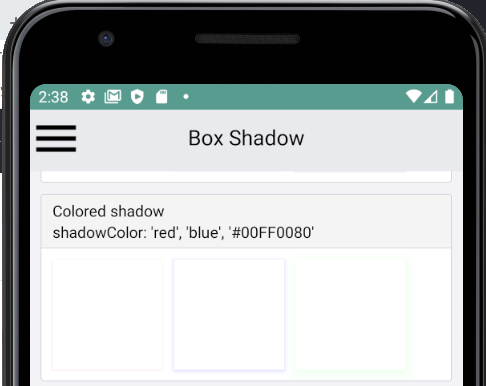
Reviewed By: mdvacca
Differential Revision: D21125479
Pulled By: shergin
fbshipit-source-id: 14dcc023977d7a9d304fabcd3c90bcf34482f137
Summary:
This Pull Request implements the PlatformColor proposal discussed at https://github.com/react-native-community/discussions-and-proposals/issues/126.   The changes include implementations for iOS and Android as well as a PlatformColorExample page in RNTester.

Every native platform has the concept of system defined colors. Instead of specifying a concrete color value the app developer can choose a system color that varies in appearance depending on a system theme settings such Light or Dark mode, accessibility settings such as a High Contrast mode, and even its context within the app such as the traits of a containing view or window.

The proposal is to add true platform color support to react-native by extending the Flow type `ColorValue` with platform specific color type information for each platform and to provide a convenience function, `PlatformColor()`, for instantiating platform specific ColorValue objects.

`PlatformColor(name [, name ...])` where `name` is a system color name on a given platform.  If `name` does not resolve to a color for any reason, the next `name` in the argument list will be resolved and so on.   If none of the names resolve, a RedBox error occurs.  This allows a latest platform color to be used, but if running on an older platform it will fallback to a previous version.
 The function returns a `ColorValue`.

On iOS the values of `name` is one of the iOS [UI Element](https://developer.apple.com/documentation/uikit/uicolor/ui_element_colors) or [Standard Color](https://developer.apple.com/documentation/uikit/uicolor/standard_colors) names such as `labelColor` or `systemFillColor`.

On Android the `name` values are the same [app resource](https://developer.android.com/guide/topics/resources/providing-resources) path strings that can be expressed in XML:
XML Resource:
`@ [<package_name>:]<resource_type>/<resource_name>`
Style reference from current theme:
`?[<package_name>:][<resource_type>/]<resource_name>`
For example:
- `?android:colorError`
- `?android:attr/colorError`
- `?attr/colorPrimary`
- `?colorPrimaryDark`
- `android:color/holo_purple`
- `color/catalyst_redbox_background`

On iOS another type of system dynamic color can be created using the `IOSDynamicColor({dark: <color>, light:<color>})` method.   The arguments are a tuple containing custom colors for light and dark themes. Such dynamic colors are useful for branding colors or other app specific colors that still respond automatically to system setting changes.

Example: `<View style={{ backgroundColor: IOSDynamicColor({light: 'black', dark: 'white'}) }}/>`

Other platforms could create platform specific functions similar to `IOSDynamicColor` per the needs of those platforms.   For example, macOS has a similar dynamic color type that could be implemented via a `MacDynamicColor`.   On Windows custom brushes that tint or otherwise modify a system brush could be created using a platform specific method.

## Changelog

[General] [Added] - Added PlatformColor implementations for iOS and Android
Pull Request resolved: https://github.com/facebook/react-native/pull/27908

Test Plan:
The changes have been tested using the RNTester test app for iOS and Android.   On iOS a set of XCTestCase's were added to the Unit Tests.

<img width="924" alt="PlatformColor-ios-android" src="https://user-images.githubusercontent.com/30053638/73472497-ff183a80-433f-11ea-90d8-2b04338bbe79.png">

In addition `PlatformColor` support has been added to other out-of-tree platforms such as macOS and Windows has been implemented using these changes:

react-native for macOS branch: https://github.com/microsoft/react-native/compare/master...tom-un:tomun/platformcolors

react-native for Windows branch: https://github.com/microsoft/react-native-windows/compare/master...tom-un:tomun/platformcolors

iOS
|Light|Dark|
|{F229354502}|{F229354515}|

Android
|Light|Dark|
|{F230114392}|{F230114490}|

{F230122700}

Reviewed By: hramos

Differential Revision: D19837753

Pulled By: TheSavior

fbshipit-source-id: 82ca70d40802f3b24591bfd4b94b61f3c38ba829
Summary:
Our JS codegen assumes that all Android view managers extend `BaseViewManager` which allows generated delegates to set base view props using `BaseViewManagerDelegate`, see and example of the generated delegate for `FbReactTTRCStepRenderFlagManager`:
```
public class TTRCStepRenderFlagManagerDelegate<T extends View, U extends BaseViewManager<T, ? extends LayoutShadowNode> & TTRCStepRenderFlagManagerInterface<T>>{
  public TTRCStepRenderFlagManagerDelegate(U viewManager) {
    super(viewManager);
  }
  Override
  public void setProperty(T view, String propName, Nullable Object value) {
    switch (propName) {
      case "traceId":
        mViewManager.setTraceId(view, value == null ? null : (String) value);
        break;
      case "stepName":
        mViewManager.setStepName(view, value == null ? null : (String) value);
        break;
      default:
        super.setProperty(view, propName, value);
    }
  }
}
```
The problem is that `FbReactTTRCStepRenderFlagManager` doesn't extend `BaseViewManager`, but `ViewManager`, which means that we cannot use it with the generated delegate. We cannot use  `ViewManager` instead of `BaseViewManager` in our JS codegen either, otherwise we will not be able to set base view props.

This diff makes it possible for delegates generated by JS to be used by Android view managers that do not extend `BaseViewManager`. By having a `BaseViewManagerInterface` we will be able to introduce a no-op base view manager implementation and wrap our original view manager in it so that we can pass as a constructor parameter to `BaseViewManagerDelegate`.

See an example of this approach for `FbReactTTRCStepRenderFlagManager`:

```
public class FbReactTTRCStepRenderFlagManager extends ViewManager<FbReactTTRCStepRenderFlag, ReactShadowNodeImpl> implements TTRCStepRenderFlagManagerInterface<FbReactTTRCStepRenderFlag> {

    private final ViewManagerDelegate<FbReactTTRCStepRenderFlag> mDelegate;

    public FbReactTTRCStepRenderFlagManager() {
        mDelegate = new TTRCStepRenderFlagManagerDelegate<>(new ViewManagerWrapper(this));
    }
    ...

    private static class ViewManagerWrapper extends BaseViewManagerAdapter<FbReactTTRCStepRenderFlag> implements TTRCStepRenderFlagManagerInterface<FbReactTTRCStepRenderFlag> {

        private final TTRCStepRenderFlagManagerInterface<FbReactTTRCStepRenderFlag> mViewManager;

        private FbReactTTRCStepRenderFlagManagerAdapter(TTRCStepRenderFlagManagerInterface<FbReactTTRCStepRenderFlag> viewManager) {
          mViewManager = viewManager;
        }

        Override
        public void setTraceId(FbReactTTRCStepRenderFlag view, Nullable String traceId) {
          mViewManager.setTraceId(view, traceId);
        }

        Override
        public void setStepName(FbReactTTRCStepRenderFlag view, Nullable String stepName) {
          mViewManager.setStepName(view, stepName);
        }
    }
}
```

Reviewed By: mdvacca

Differential Revision: D16984121

fbshipit-source-id: ea2761dda68a96ff3ba6ac64153bc4e56e396774
Summary:
We added the accessibilityState property as a more semantically rich way for components to describe information about their state to accessibility services. This PR removes the old accessibilityStates property.

 <!-- Explain the **motivation** for making this change. What existing problem does the pull request solve? -->

## Changelog

[General] [Change] - Remove accessibilityStates property.
Pull Request resolved: https://github.com/facebook/react-native/pull/26168

Test Plan: Ensure that RNTester accessibility examples function properly on both iOS and Android.

Differential Revision: D17152891

Pulled By: cpojer

fbshipit-source-id: d71d3cf0f2e0846979d2ba104b6c69e4e5725252
Summary:
This diff introduces an interface `ViewManagerDelegate` and its base implementation `BaseViewManagerDelegate`, which is used as a parent class for all view manager delegates generated by the JS codegen. Before the changes in this diff, generated delegates didn't support setting the base view properties such as background color, rotation, opacity, etc. Now it's possible to do by using `BaseViewManagerDelegate.setProperty(...)`, and since all generated delegates extend BaseViewManagerDelegate, they can just call `super.setProperty(...)` for properties they don't want to handle.

This diff also introduced a new method `ViewManager.getDelegate()`. This will allow view managers to return an instance of the delegate generated by JS and ensure that the view properties are set in a type-safe manner. If this method returns null (it does by default), we fall back to the default implementation of setting view properties using Java-generated `$$PropsSetter`
classes.

This is an example of an interface class generated by JS:

```
public interface RCTAxialGradientViewViewManagerInterface<T extends View> {
  void setColors(T view, Nullable ReadableArray value);
  void setLocations(T view, Nullable ReadableArray value);
  void setEndX(T view, Float value);
  void setEndY(T view, Float value);
  void setStartX(T view, Float value);
  void setStartY(T view, Float value);
}
```

This is an example of a delegate class generated by JS:

```
public class RCTAxialGradientViewManagerDelegate<T extends View, U extends BaseViewManager<T, ? extends LayoutShadowNode> & RCTAxialGradientViewManagerInterface<T>> extends BaseViewManagerDelegate<T, U> {
  public RCTAxialGradientViewManagerDelegate(U viewManager) {
    super(viewManager);
  }
  Override
  public void setProperty(T view, String propName, Nullable Object value) {
    switch (propName) {
      case "colors":
        mViewManager.setColors(view, (ReadableArray) value);
        break;
      case "locations":
        mViewManager.setLocations(view, (ReadableArray) value);
        break;
      case "endX":
        mViewManager.setEndX(view, value == null ? Float.NaN : ((Double) value).floatValue());
        break;
      case "endY":
        mViewManager.setEndY(view, value == null ? Float.NaN : ((Double) value).floatValue());
        break;
      case "startX":
        mViewManager.setStartX(view, value == null ? Float.NaN : ((Double) value).floatValue());
        break;
      case "startY":
        mViewManager.setStartY(view, value == null ? Float.NaN : ((Double) value).floatValue());
        break;
      default:
        super.setProperty(view, propName, value);
    }
  }
}
```

NOTE: What if a view manager, for instance ReactAxialGradientManager, wanted to add support for the borderRadius prop? In the old Java codegen, it would just need to create a method and annotate it with ReactProp (name = ViewProps.BORDER_RADIUS) and $$PropsSetter would call this method when a property with this name must be set. With the new JS codegen, borderRadius is a part of the basic view props, so setBorderRadius is not generated as a part of the ViewManagerInterface, so it’s not possible to set this value. I see two options: 1) add a method boolean setProperty (String propName, Object value) and let the view manager handle it in a non-type safe way (return true if it’s been handled). 2) Generate BaseViewManagerInterface which will include all basic view props and make BaseViewManager implement this interface, leaving all methods empty so that it stays compatible with the current implementation. Override these methods in a view manager that needs to handle a specific property in a custom way (so we would override setBorderRadius in ReactAxialGradientManager).

Reviewed By: mdvacca

Differential Revision: D16667686

fbshipit-source-id: 06a15a92f8af55640b7a53c5a34f40366d1be2a8
 Andrei Shikov
 Kevin Gozali
 Hein Rutjes
 Lulu Wu
 Tom Underhill
 Andres Suarez
 Oleksandr Melnykov
 Marc Mulcahy

