Summary:
when specifying dev server without port, e.g. http://www.example.com/, there are some issues.

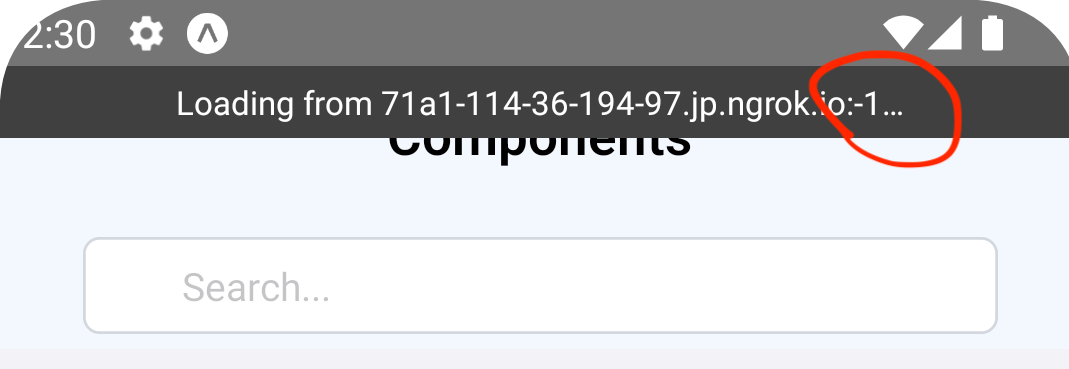
1. redbox error
<img src="https://user-images.githubusercontent.com/46429/190540390-8ee420f2-7642-427b-9f2e-e0c6d31015f8.png" width="30%">

2. showing -1 in loading view

<img src="https://user-images.githubusercontent.com/46429/190540727-158f35ad-359f-443a-a4b0-768dd2f7e400.png" width="50%">

the root cause is coming from [`java.net.URL.getPort()` will return -1 when the url doesn't have a port](https://developer.android.com/reference/java/net/URL#getPort()). this pr replaces the parser to [`okhttp3.HttpUrl`](https://square.github.io/okhttp/4.x/okhttp/okhttp3/-http-url/#port) that it will have default port 80 for http or port 443 for https. the two call paths should only serve http/https address, not file:// address. it should be safe to change from java.net.URL to okhttp3.HttpUrl.

not fully related, in the case above, android will connect to `ws://www.example.com/:8097` for react-devtools
we should strip the trailing slash in *setUpReactDevTools.js*

## Changelog

[Android] [Fixed] - Fix port as -1 if dev server without specifying port on Android

Pull Request resolved: https://github.com/facebook/react-native/pull/34705

Test Plan:
test on rn-tester with the following steps

1. `yarn start`
2. open another terminal and run `ngrok http 8081` and it will return a tunnel url, e.g. `71a1-114-36-194-97.jp.ngrok.io`
3. open dev setting in app and change the dev server to `71a1-114-36-194-97.jp.ngrok.io`
5. reload the app

Reviewed By: cipolleschi

Differential Revision: D39573988

Pulled By: cortinico

fbshipit-source-id: 397df90ab30533207bd87a3f069132d97c22c7fd
Summary:
## Impact
Fix the Static ViewConfig for <View/>.

This diff fixes the base ViewConfig for all HostComponents on both platforms. Consequently, it simplifies SVC reconciliation efforts, by nearly eliminating the first of these classes of SVC errors:
1. Unexpected properties in SVC
2. Missing properties in SVC
3. Not matching properites in SVC

## What is the base ViewConfig on each iOS/Android?
**On iOS:**
- All props come from ViewManagers
- All HostComponent ViewManagers extend <View/> ViewManager

https://pxl.cl/1SxdF

Therefore, the base ViewConfig for all components should be <View/>'s static ViewConfig.

**On Android:**

The component model is a bit more complicated:

https://pxl.cl/1Vmp5

Takeaways:
- Props come from Shadow Nodes **and** ViewManagers
- Nearly all HostComponent ViewManagers extend BaseViewManager. But, that's not <View/>'s ViewManager.
- <View/>'s ViewManager is [ReactViewManager](https://fburl.com/code/0zalv8zk), which is a descendent of BaseViewManager, and declares its own ReactProps.

So, on Android, it's not safe for the base ViewConfig to be <View>'s ViewConfig:
1. No components actualy incorportate <View/>'s props
2. Some components don't even incorporate BaseViewManager's props.

So, what should the base ViewConfig be on Android?
- Nearly all components extend BaseViewManager. BaseViewManager must have a shadow node [that extends LayoutShadowNode](https://www.internalfb.com/code/fbsource/[47d68ebc06e64d97da9d069f1ab662b392f0df8a]/xplat/js/react-native-github/ReactAndroid/src/main/java/com/facebook/react/uimanager/BaseViewManager.java?lines=40). Therefore, we'll make the base ViewConfig on Android be generated by BaseViewManager + LayoutShadowNode.

## Changes
In this diff, I removed ReactNativeViewViewConfig, and introduced a new view config called PlatformBaseViewConfig. This ViewConfig partial will capture all the props available on all HostComponents on **both** platforms. This may not necessarily be the props made available on <View/>.

The only components that don't extend the base platform props are: RCTTextInlineImage. What we do with these components is TBD.

Changelog: [Internal]

Reviewed By: p-sun, yungsters

Differential Revision: D33135055

fbshipit-source-id: 7299f60ae45ed499ce47c0d0a6309a047bff90bb
Summary:
## iOS
On iOS:
- All props come from ViewManagers
- All HostComponent ViewManagers extend <View/> ViewManager

https://pxl.cl/1SxdF

Therefore, it's safe to have all HostComponent Static View Configs extend <View/> Static View Config.

## Android

On Android, the model is a bit more complicated:

https://pxl.cl/1Vmp5

Takeaways:
- Props come from Shadow Nodes **and** ViewManagers
- Nearly all HostComponent ViewManagers extend BaseViewManager. But, that's not <View/>'s ViewManager.
- <View/>'s ViewManager is [ReactViewManager](https://fburl.com/code/0zalv8zk), which is a descendent of BaseViewManager, and declares its own ReactProps.

So, it's not safe to have all Android HostComponent Static View Configs to extend <View/>'s Static View Config:
1. No components actualy incorportate <View/>'s props
2. Some components don't even incorporate BaseViewManager's props.

## Changes
In this diff, I removed ReactNativeViewViewConfig, and introduced a new view config called PlatformBaseViewConfig. This ViewConfig partial will capture all the props available on all HostComponents on **both** platforms. This may not necessarily be the props made available on <View/>.

The only components that don't extend the base platform props are: RCTTextInlineImage. What we do with these components is TBD.

Changelog: [Internal]

Reviewed By: yungsters

Differential Revision: D32187832

fbshipit-source-id: 9a057abb3f58801615891c21e42ad4cfa5c69f21
Summary:
When the React Native Cmd+D menu is opened, something re-runs module initialization code (including DevTools backend initialization) which recreates the `WebSocket` and kills any already-connected frontend.

It's not clear to me why this is done. (Intentional? Accident?) But it makes it difficult to connect the React Native Inspector and DevTools together without multiple reloads. This Diff prevents the Cmd+D menu from killing the `WebSocket` connection as a workaround. A better long-term fix would (probably) be to not eagerly re-run these modules.

## Changelog

[General] [Fixed] - Don't disconnect DevTools WebSocket connection on Cmd+D

Reviewed By: fkgozali, sammy-SC

Differential Revision: D27742376

fbshipit-source-id: 60ab3e4763da6b055c28c7aafc6d460e7f4a601d
Summary:
A few recent imports have explicitly added ".js" to the end of their path. This prevents Metro from resolving platform-specific JS files, e.g. "Foo.android.js" or "Foo.windows.js" instead of "Foo.js".

React Native Windows provides its own implementation of files in a few cases where stock React Native will share them between Android and iOS. We hope to reduce/eliminate these long term, but requiring explicit ".js" files currently breaks us in a couple of places where we have custom implementations.

This change is a quick regex replace of ES6 and CommonJS imports in 'Libraries/" to eliminate ".js".

## Changelog

[General] [Fixed] - Do not explicitly include ".js" in Library imports
Pull Request resolved: https://github.com/facebook/react-native/pull/28311

Test Plan: I haven't done any manual validation of this, but `flow-check` should catch any issues with this during CI.

Reviewed By: cpojer

Differential Revision: D20486466

Pulled By: TheSavior

fbshipit-source-id: 31e1ccc307967417d7d09c34c859f0b2b69eac84
Summary:
still some generated files in www that need to land before we can release 0.111 here.

drop-conflicts

Changelog: [Internal]

(Note: this ignores all push blocking failures!)

Reviewed By: dsainati1

Differential Revision: D18278838

fbshipit-source-id: b20c3fefb3aab7c5fb614b33d846c7548184f49a
Summary:
When testing out the NetworkOverlay, I noticed that we were creating a lot of WebSocket connections for localhost:8097. Rick found that this is because we're trying to connect to React devtools every 2 seconds: https://github.com/facebook/react/blob/master/packages/react-devtools-core/src/backend.js#L67 and it appears we create a new WebSocket every time.

Dan suggested that we use opening the dev menu as a trigger for attempting to connect to React devtools. This diff uses RCTNativeAppEventEmitter to emit an event from native when the dev menu/dialog is shown, and listening to that event in JS to attempt to connect to devtools.

I'm also making the change of passing in a websocket instead of just passing in the host + port; this way it will only attempt to connect once on each call to `connectToDevTools` (otherwise, we would attempt to reconnect every 2 seconds as soon as the dev menu is opened, and then the next time the menu is opened we'd so start that *again*, and so on - I could have it keep track of whether it's already connecting and avoid doing it again, but this is easier and should be sufficient, I think).

We should probably also update the suggested troubleshooting tips on the devtools page to reflect this change, so that people don't get confused.

Changelog: [General] [Fixed] Fix issue where we attempt to connect to React devtools every 2 seconds

Reviewed By: mmmulani

Differential Revision: D17919808

fbshipit-source-id: 4658d995c274574d22f2f54ea06d7f29ef2f54dc
 Kudo Chien
 Ramanpreet Nara
 Andres Suarez
 Gijs Weterings
 Brian Vaughn
 Nick Gerleman
 Jordan Brown
 Emily Janzer