Summary:
[General] [Fix] - Reorder operations of native view hierarchy

When we update the native view hierarchy in `manageChildren` we:
1. iterate through all views we plan to remove and remove them from the native hierarchy
2. iterate through all views we plan to add and add them to the native hierarchy
3. iterate through all views we plan to delete and delete them (remove them from memory)

This covers these cases:
a. A view is moved from one place to another -- handled by steps 1 & 2
b. A view is added -- handled by step 2
c. A view is deleted -- handled by step 1 & 3

> Note the difference between remove and delete

Everything above sounds fine! But...

The important bit:
**A view that is going to be deleted asynchronously (by a layout animation) is NOT removed in step 1. It is removed and deleted all in step 3.** See: https://fburl.com/ryxp626i

If the reader may recall we solved a similar problem in D14529038 where we introduced the `pendingIndicesToDelete` data structure to keep track of views that were marked for deletion but had not yet been deleted. An example of an order of operations that we would've solved with D14529038 is:

* we "delete" the view asynchronously (view A) in one operation
* we add a view B that shares a parent with view A in subsequent operation
* view A finally calls its callback after the animation is complete and removes itself from the native view hierarchy

A case that D14529038 would not fix:
1. we add a view B in one operation
2. we delete a view A in the same operation asynchronously because it's in a layout animation
3. ... etc.

What we must remember is that the index we use to add view B in step 1 is based on the indices assuming that all deletions are synchronous as this [comment notes](https://fburl.com/j9uillje): removals (both deletions and moveFroms) use the indices of the current order of the views and are assumed independent of each other. Whereas additions are indexed on the updated order (after deletions!)

This diff re-arranges the order in how we act upon the operations to update the native view hierarchy -- similar to how UIImplementation does its operations on the shadow tree here: https://fburl.com/j9uillje

By doing the removals and deletions first, we know that the addAt indices will be correct because either the view is removed from the native view hierarchy or `pendingIndicesToDelete` should be tracking an async delete already so the addAt index will be normalized

Reviewed By: mdvacca

Differential Revision: D15112664

fbshipit-source-id: 85d4b21211ac802183ca2f0fd28fc4437d312100
Summary:
This diff forces the eager initialization of some additional classes into FabricJSIModuleProvider.loadClasses().
This is a "hack" that will be removed in the near future

Reviewed By: JoshuaGross

Differential Revision: D15208977

fbshipit-source-id: 2e2c7856839b6c6888452800ef6da7f269e46735
Summary: When passing StateWrapper objects across the JNI, we were not ensuring that the Java objects would own the C++ state. This was initially done because I assumed that in Java, State would either be used immediately or discarded, so this wouldn't be unsafe. As it turns out, it makes sense in some cases to store the StateWrapper in Java and use it later, potentially even in other threads, so we need to make sure we maintain ownership of the C++ object from the Java object.

Reviewed By: shergin

Differential Revision: D15206194

fbshipit-source-id: a437d921ba00b194cf08bad80666bd99baf11d52
Summary: This diff implements encapsulating all time metrics in a single class for better extensibility and readability.

Reviewed By: JoshuaGross

Differential Revision: D15179835

fbshipit-source-id: 62bdf94435a0d37a87ad9bad613cc8e38043a235
Summary:
`CatalystInstanceImpl.cpp` now depends on `JSCallInvoker` and `JavaJSCallInvokerHolder`. Therefore, we need to correctly adjust the OSS builds to include these dependencies into the `libreactnativejni.so` file.

I made `ReactCommon/turbomodule/jscallinvoker` a static library `libjscallinvoker.a`. I then made `ReactAndroid/src/main/jni/react/jni`'s `libreactnativejni.so` depend on that static library. Also, because the Android NDK build system doesn't support header namespaces, I had to use the filesystem to simulate them. This is why all the `.cpp` and `.h` files for `JSCallInvoker` were moved to a `jsireact` folder.

Reviewed By: mdvacca

Differential Revision: D15194821

fbshipit-source-id: 0cee682e41db53d0619f56ad017d5882f6d554aa
Summary:
`TurboModuleManagerDelegate` is an abstract base class with the following API:

```
  public TurboModule getModule(String name, ReactApplicationContext reactApplicationContext);
  public CxxModuleWrapper getLegacyCxxModule(String name, ReactApplicationContext reactApplicationContext);
```

```
  std::shared_ptr<TurboModule> getTurboModule(std::string name, jni::global_ref<JTurboModule> turboModule, std::shared_ptr<JSCallInvoker> jsInvoker) override;
  std::shared_ptr<TurboModule> getTurboModule(std::string name, std::shared_ptr<JSCallInvoker> jsInvoker) override;
```

On the C++ side, when asked to provide a TurboModule with name `name`:

1. First, is this a CxxModule? If so:
    1. Create the CxxModule and return
2. Otherwise:
    1. Somehow get a Java instance of the TurboModule
    2. If this Java object represents a CxxModule, like `FbReactLibSodiumModule`:
        1. Grab the C++ part of this object, and wrap it in a `TurboCxxModule.cpp` and return.
    3. Otherwise:
        1. Wrap the Java object in a C++ HostObject and return.

This pseudocode demonstrates how we'd use `TurboModuleManagerDelegate` to implement `__turboModuleProxy`.
```
__turboModuleProxy(name, jsCallInvoker):
  let cxxModule = TurboModuleManagerDelegate::getTurboModule(name, jsCallInvoker)
  if (!cxxModule) {
    return cxxModule;
  }

  // JNI Call that forwards to TurboModuleManagerDelegate.getLegacyCxxModule
  let javaCxxModule : CxxModuleWrapper = TurboModuleManager.getLegacyCxxModule(name)

  if (!javaCxxModule) {
    return std::shared_ptr<react::TurboCxxModule>(javaCxxModule.getModule())
  }

  // JNI Call that forwards to TurboModuleManagerDelegate.getModule
  let javaModule : TurboModule = TurboModuleManager.getModule(name)

  if (!javaCxxModule) {
    return TurboModuleManagerDelegate::getTurboModule(name, javaModule, jsCallInvoker)
  }

  return null
```

Reviewed By: mdvacca

Differential Revision: D15111335

fbshipit-source-id: c7b0aeda0e4565e3a2729e7f9604775782b6f893
Summary:
JSCallInvoker requires a `std::weak_ptr<Instance>` to create. In our C++, `CatalystInstance` is responsible for creating this `Instance` object. This `CatalystInstance` C++ initialization is separate from the `TurboModuleManager` C++ initialization. Therefore, in this diff, I made `CatalystInstance` responsible for creating the `JSCallInvoker`. It then exposes the `JSCallInvoker` using a hybrid class called `JSCallInvokerHolder`, which contains a `std::shared_ptr<JSCallInvoker>` member variable. Using `CatalystInstance.getJSCallInvokerHolder()` in TurboModuleManager.java, we get a handle to this hybrid container. Then, we pass it this hybrid object to `TurboModuleManager::initHybrid`, which retrieves the `std::shared_ptr<JSCallInvoker>` from the `JavaJSCallInvokerHandler`.

There were a few cyclic dependencies, so I had to break down the buck targets:
- `CatalystInstanceImpl.java` depends on `JSCallInvokerHolderImpl.java`, and `TurboModuleManager.java` depends on classes that are packaged with `CatalystInstanceImpl.java`. So, I had to put `JSCallInvokerHolderImpl.java` in its own buck target.
- `CatalystInstance.cpp` depends on `JavaJSCallInvokerHolder.cpp`, and `TurboModuleManager.cpp` depends on classes that are build with `CatalystInstance.cpp`. So, I had to put `JavaJSCallInvokerHolder.cpp` in its own buck target. To make things simpler, I also moved `JSCallInvoker.{cpp,h}` files into the same buck target as `JavaJSCallInvokerHolder.{cpp,h}`.

I think these steps should be enough to create the TurboModuleManager without needing a bridge:
1. Make `JSCallInvoker` an abstract base class.
2. On Android, create another derived class of `JSCallInvoker` that doesn't depend on Instance.
3. Create `JavaJSCallInvokerHolder` using an instance of this new class somewhere in C++.
4. Pass this instance of `JavaJSCallInvokerHolder` to Java and use it to create/instatiate `TurboModuleManager`.

Regarding steps 1 and 2, we can also make JSCallInvoker accept a lambda.

Reviewed By: mdvacca

Differential Revision: D15055511

fbshipit-source-id: 0ad72a86599819ec35d421dbee7e140959a26ab6
Summary: Convert FabricUIManager.measure params to floats. Currently we convert parameters to ints across the JNI boundary, and then back to floats several times in Java. This is unnecessary and actually makes measurements trickier. The new implementation uses floats across the JNI boundary and uses Float.POSITIVE_INFINITY to represent unconstrained values, which is consistent with Fabric C++ as well.

Reviewed By: shergin, mdvacca

Differential Revision: D15176108

fbshipit-source-id: cf849b3773007637f059279460163872f300a4aa
Summary:
When acquiring the `PARTIAL_WAKE_LOCK`, Android requires a tag to identify the source, normally the class name. This tag will show on dumpsys call and Google Play developer console.

`getSimpleName` will work fine as long as not enable ProGuard, in my case, it transformed the class name to just `"c"`, and I take my half day to find where the `c` comes from.

`getCanonicalName` will add the package path, which is more friendly for developers.

Later we can even let the developer choose the tag name, but this will require API break changes.

[Android] [Changed] - Use class canonical name for PARTIAL_WAKE_LOCK tag
Pull Request resolved: https://github.com/facebook/react-native/pull/24673

Differential Revision: D15164306

Pulled By: cpojer

fbshipit-source-id: fd65f9e5250c180b0053940b17877fe36af5d48b
Summary: The map of sComponentNames ONLY contains the names of components that are different between JS and Android. This diff adds a method to unify the way we use this map.

Reviewed By: shergin

Differential Revision: D15076549

fbshipit-source-id: 9df750dca305e55cb44037bc63f3ebb6476c8b81
Summary: Trivial diff that adds extra logging information on Exceptions that are thrown by the FabricViewTest

Reviewed By: shergin

Differential Revision: D14817899

fbshipit-source-id: 32e1d1fcd1292715dfcf2750d3f14c668927c8b8
Summary:
This diff fixes a bug that is reproducible when a view is reordered in a different level of hierarchy in the react tree.
Even if this is not supported by react, this can still happen because of viewFlattening.

Reviewed By: shergin

Differential Revision: D14817452

fbshipit-source-id: 13425b0e6a280affe681e80b4a6daa17ee56251a
Summary: This diff refactors the way we synchronize in ReactChoreographer using a lock object

Reviewed By: ejanzer

Differential Revision: D14913056

fbshipit-source-id: e86c4395d5d3c3fd5b7330b72c14920b536f74ce
Summary:
Hello Everyone, this series of commits helps to fix problems related to ART on Android. The main problem in here is that the ART components would disappear if the user turns off the screen and then turn it on again.  It's important to note that this behaviour only occurs after Android N (7.1 or higher).
Pull Request resolved: https://github.com/facebook/react-native/pull/22624

Differential Revision: D15122573

Pulled By: cpojer

fbshipit-source-id: e7fb8b9280b4c52562e3d0c1a89759d4d31cd53d
Summary:
On android when borderXColor is null it causes the app to crash with:
```
04-28 17:44:18.021 20114 20213 E unknown:ReactNative: com.facebook.react.bridge.NoSuchKeyException: borderBottomColor
04-28 17:44:18.021 20114 20213 E unknown:ReactNative: at com.facebook.react.bridge.ReadableNativeMap.getValue(ReadableNativeMap.java:111)
04-28 17:44:18.021 20114 20213 E unknown:ReactNative: at com.facebook.react.bridge.ReadableNativeMap.getValue(ReadableNativeMap.java:115)
04-28 17:44:18.021 20114 20213 E unknown:ReactNative: at com.facebook.react.bridge.ReadableNativeMap.getInt(ReadableNativeMap.java:158)
04-28 17:44:18.021 20114 20213 E unknown:ReactNative: at com.facebook.react.uimanager.ViewProps.isLayoutOnly(ViewProps.java:246)
04-28 17:44:18.021 20114 20213 E unknown:ReactNative: at com.facebook.react.uimanager.NativeViewHierarchyOptimizer.isLayoutOnlyAndCollapsable(NativeViewHierarchyOptimizer.java:482)
```
Basically it is missing a `isNull` check on the props map before trying to access the value.
Fixes#22727
[Android] [Fixed] - Fix a crash when borderXColor is null
Pull Request resolved: https://github.com/facebook/react-native/pull/24640
Differential Revision: D15120182
Pulled By: cpojer
fbshipit-source-id: bc41da572f04d8abf733b5a4e94a74a0f40acda1
Summary:
Now RN has only ReactActivity which extends AppCompatActivity, subclass of FragmentActivity, therefore no need to check if activity is FragmentActivity or not. This PR changes DialogModule to work only with FragmentActivity.

Also DialogFragment from Android is deprecated in API 28, and recommends to use DialogFragment from Support Library. Excerpt from DialogFragment documentation.

> **This class was deprecated in API level 28.**
> Use the Support Library DialogFragment for consistent behavior across all devices and access to Lifecycle.

**BREAKING CHANGE**: Brown field apps must extend FragmentActivity or its subclasses.

[Android] [Changed] - DialogModule supports only FragmentActivity
Pull Request resolved: https://github.com/facebook/react-native/pull/23365

Differential Revision: D14021986

Pulled By: cpojer

fbshipit-source-id: b0ede60ef19cec48111a12701659a8bc1f66c331
Summary:
Assistive technologies use the accessibility role of a component to tell the disabled user what the component is, and provide hints about how to use it. Many important roles do not have analog AccessibilityTraits on iOS. This PR adds many critical roles, such as editabletext, checkbox, menu, and switch to name a few.

Accessibility states are used to convey the current state of a component. This PR adds several critical states such as checked, unchecked, on and off.

[general] [change] - Adds critical accessibility roles and states.
Pull Request resolved: https://github.com/facebook/react-native/pull/24095

Differential Revision: D15079245

Pulled By: cpojer

fbshipit-source-id: 941b30eb8f5d565597e5ea3a04687d9809cbe372
Summary:
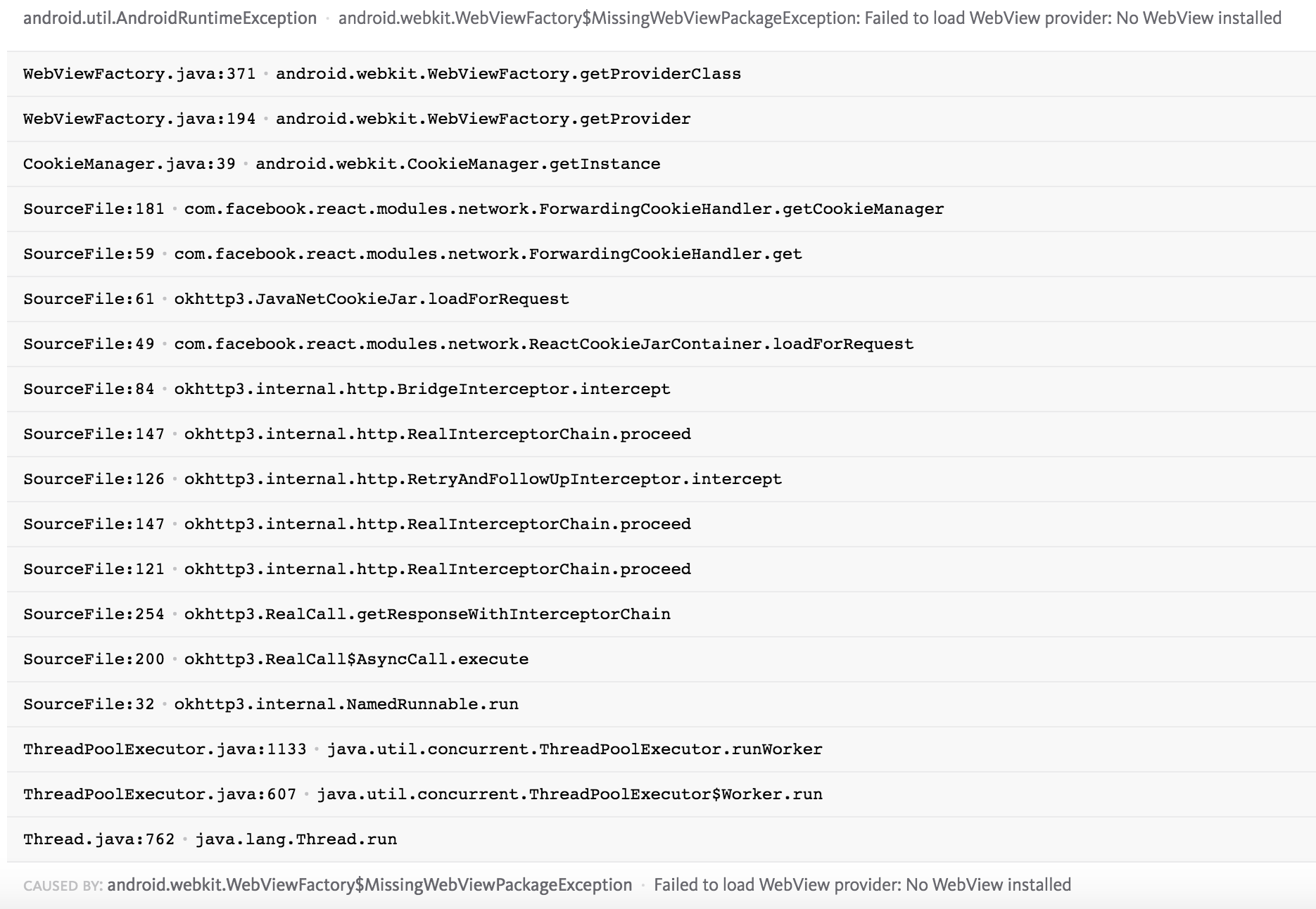
We are seeing crash reports that the webview is missing. In this case
it should fail gracefully so that a missing webview does not block
from using an app built with React Native.

The contains could also be changed to check for "webview" in general
to catch all webview related exception. It's currently checking on
for the specific string that I'm seeing in our app's crashreporting tool.

<img width="1507" alt="Screen Shot 2019-04-19 at 11 26 19 AM" src="https://user-images.githubusercontent.com/741767/56438307-5e1c2f80-6297-11e9-970b-a5095d18e9d7.png">

<img width="935" alt="Screen Shot 2019-04-19 at 11 32 58 AM" src="https://user-images.githubusercontent.com/741767/56438213-fa920200-6296-11e9-8008-5eb344eca8a8.png">

[Android] [Fixed] - The ReactCookieJarContainer/ForwardingCookieHandler now handles the missing WebView  gracefully.
Pull Request resolved: https://github.com/facebook/react-native/pull/24533

Differential Revision: D15062824

Pulled By: cpojer

fbshipit-source-id: 80805a47494f0d924b7ee029ce8ca0504eaeee57
Summary:
@public

In order to encapsulate property access on `YGStyle`, as a first measure we wrap all fields with accessors.

This will e.g. enable dynamic property storage and instrumentation in the future.

All accessors have a `const` version that allows direct access via `const&`. For mutation, bit fields are wrapped with a custom reference object.

This style allows for the least amount of changes in client code. Property access simply needs appended parens, eg `style.direction` becomes `style.direction`.

Reviewed By: shergin

Differential Revision: D14999096

fbshipit-source-id: fbf29f7ddab520513d4618f5e70094c4f6330b30
Summary:
React Native Environment Info:
    System:
      OS: Linux 4.15 Ubuntu 18.04.1 LTS (Bionic Beaver)
      CPU: (4) x64 Intel(R) Core(TM) i5-7300U CPU @ 2.60GHz
      Memory: 1.12 GB / 15.55 GB
      Shell: 4.4.19 - /bin/bash
    Binaries:
      Node: 8.10.0 - /usr/bin/node
      Yarn: 1.13.0 - /usr/local/bin/yarn
      npm: 3.5.2 - /usr/bin/npm
    SDKs:
      Android SDK:
        API Levels: 16, 19, 22, 23, 24, 25, 26, 27, 28
        Build Tools: 23.0.1, 23.0.3, 25.0.0, 25.0.2, 25.0.3, 26.0.1, 26.0.3, 27.0.3, 28.0.2, 28.0.3
        System Images: android-16 | Google APIs Intel x86 Atom, android-19 | Google APIs Intel x86 Atom, android-24 | Google Play Intel x86 Atom, android-27 | Google APIs Intel x86 Atom, android-28 | Intel x86 Atom_64, android-28 | Google APIs Intel x86 Atom, android-28 | Google Play Intel x86 Atom
    npmPackages:
      react: 16.8.6 => 16.8.6
      react-native: git+https://github.com/facebook/react-native.git#v0.59.5 => 0.59.5
    npmGlobalPackages:
      react-native-cli: 2.0.1
      react-native-git-upgrade: 0.2.7

The workaround implemented in https://github.com/facebook/react-native/pull/21117 tries to fix
https://issuetracker.google.com/issues/112385925 scroll direction (according to the latest comments, the scroll direction problem has been reverted in security patches so not sure if the workaround is still valid).

But... proposed solution in fling method is using signum which leads to zero computedVelocityY in case of zero mOnScrollDispatchHelper.getYFlingVelocity() on old devices(Samsung s4 mini) even when real velocityY is non zero

```
final int correctedVelocityY = (int)(Math.abs(velocityY) * Math.signum(mOnScrollDispatchHelper.getYFlingVelocity()));
```

Proposed solution is to take signum from original velocityY in case of zero
```
float signum = Math.signum(mOnScrollDispatchHelper.getYFlingVelocity());
if (signum == 0) {
  signum = Math.signum(velocityY);
}
final int correctedVelocityY = (int)(Math.abs(velocityY) * signum);
```

The symptoms are the same as described in issue https://github.com/facebook/react-native/issues/22925, but proposed workaround doesn't work.

[Android][fixed] - Fix smooth scrolling on old devices (SDK >=16)
Pull Request resolved: https://github.com/facebook/react-native/pull/24545

Differential Revision: D15044834

Pulled By: cpojer

fbshipit-source-id: 3f523eb1a438df774e22387aecded433b9031ab9
Summary:
`MountingTransaction` encapsulates all artifacts of `ShadowTree` commit, particularly list of mutations and meta-data.
We will rely on this heavily in the coming diffs.

Reviewed By: JoshuaGross

Differential Revision: D15021795

fbshipit-source-id: 811da7afd7b929a34a81aa66566193d46bbc34f8
Summary: It seems like ReactContext isn't actually needed in measure functions. Changing the signature of ViewManager.measure() to take a Context instead.

Reviewed By: lunaleaps

Differential Revision: D14940330

fbshipit-source-id: b29987fd1d7f9c191a5f26138151082ca61cb351
Summary:
React Native has a `NativeModule` to manipulate programmatically the dev menu options (live reload, hot reload, remote debugging, etc), called [`DevSettings`](https://github.com/facebook/react-native/blob/master/React/Modules/RCTDevSettings.mm#L120). However this module is only available for iOS.

This PR brings the same `DevSettings` for Android, making it a cross-platform NativeModule.

Motivation: Right now if your app needs to programmatically reload RN, one option is to install [`react-native-restart`](https://www.npmjs.com/package/react-native-restart). It's a tiny dependency, but it's annoying to have to install it, while the code to do so is inside RN codebase. According to NPM, react-native-restart has ~12k weekly downloads, shows it's a recurring feature for many apps (my case).

Thus making `NativeModules.DevSettings` is a small increment in the codebase, just exposing the dev menu methods, to improve the Development Experience

[Android] [Added] - Add DevSetting native module (making it cross-platform)

With expection of `setIsShakeToShowDevMenuEnabled`, the following methods will be available for both platforms:
* reload
* setHotLoadingEnabled
* setIsDebuggingRemotely
* setIsShakeToShowDevMenuEnabled
* setLiveReloadEnabled
* setProfilingEnabled
* toggleElementInspector
Pull Request resolved: https://github.com/facebook/react-native/pull/24441

Differential Revision: D14932751

Pulled By: cpojer

fbshipit-source-id: 465e6a89c3beb5fd1ea22e80ea02e9438f596a09
Summary:
In order to meet our accessibility requirements we need to have full support for keyboard navigation. The Touchable components works with press/tap with a finger, but doesn't respond to 'enter' when using a keyboard. Navigation works fine. This PR adds an onClick listener to touchable views that have the onPress prop defined.

[Android] [Added] - Add View.OnClickListener to Touchable components when onPress is defined
Pull Request resolved: https://github.com/facebook/react-native/pull/24359

Differential Revision: D14971230

Pulled By: cpojer

fbshipit-source-id: ca5559ca1308ee6c338532a00dcea4d00fa57f42
Summary: This is removing packages and libraries from the repo.  Any modified buck files simply change the redirect targets to something more appropriate (no logic actually changed)

Differential Revision: D14950721

fbshipit-source-id: 6c14f827b76ca1dbaf83dcb983930f362c6a27d4
Summary:
Would like feedback from the community as this may not be the best solution for all

I would like to restrict (or paginate) the fling of a horizontal ScrollView when `snapToInterval` is set. This is not currently possible with `pagingEnabled`, since the pagination works only when items are the entire width of the ScrollView.

This implementation simply restricts the predicted `targetOffset` found from the `x` velocity and replaces it with the offset when the pan gesture ended.

To get pagination working, I may paginate based on the interval by calculating the offset delta from the beginning of the gesture to current offset and restricting the scrolling behavior to the `snapToInterval`. If this is preferred, I can update this PR or make a new one, but wanted to start a discussion since it seems like there are many in the community that would like this feature  #21302 .

[General] [Added] - add prop `disableIntervalMomentum` to disable the predictive scrolling behavior of horizontal ScrollViews
Pull Request resolved: https://github.com/facebook/react-native/pull/24045

Differential Revision: D14939754

Pulled By: sahrens

fbshipit-source-id: 26be19c47dfb8eed4d7e6035df53a77451e23081
Summary:
For a small subset of Android devices, the following line of code caused the device to crash

```
output.transferFrom(input, 0, Long.MAX_VALUE);
```

According to the [Java docs](https://docs.oracle.com/javase/1.5.0/docs/api/java/nio/channels/FileChannel.html), this is what the function does.

> Transfers bytes into this channel's file from the given readable byte channel.
An attempt is made to read up to count bytes from the source channel and write them to this channel's file starting at the given position. An invocation of this method may or may not transfer all of the requested bytes; whether or not it does so depends upon the natures and states of the channels. Fewer than the requested number of bytes will be transferred if the source channel has fewer than count bytes remaining, or if the source channel is non-blocking and has fewer than count bytes immediately available in its input buffer.

Hence, using `Long.MAX_VALUE` seemed to be the standard way to transfer all bytes from one channel to the other.

However, it appeared that for some reason on a subset of old Android devices, the device tries to allocate `count` bytes of memory before transferring the bytes. Obviously, this caused a crash because no device has that much memory. This was fixed transferring bytes using a 1MB buffer.

Differential Revision: D14921778

fbshipit-source-id: 7fa46e10c656e23ae7d5679c72b278188f09ad0a
Summary:
Closes: https://github.com/facebook/react-native/issues/24016

React Native 0.57 introduced cross-platform `accessibilityRole` and `accessibilityStates` props in order to replace `accessibilityComponentType` (for android) and `accessibilityTraits` (for iOS). With #24095 `accessibilityRole` and `accessibilityStates` will increase, receiving more options, which seems to be a good moment to remove deprecated props.

Remove deprecated `accessibilityComponentType` and `accessibilityTraits` props.

[General] [Removed] - Remove accessibilityComponentType and accessibilityTraits props
Pull Request resolved: https://github.com/facebook/react-native/pull/24344

Reviewed By: rickhanlonii

Differential Revision: D14842214

Pulled By: cpojer

fbshipit-source-id: 279945e503d8a23bfee7a49d42f5db490c5f6069
Summary: Create views with props in one call instead of two. Backwards-compatible.

Reviewed By: shergin

Differential Revision: D14846424

fbshipit-source-id: cb53225579089f7e51d4e9d1fc9fc2e331a994c1
Summary: Similar to iOS, here we provide the basic impl of unimplemented view.

Reviewed By: mdvacca

Differential Revision: D14895706

fbshipit-source-id: 9053edfb2175b370d9070b6921794dbcafa1f37a
Summary:
Motivation is following - I'm sure many people encountered this because it has been like this for a long time.

1 . you're developing something on android, HMR and dev mode is enabled
2 . you go to dev settings, you disable dev mode because you want to see how something behaves
3 . you reload the app because that's what is required for the change to take effect
4 . you wait for the bundle to be compiled and served, and when that is done, you get an error message about HMR not being a registered callable module - because HMR is not available when `__DEV__ === false` (todo screenshot)

this fixes the described case by checking if HMR is enabled and dev mode disabled when reloading (step 3) and disables HMR in that case.

this also fixes the case when dev mode is disabled and without knowing it, you try to enable HRM (will enable both dev hmr and dev mode).

[Android] [Changed] - improve developer experience around Dev mode and HMR interop
Pull Request resolved: https://github.com/facebook/react-native/pull/24377

Differential Revision: D14890695

Pulled By: cpojer

fbshipit-source-id: 95b6ff4131c6d05a32aadd09a9d5ed11f602122c
Summary: Running animations sometimes fail in Android. we are ignoring those failures temporarly

Reviewed By: fkgozali

Differential Revision: D14884510

fbshipit-source-id: 66d6113e12b1bd67e8bcc564943b423825b4cea6
Summary: This diff adds extra debug information in the mounting manager

Reviewed By: shergin

Differential Revision: D14817456

fbshipit-source-id: 5619c94eb76cdc20f5d7767f1aa4263e63f8d021
Summary: This diff ensure that only views created by RN are taken into consideration for recycling.

Reviewed By: fkgozali

Differential Revision: D14874678

fbshipit-source-id: ea7dd5a0f29f6acf0dce8573fc77b012395476bd
Summary:
Android API 26 and Android Support Library 26 added support for font resource type and native/downloadable fonts. It allows apps to easily download fonts from online providers, but also use of various font weights other than normal and bold, like medium. So it deprecated APIs for asset fonts, and should be removed in the future.

Advantages:
- Just copy font files in res/font and use it specifying filename (without extension) in fontFamily
- Define custom font-family using XML file (in res/font) and font files, it may have many weights and styles. See PR for example.
- Define configuration to download fonts from online font providers, and use it.

See https://developer.android.com/guide/topics/ui/look-and-feel/fonts-in-xml and https://developer.android.com/guide/topics/ui/look-and-feel/downloadable-fonts

[Android] [Changed] - add support for custom/downloadable fonts
Pull Request resolved: https://github.com/facebook/react-native/pull/23865

Differential Revision: D14506542

Pulled By: hramos

fbshipit-source-id: 67ba3148fb4b548cdbc779213cf6c1b2c3baffd2
Summary:
This diff removes the copyToClipBoardMiddleware. This was exposing the /copy-to-clipboard endpoint that allowed unauthenticated access to writing to a developers clipboard.

This was only used in a single place, the Android red box dialog, so I've removed it from there.

Reviewed By: cpojer

Differential Revision: D14790813

fbshipit-source-id: 80e044eefd9658b8c5885643cdadf7947c00d34a
Summary: Remove dependency on ReactRootView in ReactInstanceManager by creating a rough interface (ReactRoot) so that either a Surface or ReactRootView can be attached to ReactInstanceManager.

Reviewed By: ejanzer, mdvacca

Differential Revision: D14158890

fbshipit-source-id: b7ab4654b1e0ef8343230a3c15023653a7f23a4b
Summary:
Fixes#22511
I understand the motivation of adding extraRadiusForOutline to corner radius: without it there can be an empty space between border and view's background color.
So I add simple check: if corner radius is more than zero we still add extraRadiusForOutline. And if not, we don't add it to prevent all the corners to become slightly curved.
[GENERAL] [Fixed] - fix of Android's bug that causes all the corners to become slightly curved if only specific corners' radius should be more than zero.
Pull Request resolved: https://github.com/facebook/react-native/pull/24390
Differential Revision: D14870476
Pulled By: cpojer
fbshipit-source-id: df40fc584a2f8badc499413cb3c4e4d96b9e18cf
Summary: This will simplify updating the JSI API from upstream in the future.

Reviewed By: mhorowitz

Differential Revision: D14762674

fbshipit-source-id: fa4a86f08425943e301da4ef3df9893ebaa1493e
 Luna Wei
 David Vacca
 Joshua Gross
 Valentin Shergin
 Ramanpreet Nara
 Tim Wang
 Michał Pierzchała
 Guilherme Iscaro
 Janic Duplessis
 Dulmandakh
 Kevin Gozali
 Marc Mulcahy
 Thorben Primke
 Christoph Nakazawa
 David Aurelio
 Pavel Rotek
 Emily Janzer
 Estevão Lucas
 Sam Mathias Weggersen
 Rick Ratmansky
 Taylor123
 Alston Lin
 Mike Diarmid
 Vojtech Novak
 Sebastian McKenzie
 Пётр Потапов
 Will Holen