Summary:
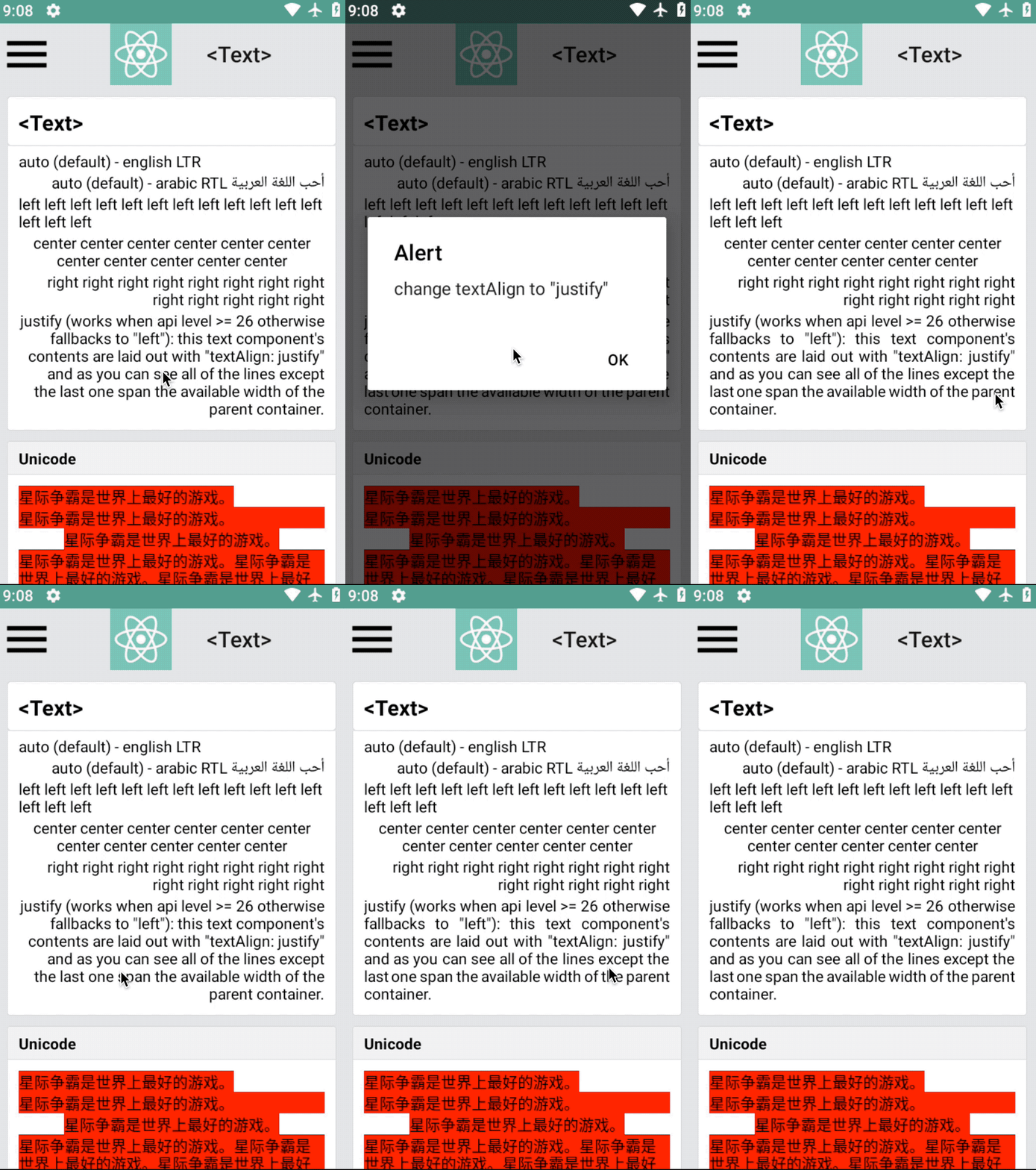
Text didn't support horizontal textAlign in Fabric for Android, this diff fixes that

Changelog: Add support for TextAlign prop in Fabric

Reviewed By: makovkastar

Differential Revision: D18068072

fbshipit-source-id: 3f8b1ba46989b55197fe9aa60ba2fb055b003d67
Summary:
This diff adds support for negative letterspacing values in Fabric android
Changelog: add support fot negative letterspacing values in Fabric android

Reviewed By: JoshuaGross

Differential Revision: D18054648

fbshipit-source-id: de1b906e6b8c0b021ffdc2e4bdad243075230667
Summary:
This diff changes updateState method to support null stateWrappers, before this method would crash with a NullPointerException, now it allows the null object to reach the view manager.

Changelog: Add support for update of nullable localState in Fabric

Reviewed By: JoshuaGross

Differential Revision: D17939651

fbshipit-source-id: c62555905e39f9e0db75b9e1d1b93f33d0560266
Summary: This diff fixes the issue with view paddings in Fabric introduced in D17081799. In Paper setting padding on a view was only supported for Text and TextInput components (see https://fburl.com/codesearch/6r6lu5vd). We want to keep Fabric backwards compatible, so we delegate setting the padding to the view manager instead of setting it directly on the view. In this way we can have a no-op implementation in the base view manager and implement this method only in view managers that support setting padding (ReactTextInputManager and ReactTextViewManager at the moment).

Reviewed By: JoshuaGross

Differential Revision: D17665011

fbshipit-source-id: 38bc56278e002bd34881cfcb9ed79df579f79e28
Summary:
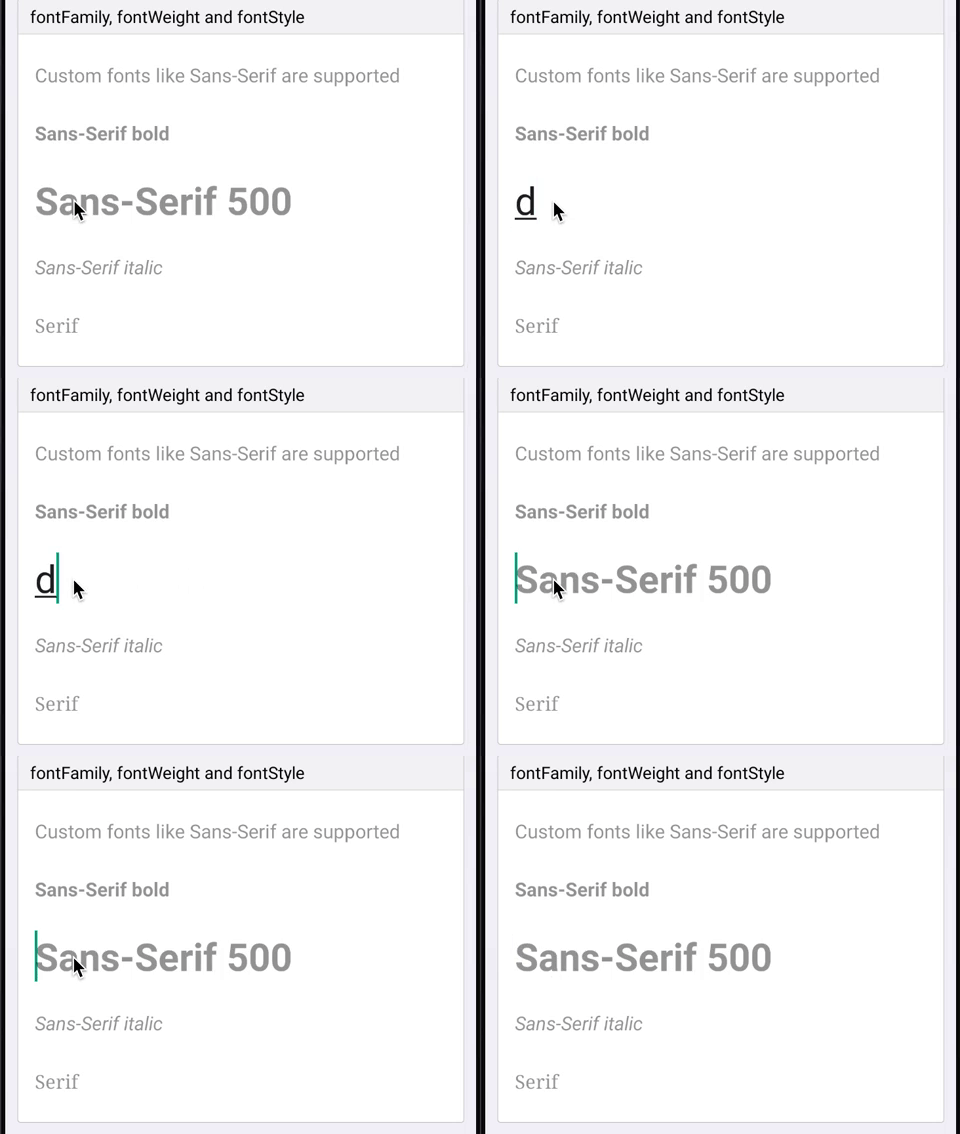
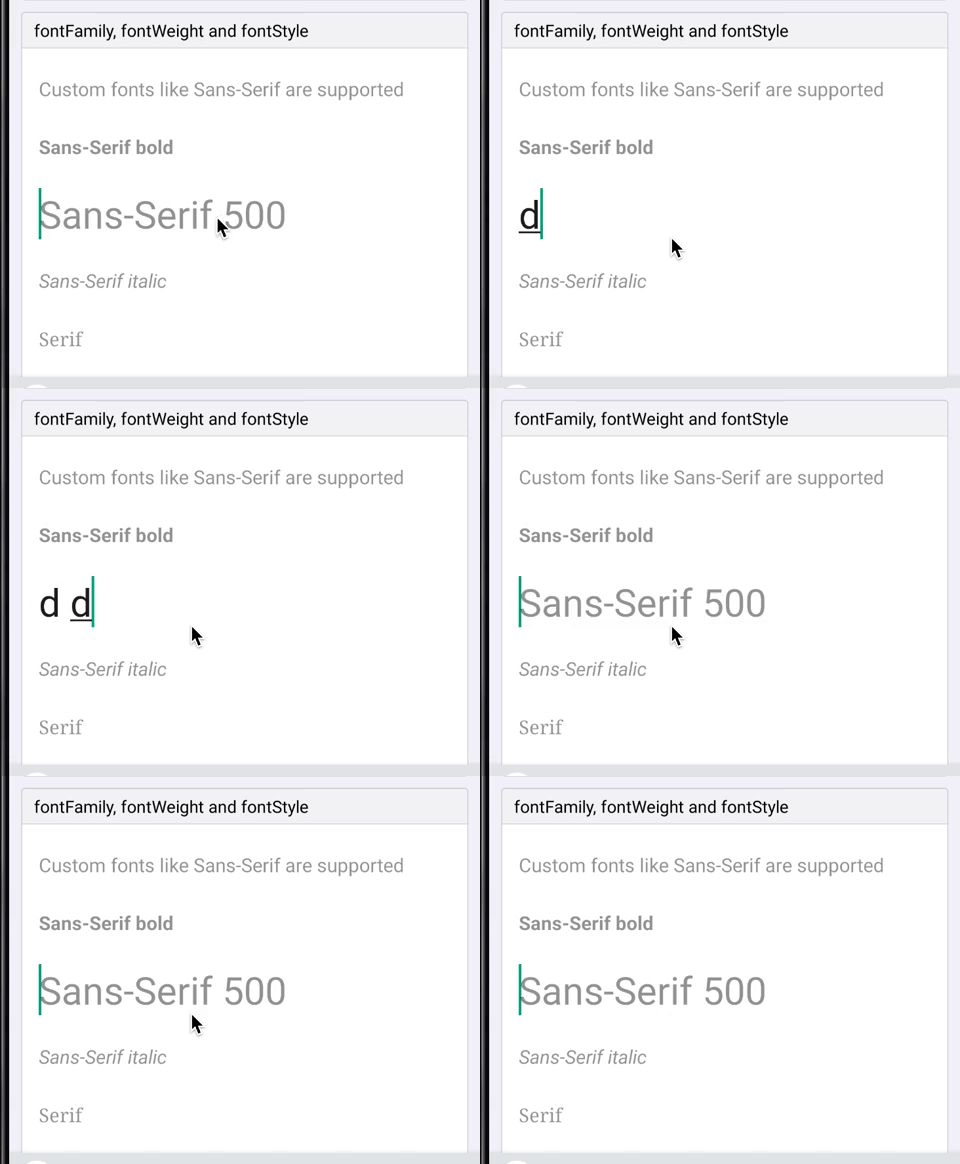
When using a medium (500) font weight on Android the wrong weight is used for the placeholder and for the first few seconds of input (before it gets text back from JS). To fix it I refactored the way we handle text styles (family, weight, style) to create a typeface to be more like the `Text` component.
Since all these 3 props are linked and used to create the typeface object it makes more sense to do it at the end of setting props instead of in each prop handler and trying to recreate the object without losing styles set by other prop handlers. Do do that we now store fontFamily, fontStyle and fontWeight as ivar of the ReactEditText class. At the end of updating prop if any of those changed we recreate the typeface object.
This doesn't actually fix the bug but was a first step towards it. There were a bunch of TODOs in the code to remove duplication between `Text` and `TextInput` for parsing and creating the typeface object. To do that I simply moved the code to util functions in a static class. Once the duplication was removed the bug was fixed! I assume proper support for medium font weights was added for `Text` but not in the duplicated code for `TextInput`.
## Changelog
[Android] [Fixed] - Fix medium font weights for TextInput on Android
Pull Request resolved: https://github.com/facebook/react-native/pull/26434
Test Plan:
Tested in my app and in RNTester that custom styles for both text and textinput all seem to work.
Repro in RNTester:
```js
function Bug() {
const [value, setValue] = React.useState('');
return (
<TextInput
style={[
styles.singleLine,
{fontFamily: 'sans-serif', fontWeight: '500', fontSize: 32},
]}
placeholder="Sans-Serif 500"
value={value}
onChangeText={setValue}
/>
);
}
```
Before:
After:
Reviewed By: mmmulani
Differential Revision: D17468825
Pulled By: JoshuaGross
fbshipit-source-id: bc2219facb94668551a06a68b0ee4690e5474d40
Summary:
This diff migrates the usages Nullable and NonNull annotations to AndroidX instead of javax.

The purpose of this change is to bring consistency in the annotations used by the core of RN

Reviewed By: makovkastar

Differential Revision: D16054504

fbshipit-source-id: 21d888854da088d2a14615a90d4dc058e5286b91
Summary:
All props to Eric Lewis! cc ericlewis

This revert of revert of land of changes originally published in #24873 (with some slight fixes). The change removes usage of LocalData from the `<Text>` component.

After this change we only have ---one (maybe two)--- three components left using LocalData.

Reviewed By: mdvacca

Differential Revision: D15962376

fbshipit-source-id: 19f41109ce9d71ce30d618a45eb2b547a11f29a2
Summary:
[Android] [Fixed] - Use HYPHENATION_FREQUENCY_NONE instead of HYPHENATION_FREQUENCY_NORMAL to measure text

The text must be measured with HYPHENATION_FREQUENCY_NONE instead of HYPHENATION_FREQUENCY_NORMAL, since ReactTextView has hyphenation frequency set to HYPHENATION_FREQUENCY_NONE. These two values must match, otherwise the measured height of text we return from the Yoga measure function might be wrong.

Even though the TextView [documentation](https://developer.android.com/reference/android/widget/TextView#setHyphenationFrequency(int)) says that the default hyphenation frequency is HYPHENATION_FREQUENCY_NORMAL before Android Q, it's not true for TextViews instantiated in code (the default value is set from the theme which is missing in case of ReactTextView).

See the screenshots below where the text is measured incorrectly which causes the last line to be cut off.

I extracted the value to a class member variable because I'm planning to expose the hyphenationFrequency prop for the Text component so that it can be configured on Android (as requested by this Github issue: https://github.com/facebook/react-native/issues/17199).

Reviewed By: shergin

Differential Revision: D16109430

fbshipit-source-id: 278c8182c0f819be27bc1d2468559b9e9ae1f807
Summary: This diff exposes LayoutDirection as part of UpdateLayoutMountItem

Reviewed By: JoshuaGross

Differential Revision: D16060521

fbshipit-source-id: 163bf2a0bdca62dcecb03a8aaa2f4bf595b18c8f
Summary: After we ran google-java-format D16071725, some Javadocs which weren't properly written broke. This includes putting unordered and ordered lists not using <ul> and <ol>, putting code blocks and pseudo-graphics not using <pre>. I ran through all the changed classes and tried to fix the broken Javadocs.

Reviewed By: cpojer

Differential Revision: D16090087

fbshipit-source-id: f31971cbc0e367a04814ff90bbfb2192751d5e16
Summary:
This diff formats the Java class files inside xplat/js/react-native-github. Since google-java-format was enabled in D16071401 we want to codemode the existing code so that users don't have to deal with formatter lint noise at diff-time.

```arc f --paths-cmd 'hg files -I "**/*.java"'```

drop-conflicts

Reviewed By: cpojer

Differential Revision: D16071725

fbshipit-source-id: fc6e3852e45742c109f0c5ac4065d64201c74204
Summary:
I found that on Android we only support 2 fontWeight options, either **normal** or **bold**, even developer can set any numeric value. But iOS supports all possible numeric values. This PR tries to add support for all possible numeric values on Android, even if it's supported only on Android P(28) and above.

This change might break texts where fontWeight use improperly, because this PR removes conversion of values above 500 to BOLD and below 500 to normal.

FYI, also moved **mCustomTypefaceCache** usage up because it was working after unnecessary mFontCache usage.

## Changelog

[Android] [Changed] - add custom font weight support to Text component on Android, only on P(API 28) and above versions.
Pull Request resolved: https://github.com/facebook/react-native/pull/25341

Test Plan: RNTester app's Text examples will show Rubik Regular, Rubik Light, Rubik Bold, Rubik Medium and Rubik Medium Italic texts in corresponding font family, style and weights.

Differential Revision: D15956350

Pulled By: mdvacca

fbshipit-source-id: 61079d953c65fb34ab4497d44c22317912a5a616
Summary:
D14014668 introduced support for nesting views within Text on Android. Part of the implementation involved accessing the UIManagerModule from ReactTextView through context. This doesn't work in bridgeless RN because we have no UIManagerModule, and the ReactContext has no Catalyst instance. Trying to access the Catalyst instance from ReactContext throws an exception if it doesn't exist, so i'm just adding a simple check here to make sure the instance exists before proceeding.

This means that this feature won't work in bridgeless mode, but that's ok for now - eventually we want to change the way this works so that it doesn't rely on accessing views in Java, which is potentially unsafe (there's nothing to stop you from mutating the views, and cpp/js would never know about it).

Reviewed By: mdvacca

Differential Revision: D15703100

fbshipit-source-id: 0448d55b8345fc707a25210a505cb6ac520c708a
Summary:
Changelog: [Android] [FIXED] - Fix backgroundColor top level prop of TextInput

This diff fixes two issues with the `backgroundColor` top level property of TextInput on Android:
 * Now it is possible to set a **string** value for the top-level `backgroundColor` property of TextInput (crashed the app previously):
```
<TextInput backgroundColor="#ffccbb">Hello, React Native</TextInput>
```
* Now it's possible to set an **integer** value for the top-level `backgroundColor` property of TextInput (had no effect previously):
```
<TextInput backgroundColor={0xffccbbff}>Hello, React Native</TextInput>
```

A `customType = "Color"` annotation parameter must be provided for `ReactBaseTextShadowNode.setBackgroundColor(...)` since the color value must be previously processed in JS before sending it over the bridge to the native code. The JS code will parse the color value and return the proper ARGB color integer to the native platforms (https://fburl.com/uqup52tn).

Without providing the custom type for the background color, if a string value is set for the top-level `backgroundColor` property in the JS code, the Android code will crash since it expects an integer value for the color in `ReactBaseTextShadowNode.setBackgroundColor(...)`, but a string will be passed from JS without any conversion and there will be a `ClassCastException` thrown. If an integer value without the alpha component (like `0xffccbb`) is set, the Android native view would get an integer color value with its alpha component set to `0x00`, which means a transparent color.

On a side note: the alpha component of a color must always be set when using an integer value for `backgroundColor` since the JS code, while processing the color type, shifts the rightmost 8 bytes (alpha component) to the leftmost position. If those 8 bytes are not the alpha component, you will get the wrong color in the end. It doesn't seem to be a problem for string values of `backgroundColor` though.

Reviewed By: mdvacca

Differential Revision: D15453980

fbshipit-source-id: f3f5d9c9877cdbce79a67f2ed93ad4589576d166
Summary:
The `measure` API receives LocalData and Props, it should also receive State.

This will also be used in future diffs.

Reviewed By: mdvacca

Differential Revision: D15325182

fbshipit-source-id: 6cb46dd603ce7d46673def16f0ddb517e2cf0c4f
Summary:
In https://github.com/facebook/react-native/pull/23865, RN introduced support for custom fonts the Android Way. But it introduced performance regression because it'll lookup for a font using getIdentifier() every time fontFamily changed. This PR fixes regression by requiring custom fonts to be listed in **fonts** array, and populating **mTypeCache** at first use using the list.

[Android] [Changed] - Require custom fonts to list in **fonts** array. Fixes performance regression.
Pull Request resolved: https://github.com/facebook/react-native/pull/24595

Reviewed By: mdvacca

Differential Revision: D15184590

Pulled By: fkgozali

fbshipit-source-id: e3feb2396609583ebc95101130186a1f5af931da
Summary: It seems like ReactContext isn't actually needed in measure functions. Changing the signature of ViewManager.measure() to take a Context instead.

Reviewed By: lunaleaps

Differential Revision: D14940330

fbshipit-source-id: b29987fd1d7f9c191a5f26138151082ca61cb351
Summary: This is removing packages and libraries from the repo.  Any modified buck files simply change the redirect targets to something more appropriate (no logic actually changed)

Differential Revision: D14950721

fbshipit-source-id: 6c14f827b76ca1dbaf83dcb983930f362c6a27d4
Summary:
Android API 26 and Android Support Library 26 added support for font resource type and native/downloadable fonts. It allows apps to easily download fonts from online providers, but also use of various font weights other than normal and bold, like medium. So it deprecated APIs for asset fonts, and should be removed in the future.

Advantages:
- Just copy font files in res/font and use it specifying filename (without extension) in fontFamily
- Define custom font-family using XML file (in res/font) and font files, it may have many weights and styles. See PR for example.
- Define configuration to download fonts from online font providers, and use it.

See https://developer.android.com/guide/topics/ui/look-and-feel/fonts-in-xml and https://developer.android.com/guide/topics/ui/look-and-feel/downloadable-fonts

[Android] [Changed] - add support for custom/downloadable fonts
Pull Request resolved: https://github.com/facebook/react-native/pull/23865

Differential Revision: D14506542

Pulled By: hramos

fbshipit-source-id: 67ba3148fb4b548cdbc779213cf6c1b2c3baffd2
Summary:
Since text and selection has dependency, handle text selection in
updateExtraData as well.

The root cause is due to setText is handled on extra data update but setSelection is handled on set property. And extra data update will be handled after all properties are handled. Since selection and text has dependency, move selection to extra data update as well.

Changelog:
----------
[Android] [Fixed] - Fix crash when set text and selection on textinput at the same time
Pull Request resolved: https://github.com/facebook/react-native/pull/22723

Differential Revision: D14783791

Pulled By: cpojer

fbshipit-source-id: a4065f3e151d23f4813d76e91d68362cfd4daaf4
Summary:
Potential breaking change: The signature of ReactShadowNode's onBeforeLayout method was changed
  - Before: public void onBeforeLayout()
  - After:  public void onBeforeLayout(NativeViewHierarchyOptimizer nativeViewHierarchyOptimizer)

Implements same feature as this iOS PR: https://github.com/facebook/react-native/pull/7304

Previously, only Text and Image could be nested within Text. Now, any view can be nested within Text. One restriction of this feature is that developers must give inline views a width and a height via the style prop.

Previously, inline Images were supported via FrescoBasedReactTextInlineImageSpan. To get support for nesting views within Text, we create one special kind of span per inline view. This span is called TextInlineViewPlaceholderSpan. It is the same size as the inline view. Its job is just to occupy space -- it doesn't render any visual. After the text is rendered, we query the Android Layout object associated with the TextView to find out where it has positioned each TextInlineViewPlaceholderSpan. We then position the views to be at those locations.

One tricky aspect of the implementation is that the Text component needs to be able to render native children (the inline views) but the Android TextView cannot have children. This is solved by having the native parent of the ReactTextView also host the inline views. Implementation-wise, this was accomplished by extending the NativeViewHierarchyOptimizer to handle this case. The optimizer now handles these cases:
  - Node is not in the native tree. An ancestor must host its children.
  - Node is in the native tree and it can host its own children.
  - (new) Node is in the native tree but it cannot host its own children. An ancestor must host both this node and its children.

I added the `onInlineViewLayout` event which is useful for writing tests for verifying that the inline views are positioned properly.

Limitation: Clipping
----------

If Text's height/width is small such that an inline view doesn't completely fit, the inline view may still be fully visible due to hoisting (the inline view isn't actually parented to the Text which has the limited size. It is parented to an ancestor which may have a different clipping rectangle.). Prior to this change, layout-only views had a similar limitation.
Pull Request resolved: https://github.com/facebook/react-native/pull/23195

Differential Revision: D14014668

Pulled By: shergin

fbshipit-source-id: d46130f3d19cc83ac7ddf423adcc9e23988245d3
Summary:
We want the ability to use Linkify on android text elements. This only adds this property to Text and not TextInput since there are some functional differences with how the types could be used between iOS and android - iOS allows one or many types while Linkify restricted us to providing only one option (using the masks).

Performance is affected ONLY FOR TEXT ELEMENTS USING THIS FEATURE since Linkify is searching for patterns.
Pull Request resolved: https://github.com/facebook/react-native/pull/19216

Differential Revision: D14621883

Pulled By: cpojer

fbshipit-source-id: cb692021d314140b9a92b29e23384afd7fd1b09e
Summary:
Google recommends to use Gravity.START and Gravity.END instead of Gravity.LEFT and Gravity.RIGHT to support RTL better.

[Android] [Changed] - Improve RTL support
Pull Request resolved: https://github.com/facebook/react-native/pull/24069

Differential Revision: D14541569

Pulled By: cpojer

fbshipit-source-id: 5c104d8bd666e1270d5410216c7f2efa6152692a
Summary:
This diff migrates RN to AndroidX.
As part of this diff I disabled few tests in RNAndroid OSS that will be re-enabled this week. As part of the refactor of BUCK files in OSS

Reviewed By: shergin

Differential Revision: D14200097

fbshipit-source-id: 932fcae251d1553e672acd67ecd0e703dcb364aa
Summary: Easy cleanup of commented code in TextLayoutManager, I kept the TODOs to complete the code in the future

Reviewed By: shergin

Differential Revision: D14372356

fbshipit-source-id: ff87f9b09e9f40ed021256f463e39299467b3e0e
Summary: Use the new copyright header format used elsewhere in the React Native repository.

Reviewed By: shergin

Differential Revision: D14091706

fbshipit-source-id: b27b8e6bcdf2f3d9402886dbc6b68c305150b7d5
Summary:
This diff refactors JNI methods used by the Binding.cpp class in order to use ReadableMap instead of ReadableNativeMap
This will be helpful to provide a different implementation of ReadableMap from C++

Reviewed By: shergin

Differential Revision: D14077762

fbshipit-source-id: 595b0c2d3a2d6070112257b65c1141a8af36f0e1
Summary: Trivial cleanup of variables and methods that were not being used in ReactTextView

Reviewed By: blairvanderhoof

Differential Revision: D14027630

fbshipit-source-id: e763d6d001d4a0c2970adebc9855190845cf5a1d
Summary:
This diff disables OverlappingRendering for ReactTextView to avoid the exception:

```
java.lang.IllegalStateException: Unable to create layer for com.facebook.react.views.text.ReactTextView
```
during fade animations

OverlappingRendering enables an optimization during rendering of animations per component, disabling this might affect performance of animations inside TextView.

We will add a ReactFlag to experiment on how this affect other surfaces.

Reviewed By: blairvanderhoof

Differential Revision: D14027631

fbshipit-source-id: c1a84e7488c44582f7b7c78965aeb7bd27f82368
Summary:
Fix lint errors and warning, which might be a cause of various crashes on older Android OS, using Android Support Library.

```bash
./gradlew :ReactAndroid:lint
```

[Android] [Changed] - fix lint error/warnings
Pull Request resolved: https://github.com/facebook/react-native/pull/23333

Differential Revision: D14019322

Pulled By: mdvacca

fbshipit-source-id: 74c98da269c318cf3b114c8d9c876186369f2b8c
Summary:
On Android `textTransform` breaks other styles applied to the text. It seems related to the usage of `ReplacementSpan` which allows drawing the text manually but seems to throw away some changes made by other span applied to the text.

To fix it I removed the usage of `ReplacementSpan` and simply transform the text before appending it to the `Spannable` string. To make sure textTransform is inherited correctly I added it to TextAttributes which handles this.
Pull Request resolved: https://github.com/facebook/react-native/pull/22670

Differential Revision: D13494819

Pulled By: cpojer

fbshipit-source-id: 1c69591084aa906c2d3b10153b354d39c0936340
Summary:
Equivalent of this iOS PR: https://github.com/facebook/react-native/pull/20915

Motivation:
----------

Whenever a user changes the system font size to its maximum allowable setting, React Native apps that allow font scaling can become unusable because the text gets too big. Experimenting with a native app like iMessage on iOS, the font size used for non-body text (e.g. header, navigational elements) is capped while the body text (e.g. text in the message bubbles) is allowed to grow.

This PR introduces a new prop on `<Text>` and `<TextInput>` called `maxFontSizeMultiplier`. This enables devs to set the maximum allowed text scale factor on a Text/TextInput. The default is 0 which means no limit.
Pull Request resolved: https://github.com/facebook/react-native/pull/23069

Differential Revision: D13748513

Pulled By: mdvacca

fbshipit-source-id: 8dd5d6d97bf79387d9a2236fa2e586ccb01afde9
Summary: Eager load classes used by Fabric. This is a temporary change that will be reverted in the near future

Reviewed By: shergin

Differential Revision: D13747454

fbshipit-source-id: 8ceb21f51982bcfcaa005dcc2ad9b457f7211795
Summary:
For certain style props, each time any style prop changed, the previous version of the style would remain. For example, if you passed `"underline"` for `textDecorationLine` on a `TextInput` and then later passed `undefined` for `textDecorationLine`, the underline would remain.

We solved this problem before in https://github.com/facebook/react-native/commit/de586bfa186289114974674bc2aece462f40393e. The fix was to use `manageSpans` to remove the old spans we added before adding the new spans. However, that fix hardcoded the list of spans to remove. Every span type that was introduced since that commit is affected by this bug:
  - CustomLetterSpacingSpan
  - CustomLineHeightSpan
  - CustomTextTransformSpan
  - ShadowStyleSpan
  - StrikethroughSpan
  - UnderlineSpan
  - TextInlineImageSpan

The reason this bug was reintroduced is `ReactBaseTextShadowNode` is responsible for adding spans and `ReactEditText` is responsible for removing spans. These classes fell out of sync.

This fix attempts a more robust solution. Every span that React Native adds to text now implements the `ReactSpan` interface. `manageSpans` deletes all spans that React Native adds by targeting the ones that implement `ReactSpan`. `ReactBaseTextShadowNode.SetSpanOperation` has been updated so that it's a compiler error to add a span that doesn't implement `ReactSpan`.
Pull Request resolved: https://github.com/facebook/react-native/pull/22994

Differential Revision: D13727580

Pulled By: mdvacca

fbshipit-source-id: 07b2eb08832efafb6c2806aa3329f0e9466b09fb
Summary:
iOS's `allowFontScaling` example was copied to Android. Also, I added a case illustrating that `allowFontScaling` gets inherited in nested `<Text>` scenarios. This tests the bug fix from #22917. This nested case was added to both iOS and Android.

Also, moved the comment in `TextAttributes.java` from the top of the file to the top of the class definition as requested in #22917.
Pull Request resolved: https://github.com/facebook/react-native/pull/22991

Differential Revision: D13671380

Pulled By: cpojer

fbshipit-source-id: a8aae4f051c76391e33bdbd6bdc80aff9b7de5cd
Summary:
If you set `letterSpacing` on an outer text and then set `fontSize` on an inner text, the wrong `letterSpacing` will be rendered.

Here's an example:

```
<Text style={{ fontSize: 10, letterSpacing: 10 }}>
  <Text style={{ fontSize: 20 }}>Some text</Text>
</Text>
```

`fontSize` affects letter spacing. In this case, the bug is that setting `fontSize` to `20` doesn't cause the letter spacing to be recalculated.

Notice that the logic for applying letter spacing only applies it if the node has a different value for `getEffectiveLetterSpacing()` than its parent. The problem is that `getEffectiveLetterSpacing()` doesn't represent the final letter spacing value -- it doesn't take `fontSize` into account. Consequently, it sometimes incorrectly skips applying letter spacing as illustrated above.

The fix is to ensure `getEffectiveLetterSpacing()` represents the final rendered letter spacing value. To do this, some of the letter spacing calculation code was moved from `CustomLetterSpacingSpan` to `getEffectiveLetterSpacing()`.
Pull Request resolved: https://github.com/facebook/react-native/pull/22993

Differential Revision: D13671505

Pulled By: cpojer

fbshipit-source-id: 400f36d3fd71ab7cb6cba8508baa71f2973f8f0e
Summary:
Purpose
----------

This commit fixes a bug and prepares us for adding support for the `maxContentSizeMultiplier` prop (it's currently only supported on iOS).

Details
----------

Today we don't explicitly track inheritance of text props. Instead we rely on `SpannableStringBuilder` to handle this for us. Consider this example:

```
<Text style={{fontSize: 10}}>
  <Text style={{letterSpacing: 5}}>
    ...
  </Text>
</Text>
```

In today's implementation, the inner text doesn't know about `fontSize` (i.e. its `mFontSize` instance variable is `Float.NaN`). But everything works properly because the outer `Text` told `SpannableStringBuilder` to apply the font size across the entire string of text.

However, today's approach breaks down when computing the value to apply to the `SpannableStringBuilder` depends on multiple props. Suppose that RN Android supported the `maxContentSizeMultiplier` prop. Then calculating the font size to apply to the `SpannableStringBuilder` would involve both the `fontSize` prop and the `maxContentSizeMultiplier` prop. If `fontSize` was set on an outer `Text` and `maxContentSizeMultiplier` was set on an inner `Text` then the inner `Text` wouldn't be able to calculate the font size to apply to the `SpannableStringBuilder` because the outer `Text's` `fontSize` prop isn't available to it.

The `TextAttributes` class solves this problem. Every `Text` has a `TextAttributes` instance which stores its text props. During rendering, a child's `TextAttributes` is combined with its parent's and handed down the tree. In this way, during rendering a `Text` has access to the relevant text props from itself and its ancestors.

This design is inspired by the [`RCTTextAttributes`](https://github.com/facebook/react-native/blob/7197aa026b6d262faa8f4dc6bb3e591f860cdc95/Libraries/Text/RCTTextAttributes.m) class from RN iOS.

Bug Fix
----------

This refactoring happens to fix a bug. Today, when setting `fontSize` on nested Text, `allowFontScaling` is always treated as though it is true regardless of the value on the root `Text`. For example, the following snippets should render "hello" identically, Instead, the bottom snippet renders "hello" as though `allowFontScaling` is true.

```
<Text allowFontScaling={false} style={{fontSize: 50}}>hello</Text>
<Text allowFontScaling={false}><Text style={{fontSize: 50}}>hello</Text></Text>
```

(The repro assumes you've increased your device's font setting so that the font size multiplier is not 1.0.)

Introducing the `TextAttributes` class fixed this. It forced us to think about how inheritance should work for `allowFontScaling`. In the new implementation, `Text` components use the value of `allowFontScaling` from the outermost `Text` component. This matches the behavior on iOS (the `allowFontScaling` prop gets ignored on virtual text nodes because it doesn't appear [in this list](https://github.com/facebook/react-native/blob/3749da13127cb7455d533cb2bc5f2cf37470c0c7/Libraries/Text/Text.js#L266-L269).)
Pull Request resolved: https://github.com/facebook/react-native/pull/22917

Reviewed By: mdvacca

Differential Revision: D13630235

Pulled By: shergin

fbshipit-source-id: e58f458de4fc3cdcbec49c8e0509da51966ef93c
 David Vacca
 Andres Suarez
 Oleksandr Melnykov
 Janic Duplessis
 Min ho Kim
 Valentin Shergin
 soh335
 Dulmandakh
 Emily Janzer
 Vojtech Novak
 Joshua Gross
 Kevin Gozali
 Christoph Nakazawa
 Rick Ratmansky
 YuTeh Shen
 Adam Comella
 Kyle Pinkham
 Sunny Luo
 Héctor Ramos