Summary:
Allow JS to keep track of mostRecentEventCount and pass it into each event or prop update. We really don't want to separately keep track of that data.

In non-Fabric, the ShadowNode will keep track of the mostRecentEventCount associated to prop updates. In Fabric, that happens on the C++ ShadowNode.

Changelog: [Internal] Simplification to TextInput native state

Reviewed By: mdvacca

Differential Revision: D20374573

fbshipit-source-id: 385fba6ec69a071c78832a686b397699a6c55d67
Summary:
See D19204032. In some cases the View might not have a ThemedReactContext, it may be wrapped, so we use a previously-created helper to get the correct context from the View or we throw a soft exception.

Changelog: [Internal] Fabric change

Reviewed By: mdvacca

Differential Revision: D20355126

fbshipit-source-id: 469a3b7f8f2d3b98236f3170dd62c4a6e7e1e46f
Summary:
Work around crash in Android TextInput when default colors are null.

This likely indicates that the Context is corrupted in some way, so this is not a permanent solution.

Changelog: [Internal] Raise soft exception is default platform text color isn't defined

Reviewed By: mdvacca

Differential Revision: D20351080

fbshipit-source-id: d912c9348272c2f3a3b8d571d465d482060efe5a
Summary:
Fixed some typos in the comment.

## Changelog

[Internal] [Fixed] - Fixed typo in the comments
Pull Request resolved: https://github.com/facebook/react-native/pull/28269

Test Plan: Changes are only made in the comments, so test is not necessary.

Reviewed By: cpojer

Differential Revision: D20342637

Pulled By: shergin

fbshipit-source-id: f6e7dd538ee54c43e1570c35e1f8c4502054e328
Summary:
This diff fixes the rendering of the TextInput RNTester examples in catalyst app.
The root cause of the bug is that we were parsing the props of the text using the TextAttributeProps class, this is incorrect because TextAttributeProps is a holder of the C++ TextAttributes and not TextProps, but the name is confusing.
As a consecuence there was some mistmaches of types during parsing and that was throwing an exception in some examples.

I created the task T63643819 to refactor these classes to make this cleaner.
I'll be working on T63643819 next week, now I want to unblock this bug.

changelog: [internal]

Reviewed By: JoshuaGross

Differential Revision: D20320969

fbshipit-source-id: 7b47546ba4f34df2a7fa151ab200823ea2eeb696
Summary:
On Android, when changing the props on TextInput component, there are cases where behavior is incorrect.

ex: there were two other PR requests to fix the following issues:
1) TextInput doesnt respect the autoCapitalize prop when keyboardType is set to "default"
2) Password visibility is broken

But those PRs ended up breaking a transition from phone-pad to default

Root cause
- The issue is that the bits that Android defines to store the InputType flags are reused.
- For example, the previous issue: TYPE_TEXT_FLAG_CAP_WORDS and TYPE_NUMBER_FLAG_DECIMAL are both using 0x00002000 bit. So when switching input types from phone-pad to default (text), it is not known if this bit should be cleared. It could have been set for capitalize or for indicating the num pad should be generic.

the solution is to always unset the TYPE_CLASS flags before setting the keyboardType so the user has the correct keyboard.

Changelog: [Fixed] TextInput transition from phone-pad to default

Reviewed By: JoshuaGross

Differential Revision: D20263334

fbshipit-source-id: 0b283fbd6314bf10b90f760917447d2439aaa147
Summary:
Changelog: [Internal]

# Problem

Fabric didn't know about content offset, even though `reactSmoothScrollTo` calls `updateStateOnScroll`, the value of content offset is {0, 0}.

# Fix

Call `updateStateOnScroll` from `reactSmoothScrollTo` with where the scroll view is going to be rather than where it is.

Reviewed By: JoshuaGross, mdvacca

Differential Revision: D20248959

fbshipit-source-id: b1da645576dd5e8dce29e7e1d90ab232e0df9fd5
Summary:
# Problem

HorizontalScrollView was not reporting its `contentOffset` to Fabric, therefore `measure`  was returning wrong value.

# Solution

Copy over implementation of `updateState` from scrollView. I noticed that there is a lot of duplication between the two classes, that's why I decided to duplicate `updateState` as well.

Changelog: [Internal]

Reviewed By: JoshuaGross, mdvacca

Differential Revision: D20247552

fbshipit-source-id: 48b1eb0c11198a32531effe55301f8d554e92130
Summary:
This Pull Request implements the PlatformColor proposal discussed at https://github.com/react-native-community/discussions-and-proposals/issues/126.   The changes include implementations for iOS and Android as well as a PlatformColorExample page in RNTester.

Every native platform has the concept of system defined colors. Instead of specifying a concrete color value the app developer can choose a system color that varies in appearance depending on a system theme settings such Light or Dark mode, accessibility settings such as a High Contrast mode, and even its context within the app such as the traits of a containing view or window.

The proposal is to add true platform color support to react-native by extending the Flow type `ColorValue` with platform specific color type information for each platform and to provide a convenience function, `PlatformColor()`, for instantiating platform specific ColorValue objects.

`PlatformColor(name [, name ...])` where `name` is a system color name on a given platform.  If `name` does not resolve to a color for any reason, the next `name` in the argument list will be resolved and so on.   If none of the names resolve, a RedBox error occurs.  This allows a latest platform color to be used, but if running on an older platform it will fallback to a previous version.
 The function returns a `ColorValue`.

On iOS the values of `name` is one of the iOS [UI Element](https://developer.apple.com/documentation/uikit/uicolor/ui_element_colors) or [Standard Color](https://developer.apple.com/documentation/uikit/uicolor/standard_colors) names such as `labelColor` or `systemFillColor`.

On Android the `name` values are the same [app resource](https://developer.android.com/guide/topics/resources/providing-resources) path strings that can be expressed in XML:
XML Resource:
`@ [<package_name>:]<resource_type>/<resource_name>`
Style reference from current theme:
`?[<package_name>:][<resource_type>/]<resource_name>`
For example:
- `?android:colorError`
- `?android:attr/colorError`
- `?attr/colorPrimary`
- `?colorPrimaryDark`
- `android:color/holo_purple`
- `color/catalyst_redbox_background`

On iOS another type of system dynamic color can be created using the `IOSDynamicColor({dark: <color>, light:<color>})` method.   The arguments are a tuple containing custom colors for light and dark themes. Such dynamic colors are useful for branding colors or other app specific colors that still respond automatically to system setting changes.

Example: `<View style={{ backgroundColor: IOSDynamicColor({light: 'black', dark: 'white'}) }}/>`

Other platforms could create platform specific functions similar to `IOSDynamicColor` per the needs of those platforms.   For example, macOS has a similar dynamic color type that could be implemented via a `MacDynamicColor`.   On Windows custom brushes that tint or otherwise modify a system brush could be created using a platform specific method.

## Changelog

[General] [Added] - Added PlatformColor implementations for iOS and Android
Pull Request resolved: https://github.com/facebook/react-native/pull/27908

Test Plan:
The changes have been tested using the RNTester test app for iOS and Android.   On iOS a set of XCTestCase's were added to the Unit Tests.

<img width="924" alt="PlatformColor-ios-android" src="https://user-images.githubusercontent.com/30053638/73472497-ff183a80-433f-11ea-90d8-2b04338bbe79.png">

In addition `PlatformColor` support has been added to other out-of-tree platforms such as macOS and Windows has been implemented using these changes:

react-native for macOS branch: https://github.com/microsoft/react-native/compare/master...tom-un:tomun/platformcolors

react-native for Windows branch: https://github.com/microsoft/react-native-windows/compare/master...tom-un:tomun/platformcolors

iOS
|Light|Dark|
|{F229354502}|{F229354515}|

Android
|Light|Dark|
|{F230114392}|{F230114490}|

{F230122700}

Reviewed By: hramos

Differential Revision: D19837753

Pulled By: TheSavior

fbshipit-source-id: 82ca70d40802f3b24591bfd4b94b61f3c38ba829
Summary:
This diff implements serialization and deserialization of text attachments as part of the calculation of layout of text components
changelog: [internal]

Reviewed By: JoshuaGross

Differential Revision: D20087251

fbshipit-source-id: dbcbd22f856aadace14343205548154ea80c8464
Summary:
ez diff to remove TODO to support inlinew Views in Fabric + venice

changelog: [internal]

Reviewed By: JoshuaGross

Differential Revision: D20088698

fbshipit-source-id: bd7cbbd76a8c13edf94d4eecac0dd670ccd0d209
Summary:
For backwards-compatibility with Paper, we're implementing a feature in Fabric that will allow TextInputs to use the default padding from the theme in Android.

Note that this uses some pretty ugly hacks that probably shouldn't be used inside of components at all: looking directly at rawProps, overriding props/Yoga styles in the component descriptor, etc. I would (personally) really like to kill this feature entirely unless and until we can find a more elegant solution.

Changelog: [Internal]

TextInputs are still not pixel-perfect with Paper, but they're much closer, and the underline visual glitchiness is no longer an issue.

Reviewed By: mdvacca

Differential Revision: D20109605

fbshipit-source-id: 543282843e0a9f03a504d72d7a014431099bd64c
Summary:
This diff disables the rendering of TextInlineViews in ClassicRN when the users is running with Fabric enabled.

changelog: [internal]

Reviewed By: JoshuaGross

Differential Revision: D20087254

fbshipit-source-id: b4664b17b4c845d212f72e75eee58860fe31abee
Summary:
This diff changes the Fabric measure API in order to support attachments parameters

changelog: [internal]

Reviewed By: JoshuaGross

Differential Revision: D20087252

fbshipit-source-id: 20e1526aaa3695d38d0805416df8a32adb8296ad
Summary:
This diff enables support for TextInlineViews with dynamic sizes by default, removing old code and calls to MCs.

changelog: [internal]

Reviewed By: JoshuaGross, makovkastar

Differential Revision: D20026795

fbshipit-source-id: 48adf356b418866d937be9b478d9186342a07de8
Summary: Switching SwipeRefreshLayout to use the bridgeless-friendly API for getting the EventDispatcher.

Reviewed By: mdvacca

Differential Revision: D20016310

fbshipit-source-id: 2f674f45768640fb6219df690fa34f74206fdf19
Summary:
motivation: there are cases where one'd like to control the radius of the ripple effect that's present on TouchableNativeFeedback - in my case, I want to make sure that both icons and text have the same ripple appearance, but that's currently not possible as far as I can tell.
Currently (afaik) the only way to set (upper) ripple limits is by specifying width, height and border radius ( + `overflow: hidden`), and this works well for icons which can usually be bounded by a square, but not for text which can have rectangular shape.
This PR adds `rippleRadius` parameter to `SelectableBackground()`, `SelectableBackgroundBorderless()` and `Ripple()` static functions present on `TouchableNativeFeedback`. It can make the ripple smaller but also larger. The result looks like this:
added to RNTester:

difference from the other ripples:

I'm ofc open to changing the api if needed, but I'm not sure there's much space for manoeuvring. While I was at it, I did a slight refactor of the class into several smaller, more focused methods.
It's possible that in some cases, this might help to work around this issue https://github.com/facebook/react-native/issues/6480.
## Changelog
[Android] [Added] - allow setting custom ripple radius on TouchableNativeFeedback
Pull Request resolved: https://github.com/facebook/react-native/pull/28009
Test Plan: I tested this locally using RNTester
Reviewed By: TheSavior
Differential Revision: D20004509
Pulled By: mdvacca
fbshipit-source-id: 10de1754d54c17878f36a3859705c1188f15c2a2
Summary:
Right now, `requestFocus()` is a no-op if the EditText view thinks it's already focused. In certain cases, though, we still want to focus the view even if it's already focused - for example, if TalkBack is enabled and you dismiss the keyboard, you want to be able to tap on the TextInput again to bring back the keyboard, even though the View never thinks it lost focus.

What I'm doing instead is basically disregarding the View's current focus state if we *would* focus the TextInput, which is in 3 circumstances:

- When the view is attached to a window, if autofocus is true
- When the focus is being requested by JS
- When the focus is being requested by an accessibility action from the OS

Changelog: [Android][Fixed] Change how TextInput responds to requestFocus to fix a11y focus issue

Reviewed By: mdvacca

Differential Revision: D19750312

fbshipit-source-id: 30b9fab40af4a083fa98f57aba7e586540238bea
Summary:
We must use FLog instead of android.util.log, this diff moves the current callsites of android.util.log to FLog

changeLog:[internal]

Reviewed By: JoshuaGross

Differential Revision: D19884741

fbshipit-source-id: 300f7d691961aa51f0b525c37da7ae3d64fe5131
Summary:
# Problem
`UIManager::getRelativeLayoutMetrics`  returns incorrect `frame.origin.y` value.

Just quick reiteration how calculation of `frame.origin` works. We take frame of the target shadow node, travers hierarchy to the root and keep adding `frame.origin` of each ancestor to target shadow node's origin.

One more important piece of information, to calculate scroll view's `frame.origin`, we need to have its contentOffset which gets passed to Fabric core through state.

# So where does it go wrong?
Problem is that on Android, calling view command `scrollTo` doesn't set its internal state correctly. So when we calculate the layoutmetrics, scroll view's `frame.origin` is off by whatever value was used in `scrollTo`.

# The fix
In `ReactScrollView`, correctly set state after `scrollTo` is called on it.

Changelog: [Internal]

Reviewed By: JoshuaGross

Differential Revision: D19835549

fbshipit-source-id: d56e7b0b05023c0497e52c8b46fdcf58ca78b4a5
Summary:
This adds support for `adjustsFontSizeToFit` and `minimumFontScale` on Android. The implementation tries to match closely the behaviour on iOS (hardcoded 4px min size for example). It uses a simpler linear algorithm for now, opened to improving it now if it is a deal breaker or in a follow up.

See https://twitter.com/janicduplessis/status/1171147709979516929 for a more detailed thread about the implementation

## Changelog

[Android] [Added] - Implement `adjustsFontSizeToFit` on Android
Pull Request resolved: https://github.com/facebook/react-native/pull/26389

Test Plan: Tested by adding the existing `adjustsFontSizeToFit` example from the iOS text page to android. Also added a case for limiting size by using `maxHeight` instead of `numberOfLines`.

Reviewed By: mdvacca

Differential Revision: D17285473

Pulled By: JoshuaGross

fbshipit-source-id: 43dbdb05e2d6418e9a390d11f921518bfa58e697
Summary:
This diff refactors Text and Text input components in Fabric to support customizable emojis

changelog: [internal]

Reviewed By: JoshuaGross

Differential Revision: D19679391

fbshipit-source-id: 358aa97064209d28d317ba4ca5fff84245c9b1bb
Summary:
This diff refactors support of emojis in RN classic in order to make it easy to extend support for text input and fabric (as part of this stack)

changelog:[internal]

Reviewed By: JoshuaGross

Differential Revision: D19679394

fbshipit-source-id: 45eff49800b3db281721088f107494005d390fff
Summary:
Follow up to https://github.com/facebook/react-native/issues/27803. To keep consistency between the implementations this also implements autoFocus natively on Android. This will allow removing the JS auto focus logic completely.

## Changelog

[Android] [Fixed] - Implement native TextInput autoFocus on Android
Pull Request resolved: https://github.com/facebook/react-native/pull/27924

Test Plan: Test using the TextInput example in RN tester.

Differential Revision: D19674506

Pulled By: TheSavior

fbshipit-source-id: 9cbb517fc69bccd11f5292a1ccb4acea2e3713e9
Summary: Migrate ReactTextinputManager to support bridgeless mode by accessing the EventDispatcher through the UIManagerHelper instead of from ReactContext.

Reviewed By: mdvacca

Differential Revision: D19614184

fbshipit-source-id: 5dd4945223d10785f8fe171e06d6f7ef42f9d834
Summary:
Migrate ReactTextinputManager to support bridgeless mode by accessing the EventDispatcher through the UIManagerHelper instead of from ReactContext.

Changelog: [Internal]

Reviewed By: mdvacca

Differential Revision: D19456326

fbshipit-source-id: 5e9643793cd764e29964f565db24cdea683ac032
Summary:
Migrating ReactImageView to use the new API for accessing the EventDispatcher (UIManagerHelper.getEventDispatcherForReactTag) that supports bridgeless mode.

Changelog: [Internal]

Reviewed By: PeteTheHeat

Differential Revision: D19190765

fbshipit-source-id: a958dfc9c48845270e99f8d378ce034cddc8036f
Summary:
We should have been calling this already. Trivial fix. The intent of the view command was always to update selection, I just forgot to add it. See test videos.

Changelog: [Internal]

Reviewed By: mdvacca

Differential Revision: D19548178

fbshipit-source-id: 14a1bdc11d84c05f2435c48c3bb96b64e8c68cb4
Summary:
A previous PR broke toggling between visible and non-visible password (basically once a password field was made visible, future updates to the keyboardType were effectively ignored, so the password would always be visible).

Original PR: https://github.com/facebook/react-native/pull/27523

Changelog: [Internal]

Reviewed By: mdvacca, rodrigos-facebook

Differential Revision: D19527245

fbshipit-source-id: a5ab343c8a0c6a608171dbfa5afc7536ff241826
Summary:
This is an easy refactor of constants in ImageResizeMode

changelog: [Internal]

Reviewed By: JoshuaGross

Differential Revision: D19509348

fbshipit-source-id: 2bed9e35f0c7daa04c64ec7fba6975517633bfa7
Summary:
This PR makes it possible for subclasses of `ReactTextInputShadowNode` to control the construction of the "dummy" `EditText` instance that `ReactTextInputShadowNode` internally uses to determine the expected height of the view. This PR does not change the default behavior, it just opens up that default to being overriden.

This is useful in the case of custom views that have different behavior from a "default" `EditText` instance (`new EditText(context)`). For example, it might have a different style applied.

As a side benefit, this change also makes it easy to have subclasses not apply the default theme, which can allow the custom view to avoid a longstanding crash issue (https://github.com/facebook/react-native/issues/17530).

## Changelog

[Android] [Added] - Allow overriding `EditText` construction in `ReactTextInputShadowNode`
Pull Request resolved: https://github.com/facebook/react-native/pull/27782

Test Plan: All tests pass.

Reviewed By: mdvacca

Differential Revision: D19450593

Pulled By: JoshuaGross

fbshipit-source-id: 8d2ce6117246fc3e2108623312b38583af5722b3
Summary:
This diff ensures the measurement and rendering of FB emojis is correnct in RN Android.
Before this commit we were customizing Spannable object with FB emojis right before rendering the text into the TextView, this diff ensures that the Spannable is "customized" as soon as it is created, ensuring the measurement of the Text.

changelog: [internal]

Reviewed By: JoshuaGross

Differential Revision: D19354107

fbshipit-source-id: 92e07cf30503404f7820f25eaa9efdc02f6bddbd
Summary:
This diff fixes the redbox error: Views nested within a <Text> must have a width and height

This error is reproducible when rendering a View with no fixed size, inside a <Text>. e.g.
```
function PlaygroundContent(props: {}) {
  return (
    <View style={styles.container}>
      <Text>
        <View>
          <Image source={fbicon.filled('chevron-down', 10)} />
        </View>
      </Text>
    </View>
  );
}
```

changelog: Add support to render <View> with no fixed size nested within a <Text>

Reviewed By: shergin

Differential Revision: D19387760

fbshipit-source-id: a9cee8410e56a2d362d6b8f993e602719c416925
Summary:
Fix for https://github.com/facebook/react-native/issues/27510.
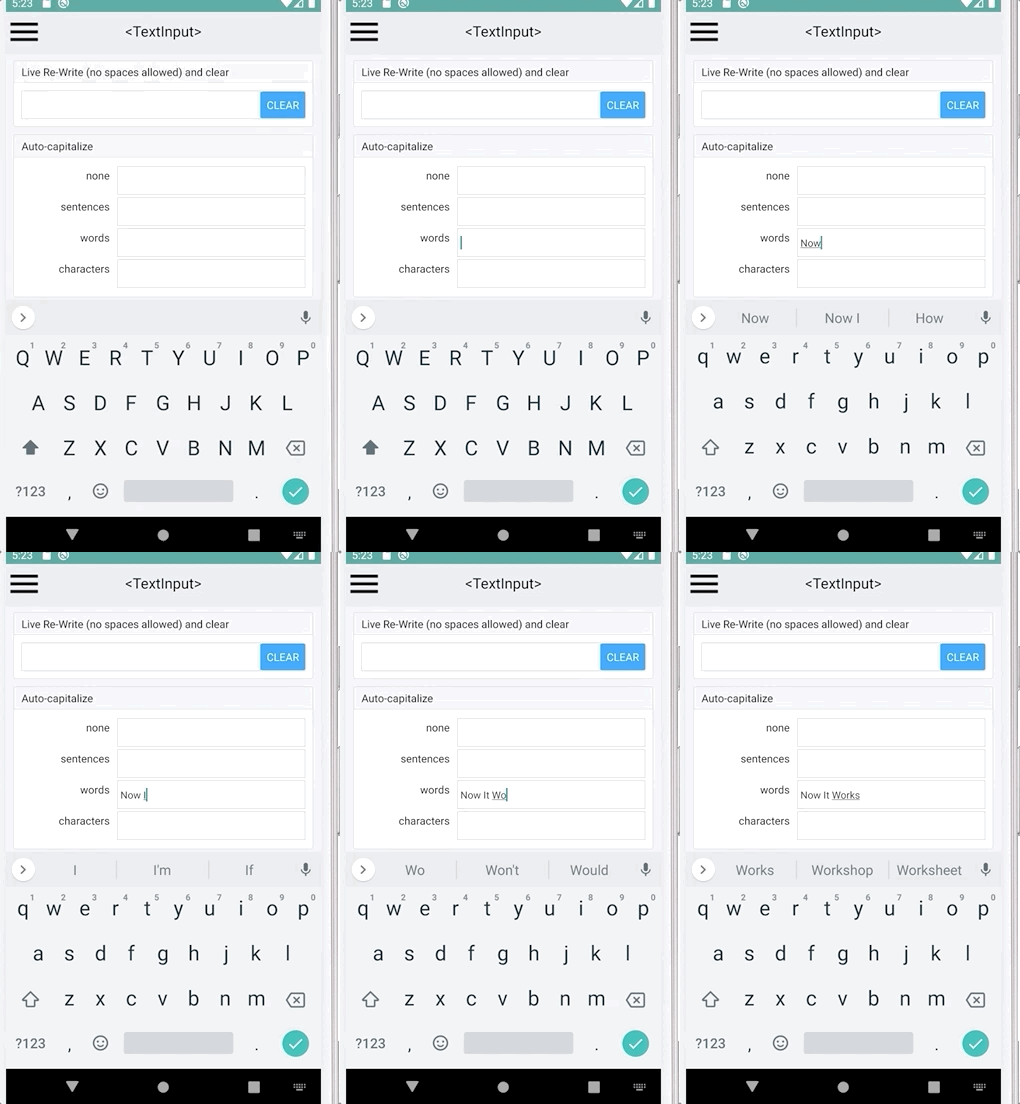
Setting the `InputType.TYPE_CLASS_TEXT` flag when `keyboardType` is null or default breaks autoCapitalize. Handle the case when `keyboardType` is null, default, or invalid type.
## Changelog
[Android] [Fixed] - Fix setting keyboardType from breaking autoCapitalize
Pull Request resolved: https://github.com/facebook/react-native/pull/27523
Test Plan:
Added keyboardType prop to RNTester as so
```
<TextInput autoCapitalize="words" keyboardType="default" style={styles.default} />
```
Reviewed By: makovkastar
Differential Revision: D19132261
Pulled By: JoshuaGross
fbshipit-source-id: be66f0317ed305425ebcff32046ad4bff06d367f
Summary:
This diff back out the migration of events on ScrollView to be bridgeless (D18862857)
This is causing the bug: T59882485 and the migration is not necessary in production yet.

Heads-up ejanzer this diff will affect events for scroll in Venice, I will create another diff to figure it out the root cause. But we need the land and pick this diff in v252

Changelog: [internal]

Reviewed By: ejanzer

Differential Revision: D19269906

fbshipit-source-id: d61e67975d508cddafc3af34b0f7dfe83bda6bd7
Summary:
This diff fixes the rendering of TextInput component for Android 4 devices.
This bug was caused by D18196901, when we changed the base class of ReactEditText from EditText to AppCompatEditText.
The root of the problem is that AppCompatEditText wraps the ReactContext received as a parameter in the construction of the View into a ContextWrapper object. This break the implicity assumption that the method View.getContext will return the same context that was used during the construction of the view.
https://android.googlesource.com/platform/frameworks/support/+/dd55716/v7/appcompat/src/android/support/v7/widget/AppCompatEditText.java#55

Changelog: [internal]

Reviewed By: ejanzer

Differential Revision: D19204032

fbshipit-source-id: eefb562b1da22e6cc58c75845c87dd032d727f49
Summary:
This implements propagation of ScrollView's contentOffset value on Android. That allows `LayoutableShadowNode::getRelativeLayoutMetrics` (and some measure functions) return values that take that info into  account.

Changelog: [Internal] Fabric-specific internal change.

Reviewed By: mdvacca

Differential Revision: D19027433

fbshipit-source-id: 023ff9642d023971b3d24d5cc5f7c2f4b443031e
Summary:
Google recommends to extend AppCompat widgets, and Android Studio suggests the change. This PR changes ReactEditText to extend AppCompatEditText.

## Changelog

[Android] [Changed] - ReactEditText extends AppCompatEditText
Pull Request resolved: https://github.com/facebook/react-native/pull/27039

Test Plan: CI is green

Reviewed By: mdvacca

Differential Revision: D18196901

Pulled By: hramos

fbshipit-source-id: 1484ae3da1be5776d0431dab3d4bb7ddbe5b8b7c
Summary:
This diff migrates a couple of events callsites of ReactRootView and ScrollView to be compatible with Bridgeless React mode

Changelog: [internal]

Reviewed By: ejanzer

Differential Revision: D18862857

fbshipit-source-id: f8e0d2d684bfaf84e9c138746507bb7728481b18
Summary:
UpdateLocalData and UpdateState return an `extra data` object, which in the case of TextInput contains padding. In Paper, the padding was always set on this object; in Fabric, it generally is not. However, the ViewManager was unconditionally setting the padding on the view, regardless of whether or not padding was set. We just check the padding values before setting now. This fixes an issue where the padding would be reset when the user started typing in Fabric.

Changelog: [Internal]

Reviewed By: mdvacca

Differential Revision: D18875261

fbshipit-source-id: d7cb87c07f47ab522e32cd34a4ca6ed5fea2e832



