Summary:
Pull Request resolved: https://github.com/facebook/react-native/pull/52380

Apps that rely support focus in FlatList rendered items are missing out on a FlatList optimization that defers rendering for offscreen content updates.

For example, on Android, if you focus and smooth scroll an item into view, the onScroll event will fire first. For most sufficiently large virtualization windows, the next render will be delayed by the render batch timeout as most materialization of virtualized views is not treated as a high pri render.

However, this batch / timeout mechanism isn't being used for cell render updates that occur as a result of a focus change.

This change adds the same timeout mechanism used for scroll events. In most cases, the view that is focused is in the viewport, and the extra rendering needed is already scheduled (or executed with high priority if needed) when the onScroll event is processed.

In cases where the focus change occurs outside the viewport, most platforms will want to do some kind of "bring into view" anyway, and the same applies - onScroll will take care of scheduling the cell rendering priority.

## Changelog

[Internal]

Reviewed By: NickGerleman

Differential Revision: D77681274

fbshipit-source-id: 1ade377e513eca21338a380ff9299dd410606aec
Summary:
Pull Request resolved: https://github.com/facebook/react-native/pull/51413

Prefers using this as a destructured import instead of as a member expression of `React`.

Changelog:
[Internal]

Reviewed By: SamChou19815

Differential Revision: D74895841

fbshipit-source-id: c1d3af40134a3721c9a7b676ee1f2c4a18612e4d
Summary:
Pull Request resolved: https://github.com/facebook/react-native/pull/51410

Prefers using this as a destructured import instead of as a member expression of `React`.

Changelog:
[Internal]

Reviewed By: SamChou19815

Differential Revision: D74895844

fbshipit-source-id: 67f334981a1effce051c89e3d4643232aa22b4e9
Summary:
Fixes https://github.com/facebook/react-native/issues/50817

Using a fragment is very common when rendering elements. We are cloning and adding `onLayout` always to the ListEmptyComponent element, but this would seem to work only when `View` is used for this as a wrapper in this prop. To prevent this unnecessary warning, I think we can easily check whether it is a fragment or not before cloning and adding the extra props – this adds backwards compatibility for those that don't need to use `onLayout`.

## Changelog:

[GENERAL] [FIXED] - Skip cloning Fragments in ListEmptyComponent to avoid onLayout warning

Pull Request resolved: https://github.com/facebook/react-native/pull/50833

Test Plan: Use the code snippet from the linked issue to verify that the warning is not thrown anymore when using a Fragment.

Reviewed By: javache

Differential Revision: D73421503

Pulled By: rshest

fbshipit-source-id: 0da4a38130601943e4704589ac275eba39767191
Summary:
Pull Request resolved: https://github.com/facebook/react-native/pull/50180

Prepare for the change that makes `React.ComponentType` an alias of `component(...Props)`, which comes with stricter checking and making the props automatically readonly.

Changelog: [Internal]

Reviewed By: gkz

Differential Revision: D71566900

fbshipit-source-id: cefcc10fda9a9777532f25b325412b0d50ebb9b8
Summary:
Pull Request resolved: https://github.com/facebook/react-native/pull/49633

Changelog: [internal]

This replaces the definition of `HostInstance` to use an interface instead of an object, to better represent the underlying type (an instance of `ReactFabricHostComponent`) and simplify the migration to the new DOM API.

Reviewed By: huntie

Differential Revision: D70023947

fbshipit-source-id: bf312abf02fec48b2b5afb41053593ce542f7324
Summary:
Pull Request resolved: https://github.com/facebook/react-native/pull/49262

Changelog: [General][Breaking] Deep imports into `react-native/virtualized-lists` with require syntax may need to be appended with `.default`

Reviewed By: huntie

Differential Revision: D69308532

fbshipit-source-id: 6de15d46e0931616bc9849edbccb7cf745e15dd5
Summary:
Pull Request resolved: https://github.com/facebook/react-native/pull/47690

Creates a feature flag to evalute the impact of disabling `InteractionManager` in `Batchinator` and synchronously invoking callbacks after the timeout.

This also deletes the `dispose` arguments in `Batchinator` that were unused.

Changelog:
[Internal]

Reviewed By: bvanderhoof

Differential Revision: D66139643

fbshipit-source-id: d17bab0cd25c0c69779686cb435c063f707255e4
Summary:
Pull Request resolved: https://github.com/facebook/react-native/pull/47463

Note this is just a temporary approach which will be cleaned up later.

Changelog: [Internal]

Reviewed By: yungsters

Differential Revision: D65514902

fbshipit-source-id: f722031c5cd34eb1400b3f732fd94c0b03d5434d
Summary:
Pull Request resolved: https://github.com/facebook/react-native/pull/47340

This diff cleans up some problematic `React.ElementRef<T>` when T is generic type.

Changelog: [Internal]

Reviewed By: alexmckenley

Differential Revision: D65280467

fbshipit-source-id: 71172b16320a10cbc7a8b46dae5d3dd0eb00ba0c
Summary:
Pull Request resolved: https://github.com/facebook/react-native/pull/46990

This is a reattempt land D63643856 to fix the scroll onendreached event not firing.

Changelog:
[General][Fixed] - Fix onEndReached not being called when getItemLayout is present and we scroll past render window

Reviewed By: NickGerleman

Differential Revision: D64222424

fbshipit-source-id: 7e22f377d2f754beb39fff2b5c097cea350daa7e
Summary:
This diff reverts D63643856

`_highestMeasuredFrameIndex` is not properly invalidated causing issues with previous logic when data size shrinks.

bypass-github-export-checks

Changelog:
[General][Changed] - Revert "Fix onEndReached not being called when getItemLayout is present and we scroll past render window"

Reviewed By: NickGerleman

Differential Revision: D64009287

fbshipit-source-id: 8a21b57f5247fc743e65f9a730ff33a9a89d2bc1
Summary:
Pull Request resolved: https://github.com/facebook/react-native/pull/46736

Copying the comment in code:

> We only call `onEndReached` after we render the last cell, but when getItemLayout is present, we can scroll past the last rendered cell, and never trigger a new layout or bounds change, so we need to check again after rendering more cells.

Changelog:
[General][Fixed] - Fix onEndReached not being called when getItemLayout is present and we scroll past render window

Reviewed By: yungsters

Differential Revision: D63643856

fbshipit-source-id: 9c53789cb15b225ceac353c37cbb67f7beeaf4fb
Summary:
Pull Request resolved: https://github.com/facebook/react-native/pull/45998

The exact `React.Element` type is deprecated and will be removed in a future version of Flow.

Changelog: [Internal]

Reviewed By: gkz

Differential Revision: D61205640

fbshipit-source-id: a029a3a46c7d8d9f94b0b931b991b2ce461151b2
Summary:
Currently if the virtualized list content is small `onStartReached` won't be called initially when the list is mounted. This is because when the content is small `onEndReached` will be called initially preventing `onStartReached` from being called. In `_maybeCallOnEdgeReached` calling `onEndReached` and `onStartReached` are in the same conditional so they cannot both be triggered at once. To improve the consistency of `onStartReached` we should call both `onEndReached` and `onStartReached` if needed.

## Changelog:

[GENERAL] [FIXED] - Call onStartReached initially when list is small and `onEndReached` is called

Pull Request resolved: https://github.com/facebook/react-native/pull/42902

Test Plan:
I used this code to test in RN Tester (replace content of RNTesterAppShared.js)

```ts
import React, { useState, useEffect } from "react";
import { StyleSheet, FlatList, View, Text, TouchableOpacity } from "react-native";

function App() {
  const [data, setData] = useState(generatePosts(4));
  const [idCount, setIdCount] = useState(1);

  const renderItem = ({ item }) => <Item data={item} />;
  const keyExtractor = (item) => item.id.toString();

  console.log("-------")
  return (
    <View style={{ flex: 1, marginVertical: 20 }}>
      <FlatList
        key={idCount}
        data={data}
        renderItem={renderItem}
        keyExtractor={keyExtractor}
        onEndReachedThreshold={0.05}
        onEndReached={() => console.log("onEndReached")}
        onStartReachedThreshold={0.05}
        onStartReached={() => console.log("onStartReached")}
        inverted
      />
      <TouchableOpacity  style={{height: 50, width: '100%', backgroundColor: 'purple'}} onPress={()=>{
          setIdCount(state => state + 1)
          setData(generatePosts(2))
      }}><Text> Press</Text></TouchableOpacity>
    </View>
  );
}

function Item({ data }) {
  return (
    <View style={styles.item}>
      <Text style={styles.title}>
        {data.id} - {data.title}
      </Text>
    </View>
  );
}

const styles = StyleSheet.create({
  item: {
    backgroundColor: "#f9c2ff",
    padding: 20,
    marginVertical: 8,
    marginHorizontal: 16,
  },
  title: {
    fontSize: 24,
  },
});

const generatePosts = (count, start = 0) => {
  return Array.from({ length: count }, (_, i) => ({
    title: `Title ${start + i + 1}`,
    vote: 10,
    id: start + i,
  }));
};

export default App;
```

Before the change only onEndReached is called, after the change both onStartReached and onEndReached is called.

Reviewed By: sammy-SC

Differential Revision: D53518434

Pulled By: cipolleschi

fbshipit-source-id: bc34e0d4758df6d5833be7290e5a66efaf252ffd
Summary:
The logic to constrain the last spacer size is incorrect in some cases where the spacer is the last spacer, but not the last section in the list.

For more context, the role of spacer constraining is explained in this comment:

```
// Without getItemLayout, we limit our tail spacer to the _highestMeasuredFrameIndex to
// prevent the user for hyperscrolling into un-measured area because otherwise content will
// likely jump around as it renders in above the viewport.
 ```

For example it is incorrect in the case where we have:

ITEMS
SPACER
ITEMS

In this case the spacer is not actually the tail spacer so the constraining is incorrectly appied.

This causes issues mainly when using `maintainVisibleContentPosition` since it will cause it to scroll to an incorrect position and then cause the view that was supposed to stay visible to be virtualized away.

## Changelog:

[GENERAL] [FIXED] - Fix last spacer constrain logic in VirtualizedList

Pull Request resolved: https://github.com/facebook/react-native/pull/41846

Test Plan:
Tested using https://gist.github.com/janicduplessis/b67d1fafc08ef848378263208ab93d4c in RN tester, before the change content will jump on first click on add items.

Tested using the same example and setting initial posts to 1000, then we can see our content view size is still constrained properly (see scrolling indicator as reference).

Reviewed By: yungsters

Differential Revision: D51964500

Pulled By: NickGerleman

fbshipit-source-id: 4465aa5a36c95466aef6571314973c1e2c9a0f2c
Summary:
Pull Request resolved: https://github.com/facebook/react-native/pull/41381

Noticed that when scrolling VirtualizedList's CellRenderer was re-rendering due to `onCellFocusCapture` not having a stable identify. Change the interface to CellRenderer to pass in the `cellKey` in the callback to save on creating new callbacks.

Changelog: [Internal]

Reviewed By: sammy-SC

Differential Revision: D51112928

fbshipit-source-id: 3fcb974d9b5585403895746fbc45f2cf5a9fa6b1
Summary:
Pull Request resolved: https://github.com/facebook/react-native/pull/41270

`scheduleCellsToRenderUpdate()` is called in response to new measurements, or component changes. It has logic to decide whether to immediately calculate new state, or to defer it until a later batched period.

It will not immediately update state if we don't yet have measurements for cells, but this condition is after another which calculates priority, relying on these measurements. These are garbage if we don't yet have measurements, and trigger an invariant violation in horizontal RTL.

This switches around the conditions, to avoid offset resolution if we don't yet have valid measurements.

I suspect some "hiPri" renders where cells shift are bugged right now when we update state in response to content size change, before we have new corresponding cell layouts.

Changelog:
[General][Fixed] - Bail on hiPri render on missing layout data before checking priority

Reviewed By: yungsters

Differential Revision: D50791506

fbshipit-source-id: 8dbffc37edd2a42f7842c0090d344dcd6f3e3c6d
Summary:
Pull Request resolved: https://github.com/facebook/react-native/pull/41113

changelog: [internal]

We must prevent VirtualizedList._onContentSizeChange from being triggered by a conflicting bubbling onContentSizeChange event.
For TextInput, we change the event onContentSizeChange from bubbling to direct (https://github.com/facebook/react-native/commit/744fb4a0d23d15a40cd591e31f6c0f6cb3a7f06b). To make this safer, we need to filter out any `onContentSizeChange` event since we can't control 3rd party components from dispatching onContentSizeChange as bubbling event.

Reviewed By: NickGerleman

Differential Revision: D50451232

fbshipit-source-id: b7a446e4efc9c45024d37f35cb53f2fcbb28799f
Summary:
Pull Request resolved: https://github.com/facebook/react-native/pull/39646

We can dramatically simplify this code and remove quirks/hacks, now that we can assume layout events are always fired top down.

Changelog: [Internal]

Reviewed By: yungsters

Differential Revision: D49628669

fbshipit-source-id: 7de5bbc4597eba1c59aaa7672c70e76d2786c7ef
Summary:
Pull Request resolved: https://github.com/facebook/react-native/pull/39335

In RTL we must have scrollview content length in order to resolve cell metrics. This means that on Paper, where layout events are bottom up, we cannot immediately calculate viewability in response to cell metric changes, as we may not yet have an accurate length of laid out list content.

This change makes us defer calculation of viewability changes in this case via `setTimeout()`, to run in a single batch after the next layout events are fired.

 ---

We need container dimensions to resolve the right-edge relative child directions. It is tricky to do this at a guaranteed right time with onLayout model on Paper.
When we are laying out children, the first layout on Paper looks like:

1. Child is laid out

2. Container is laid out

However, we will never see container onLayout if a child layout does not change the dimensions of the parent container. This will be the common case of subsequent child layouts, where the spacer size was accurate.

I.e. we may or may not ever see content laid out, but can only rely on having both offsets be up to date if we trigger calculation after the container layout would have happened. This is not an issue on Fabric where layout events are fired top-down, or for the most common cases of VirtualizedList, where we run calculations in idle batches that will happen after layout is set, but ends up causing problems for two scenarios I didn't originally account for:

We may recalculate cells to render immediately instead scheduling a later update if the list thinks blanking is immediate (high priority render). This means we cannot do an immediate update in response to cell layout, but we can in response to events batched after layout events are all dispatched, or in worst case delay in Paper RTL.
We do not batch/schedule viewability calculations in response to cell layout in the same wasy as we do for calculating cells to render, but do need them to trigger recalculation.

The way less hacky, but much more invasive solution, that would simplify a lot of this, would be to include parentWidth and parentHeight in onLayout events for Paper (and Fabric for consistency), so that we don't need to rely on event ordering, or sometimes not firing. I thought this would be too much at first, if we didn't have other use-cases, but am more and more tempted to tear down a lot of what we have here to do that instead, since this is not going to be able to rely on useLayoutEffect or IntersectionObserver in today's VirtualizedList because it will need to support Paper for the forseeable future..

Changelog:
[General][Fixed] - Fix invariant violation when using viewability callbacks with horizontal RTL FlatList on Paper

Reviewed By: yungsters

Differential Revision: D49072963

fbshipit-source-id: accd33e2c50935bb67700d94820f6418f130fe08
Summary:
Pull Request resolved: https://github.com/facebook/react-native/pull/39031

`UIScrollView` `contentOffset` is flow-relative, so `x` is relative to the right edge of the screen. This coordinate space disagrees with layout events, `scrollTo` coordinates, and other platforms.

This applies the same logic we use for inverting `scrollTo` coordinates to invert `contentOffset` in scroll events, in both Paper and Fabric. We then remove the iOS specific workaround we have in VirtualizedList.

I did not test `contentInset` as part of this, whose structure has explicit edges like `left` and `right`.

Changelog:
[iOS][Fixed] - Fix inverted `contentOffset` in scroll events in RTL

Reviewed By: rozele

Differential Revision: D48379915

fbshipit-source-id: 8a9cbb01608e79ef3b179a76fbe3997a0cd23845
Summary:
The offset we record should be the one closest to the reference zero-point in the coordinate space. This makes scroller offset reference match the cell reference we keep in D47978631.

Changelog:
[General][Fixed] - Use right edge of ScrollView viewport for `scrollMetrics.offset` in RTL

bypass-github-export-checks

Reviewed By: lenaic

Differential Revision: D48132236

fbshipit-source-id: 3307081e5e859f1b4afbc15a84c5be1b33915206
Summary:
Pull Request resolved: https://github.com/facebook/react-native/pull/38737

This fixes up behavior on Android so that `scrollToIndex` aligns the right edge of the cell of the given index to the right edge of the scrollview viewport. We do not incorporate RTL on iOS which inverts x/y coordinates from scroller (but not layout).

Changelog:
[General][Fixed] - Right align scrollToIndex in RTL

Reviewed By: lenaic

Differential Revision: D47978637

fbshipit-source-id: 7786b5d97efaced318018409e2c7577a3d8f7402
Summary:
Pull Request resolved: https://github.com/facebook/react-native/pull/38736

`scrollToIndex` relies on cached layout information, so we should cache the results from `onContentSizeChange` before attempting the scroll. Otherwise we will fail to scroll in RTL.

Changelog:
[General][Fixed] Cache ScrollView content length before calling `scrollToIndex`

Reviewed By: lenaic

Differential Revision: D47978635

fbshipit-source-id: 27f2a4702650e8a73e8812128821ca03f36216dd
Summary:
Pull Request resolved: https://github.com/facebook/react-native/pull/38648https://github.com/facebook/react-native/pull/38475 made this code no longer no-op on Android, which caused regressions documented in https://github.com/facebook/react-native/issues/38470#issuecomment-1639620459 due to VirtualizedList having more out-of-date information.
We are already coalescing scroll events on both Android and iOS, which will ensure we are not flooded with events. VirtualizedList also already inserts an artificial 50ms delay to new renders by default when high priority work is not happening (see `updateCellsBatchingPeriod`). This limits the heavy work done by VirtualizedList (no new renders or expensive math on scroll events), while letting the list still have the most recent events.
We can eventually remove this once VirtualizedList is able to use OffScreen universally.
Changelog:
[General][Changed] - Remove default 50ms Scroll Event Throttling in VirtualizedList
Reviewed By: ryancat
Differential Revision: D47823772
fbshipit-source-id: 55d22a1074235ccc1b2cf167f6b1758640c79edb
Summary:
Pull Request resolved: https://github.com/facebook/react-native/pull/38655https://github.com/facebook/react-native/pull/35993 added logic in VirtualizedList to support `maintainVisibleContentPosition`. This logic makes sure that a previously visible cell being used as an anchor remains rendered after new content is added.
The strategy here is to calculate the difference in previous and new positions of the anchor, and move the render window to its new location during item change. `minIndexForVisible` is used as this anchor.
When an item change moves the anchor to a position below `minIndexForVisible`, shifting the render window may result in a window which starts before zero. This fixes up `_constrainToItemCount()` to handle this.
Changelog:
[General][Fixed] - Fix invariant violation when `maintainVisibleContentPosition` adjustment moves window before list start
Reviewed By: yungsters
Differential Revision: D47846165
fbshipit-source-id: 8a36f66fdad321acb255745dad85618d28c54dba
Summary:
This PR is a result of this PR, which got merged but then reverted:
- https://github.com/facebook/react-native/pull/37913
We are trying to implement a workaround for https://github.com/facebook/react-native/issues/35350, so react-native users on android API 33+ can use `<FlatList inverted={true} />` without running into ANRs.
As explained in the issue, starting from android API 33 there are severe performance issues when using scaleY: -1 on a view, and its child view, which is what we are doing when inverting the ScrollView component (e.g. in FlatList).
This PR adds a workaround. The workaround is to also scale on the X-Axis which causes a different transform matrix to be created, that doesn't cause the ANR (see the issue for details).
However, when doing that the vertical scroll bar will be on the wrong side, thus we switch the position in the native code once we detect that the list is inverted, using the newly added `isInvertedVirtualizedList` prop.
This is a follow up PR to:
- https://github.com/facebook/react-native/pull/38071⚠️ **Note:** [38071](https://github.com/facebook/react-native/pull/38071) needs to be merged and shipped first! Only then we can merge this PR.
## Changelog:
<!-- Help reviewers and the release process by writing your own changelog entry.
Pick one each for the category and type tags:
[ANDROID|GENERAL|IOS|INTERNAL] [BREAKING|ADDED|CHANGED|DEPRECATED|REMOVED|FIXED|SECURITY] - Message
For more details, see:
https://reactnative.dev/contributing/changelogs-in-pull-requests
-->
[ANDROID] [FIXED] - ANR when having an inverted FlatList on android API 33+
Pull Request resolved: https://github.com/facebook/react-native/pull/38073
Test Plan:
- Check the RN tester app and see that scrollview is still working as expected
- Add the `internalAndroidApplyInvertedFix` prop as test to a scrollview and see how the scrollbar will change position.
Reviewed By: cortinico
Differential Revision: D47848063
Pulled By: NickGerleman
fbshipit-source-id: 4a6948a8b89f0b39f01b7a2d44dba740c53fabb3
Summary:
Pull Request resolved: https://github.com/facebook/react-native/pull/38529

VirtualizedList internally represents metrics along the scrolling axis using `offset` (x, y), and `length` (width, height). This one dimensional representation allows the list to be generic to being horizontal or vertical.

Right now offset conversion directly takes the `x` or `y` axis value, but  this is not correct when we are using a horizontal FlatList in RTL.

This change converts most VirtualizedList code handling  `offset,length` coordinates consistently flow from start to end, including in horizontal RTL and in inverted FlatList.

This is paired with a fix to Android native code in D47627115. With these together, basic Horizontal FlatList scenarios should work correctly when laid out in RTL.

Changelog:
[General][Fixed] - Fix virtualization logic with horizontal RTL lists

Reviewed By: vincentriemer

Differential Revision: D46586420

fbshipit-source-id: 79594e197d21871bb493399999e91fc0d6c7b050
Summary:
As explained in this issue:

- https://github.com/facebook/react-native/issues/35350

starting from android API 33 there are severe performance issues when using `scaleY: -1` on a view, and its child view, which is what we are doing when inverting the `ScrollView` component (e.g. in `FlatList`).

This PR adds a workaround. The workaround is to also scale on the X-Axis which causes a different transform matrix to be created, that doesn't cause the ANR (see the issue for details).
However, when doing that the vertical scroll bar will be on the wrong side, thus we switch the position in the native code once we detect that the list is inverted.

The goal of this PR is that react-native users can just use `<FlatList inverted={true} />` without running into any ANRs or the need to apply manual hot fixes 😄

## Changelog:

<!-- Help reviewers and the release process by writing your own changelog entry.

Pick one each for the category and type tags:

[ANDROID] [FIXED] - ANR when having an inverted `FlatList` on android API 33+

For more details, see:
https://reactnative.dev/contributing/changelogs-in-pull-requests
-->

[ANDROID] [FIXED] - ANR when having an inverted `FlatList` on android API 33+

Pull Request resolved: https://github.com/facebook/react-native/pull/37913

Test Plan:
- The change is minimal, and only affects android.
- Run the RNTesterApp for android and confirm that in the flatlist example the inverted list is still working as expected.

Reviewed By: rozele

Differential Revision: D46871197

Pulled By: NickGerleman

fbshipit-source-id: 872a2ce5313f16998f0e4d2804d61e4d8dca7bfd
Summary:
Pull Request resolved: https://github.com/facebook/react-native/pull/37777

This extracts the state and logic VirtualizedList uses to query information related to cell metrics. We will need to modify this (and other places) when fixing up RTL support for horizontal FlatList.

Changelog: [Internal]

Reviewed By: javache

Differential Revision: D46427052

fbshipit-source-id: 0a23f6c726447de0f20c583b4d507003efd6a754
Summary:
Pull Request resolved: https://github.com/facebook/react-native/pull/37778

These functions describe how to get the metrics of a specific cell. "Frame" here seems non-descriptive and redundant to the "Metrics" part. Renaming this before a larger refactor.

Changelog: [Internal]

Reviewed By: philIip

Differential Revision: D46427058

fbshipit-source-id: e9ad9cf15e1adfd07604eb11526de0ed8cf99000
Summary:
`maintainVisibleContentPosition` is broken when using virtualization and the new content pushes visible content outside its "window". This can be reproduced in the example from this diff. When using a large page size it will always push visible content outside of the list "window" which will cause currently visible views to be unmounted so the implementation of `maintainVisibleContentPosition` can't adjust the content inset since the visible views no longer exist.
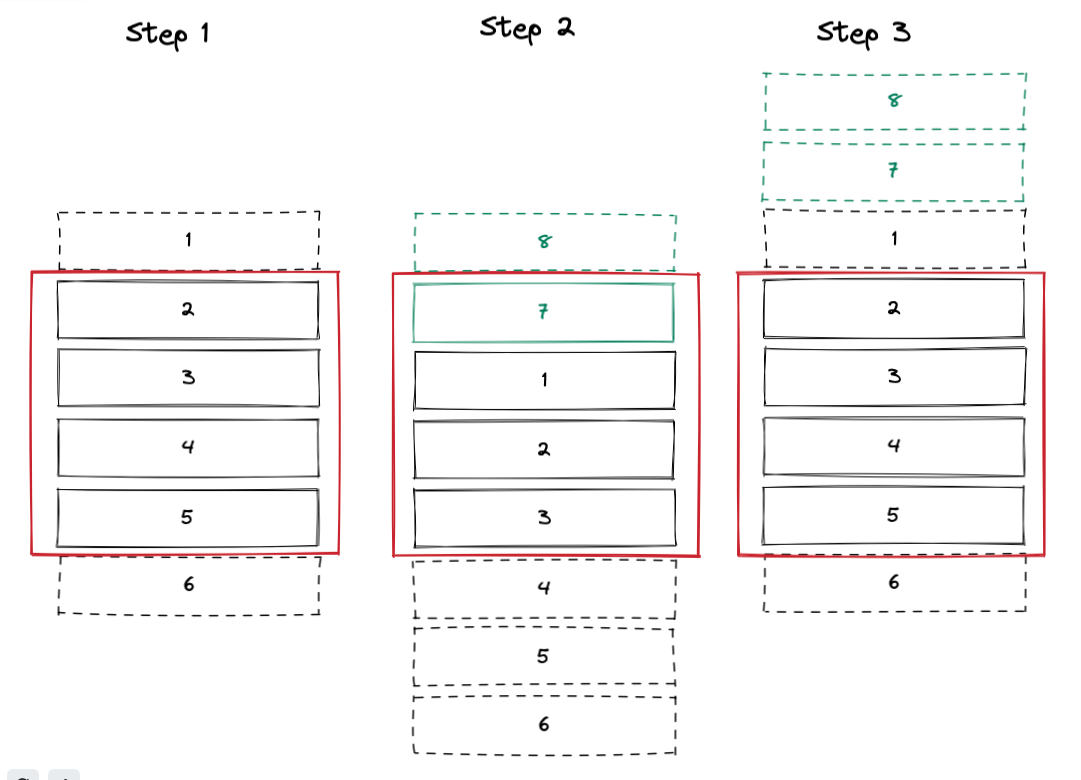
The first illustration shows the working case, when the new content doesn't push visible content outside the window. The red box represents the window, all views outside the box are not mounted, which means the native implementation of `maintainVisibleContentPosition` has no way to know it exists. In that case the first visible view is https://github.com/facebook/react-native/issues/2, after new content is added https://github.com/facebook/react-native/issues/2 is still inside the window so there's not problem adjusting content offset to maintain position. As you can see Step 1 and 3 result in the same position for all initial views.
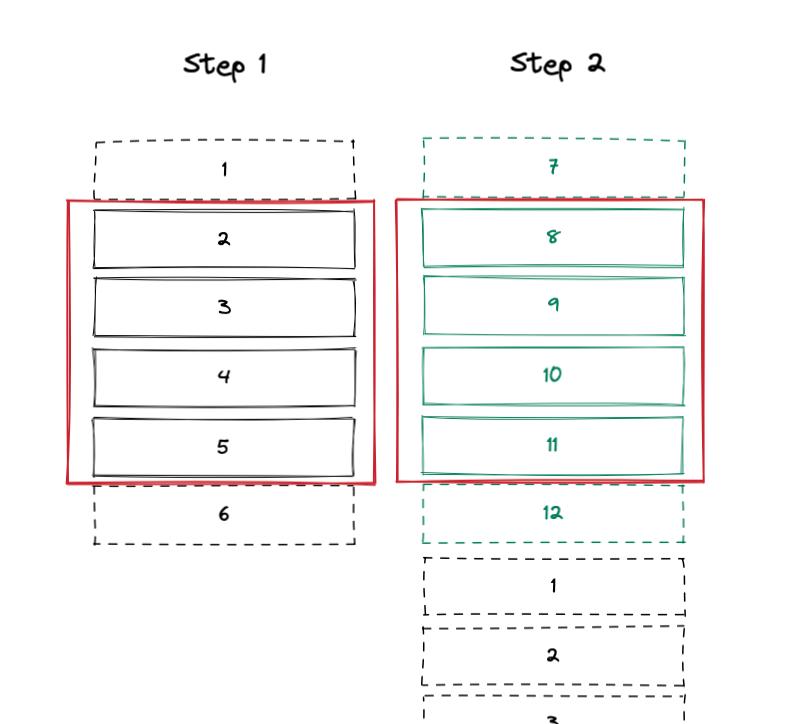
The second illustation shows the broken case, when new content is added and pushes the first visible view outside the window. As you can see in step 2 the view https://github.com/facebook/react-native/issues/2 is no longer rendered so there's no way to maintain its position.
#### Illustration 1
#### Illustration 2
To fix `maintainVisibleContentPosition` when using `VirtualizedList` we need to make sure the visible items stay rendered when new items are added at the start of the list.
In order to do that we need to do the following:
- Detect new items that will cause content to be adjusted
- Add cells to render mask so that previously visible cells stay rendered
- Ignore certain updates while scroll metrics are invalid
### Detect new items that will cause content to be adjusted
The goal here is to know that scroll position will be updated natively by the `maintainVisibleContentPosition` implementation. The problem is that the native code uses layout heuristics which are not easily available to JS to do so. In order to approximate the native heuristic we can assume that if new items are added at the start of the list, it will cause `maintainVisibleContentPosition` to be triggered. This simplifies JS logic a lot as we don't have to track visible items. In the worst case if for some reason our JS heuristic is wrong, it will cause extra cells to be rendered until the next scroll event, or content position will not be maintained (what happens all the time currently). I think this is a good compromise between complexity and accuracy.
We need to find how many items have been added before the first one. To do that we save the key of the first item in state `firstItemKey`. When data changes we can find the index of `firstItemKey` in the new data and that will be the amount we need to adjust the window state by.
Note that this means that keys need to be stable, and using index won't work.
### Add cells to render mask so that previously visible cells stay rendered
Once we have the adjusted number we can save this in a new state value `maintainVisibleContentPositionAdjustment` and add the adjusted cells to the render mask.
This state is then cleared when we receive updated scroll metrics, once the native implementation is done adding the new items and adjusting the content offset.
This value is also only set when `maintainVisibleContentPosition` is set so this makes sure this maintains the currently behavior when that prop is not set.
### Ignore certain updates while scroll metrics are invalid
While the `maintainVisibleContentPositionAdjustment` state is set we know that the current scroll metrics are invalid since they will be updated in the native `ScrollView` implementation. In that case we want to prevent certain code from running.
One example is `onStartReached` that will be called incorrectly while we are waiting for updated scroll metrics.
## Changelog
[General] [Fixed] - Fix VirtualizedList with maintainVisibleContentPosition
Pull Request resolved: https://github.com/facebook/react-native/pull/35993
Test Plan:
Added bidirectional paging to RN tester FlatList example. Note that for this to work RN tester need to be run using old architecture on iOS, to use new architecture it requires https://github.com/facebook/react-native/pull/35319
Using debug mode we can see that virtualization is still working properly, and content position is being maintained.
https://user-images.githubusercontent.com/2677334/163294404-e2eeae5b-e079-4dba-8664-ad280c171ae6.mov
Reviewed By: yungsters
Differential Revision: D45294060
Pulled By: NickGerleman
fbshipit-source-id: 8e5228318886aa75da6ae397f74d1801d40295e8
 Sam Zhou
 Marco Wang
 Eric Rozell
 Tim Yung
 Mateo Guzmán
 Jakub Piasecki
 Andrew Wang
 Rubén Norte
 Liron Yahdav
 YunPeng Chong
 generatedunixname89002005232357
 Nick Gerleman
 Janic Duplessis
 Fabrizio Cucci
 Pieter De Baets
 Moti Zilberman
 Samuel Susla
 Hanno J. Gödecke
 Nick Gerleman

