Summary:
Pull Request resolved: https://github.com/facebook/react-native/pull/51600

The `infoLog` is a `console.log` wrapper to separate ad-hoc console debug logging, however console logs are already used in some files in rn-tester (ex. RNTesterAppShared.js). The same applies to files in react-native package.

Changelog:
[General][Changed] - Removed `infoLog` from react-native package

Reviewed By: huntie

Differential Revision: D75402930

fbshipit-source-id: 1a14a9122552130415f058d3647d715225321ab8
Summary:
Pull Request resolved: https://github.com/facebook/react-native/pull/51404

Prefers using this as a destructured import instead of as a member expression of `React`.

Changelog:
[Internal]

Reviewed By: SamChou19815

Differential Revision: D74893440

fbshipit-source-id: 9032f1e867a34b9cfa808f920a38f2630046eed7
Summary:
Pull Request resolved: https://github.com/facebook/react-native/pull/51403

Prefers using this as a destructured import instead of as a member expression of `React`.

Changelog:
[Internal]

Reviewed By: SamChou19815

Differential Revision: D74891875

fbshipit-source-id: 981e85b5da84950c9e66e8d6b6496019e536711d
Summary:
Pull Request resolved: https://github.com/facebook/react-native/pull/50958

In rn-tester package there are many react-native deep imports which will be deprecated in the future. It is a starter for migrating rn-tester to using root imports instead. Only deep imports that are already root exported are changed. This diff avoids using `CodegenTypes` as it causes build errors and will be resolved in next stages.

Besides import changes, `PointerEvent` type is now also exported from the root.

Changelog:
[Internal]

Reviewed By: huntie

Differential Revision: D73656526

fbshipit-source-id: 5814a3d9c6a04b1236581dbbe291cd109e2c71c0
Summary:
Pull Request resolved: https://github.com/facebook/react-native/pull/50214

This diff is a second step toward the TS AnimatedProps alignment. In this change the rest of the extended types and recursions in `WithAnimatedValue` are applied.

Changelog:
[Internal] - Aligned AnimateProps to match TS types.

Reviewed By: huntie

Differential Revision: D71623036

fbshipit-source-id: d4777e25c3bf3119608938ee4cd246cdc4c4f7ee
Summary:
Pull Request resolved: https://github.com/facebook/react-native/pull/50195

In Flow, all AnimatedProps properties are set to `any` and misaligned with Typescript definitions. This diff is a first step toward the TS AnimatedProps. The problem can be broken down into a few parts, at each point more types will be extended in WithAnimatedValue and the rest will be set to `any`. This approach enables smoother migration and validation.

Changelog:
[Internal] - Check for Builtin and Nullable types in WithAnimatedValue to align closer to TS types.

Reviewed By: huntie

Differential Revision: D71551006

fbshipit-source-id: 9316227f4ba32bdaa5be8097483a03ae19bf516f
Summary:
Pull Request resolved: https://github.com/facebook/react-native/pull/47340

This diff cleans up some problematic `React.ElementRef<T>` when T is generic type.

Changelog: [Internal]

Reviewed By: alexmckenley

Differential Revision: D65280467

fbshipit-source-id: 71172b16320a10cbc7a8b46dae5d3dd0eb00ba0c
Summary:
Pull Request resolved: https://github.com/facebook/react-native/pull/46898

Replaces *many* `Text` component usages with `RNTesterText`: a thin wrapper around `Text` that applies color based on the color scheme chosen by the user. It makes text legible for dark mode across 41 different example files. This changes intentionally do not touch a few larger component sites that expand beyond RNTester, like `Animated` and `NewAppScreen`

Changelog: [Internal]

Reviewed By: rshest

Differential Revision: D64053464

fbshipit-source-id: 9516fef2afe1b364eb38e85e3a2dbb5c434e44db
Summary:
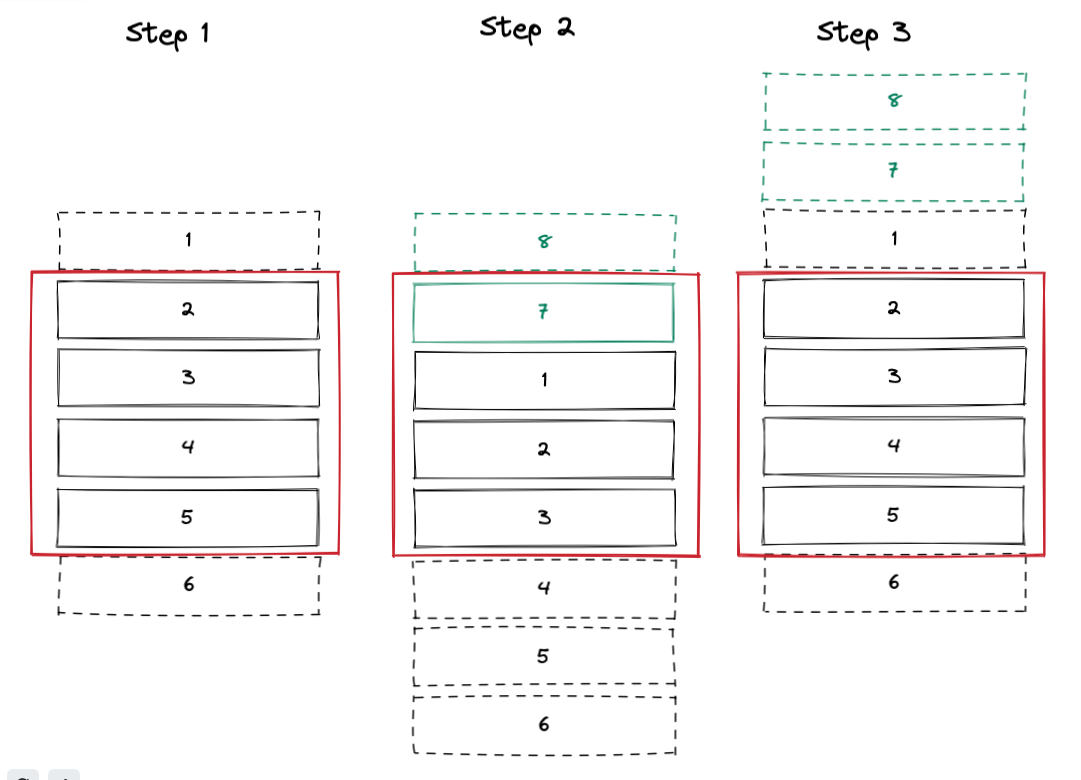
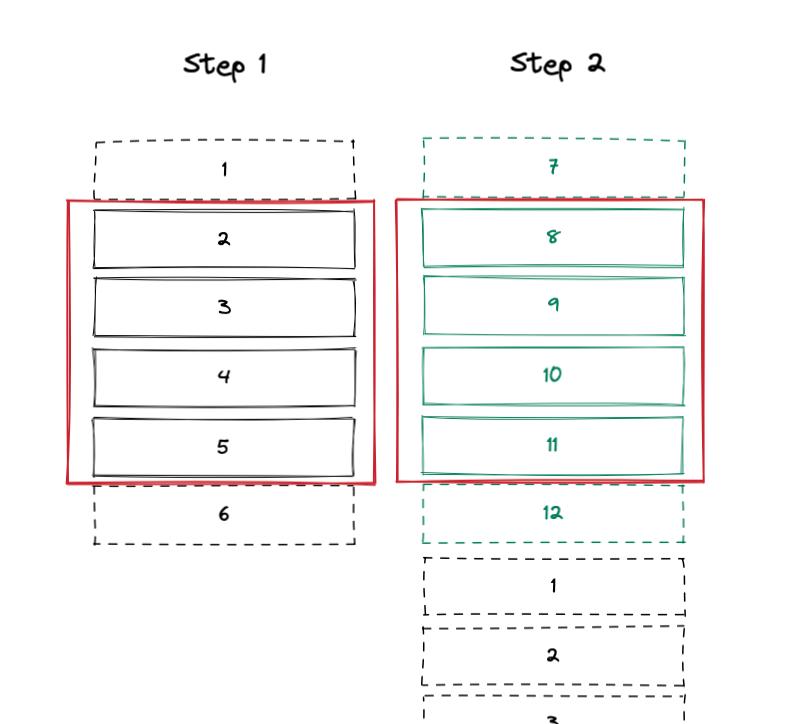
`maintainVisibleContentPosition` is broken when using virtualization and the new content pushes visible content outside its "window". This can be reproduced in the example from this diff. When using a large page size it will always push visible content outside of the list "window" which will cause currently visible views to be unmounted so the implementation of `maintainVisibleContentPosition` can't adjust the content inset since the visible views no longer exist.
The first illustration shows the working case, when the new content doesn't push visible content outside the window. The red box represents the window, all views outside the box are not mounted, which means the native implementation of `maintainVisibleContentPosition` has no way to know it exists. In that case the first visible view is https://github.com/facebook/react-native/issues/2, after new content is added https://github.com/facebook/react-native/issues/2 is still inside the window so there's not problem adjusting content offset to maintain position. As you can see Step 1 and 3 result in the same position for all initial views.
The second illustation shows the broken case, when new content is added and pushes the first visible view outside the window. As you can see in step 2 the view https://github.com/facebook/react-native/issues/2 is no longer rendered so there's no way to maintain its position.
#### Illustration 1
#### Illustration 2
To fix `maintainVisibleContentPosition` when using `VirtualizedList` we need to make sure the visible items stay rendered when new items are added at the start of the list.
In order to do that we need to do the following:
- Detect new items that will cause content to be adjusted
- Add cells to render mask so that previously visible cells stay rendered
- Ignore certain updates while scroll metrics are invalid
### Detect new items that will cause content to be adjusted
The goal here is to know that scroll position will be updated natively by the `maintainVisibleContentPosition` implementation. The problem is that the native code uses layout heuristics which are not easily available to JS to do so. In order to approximate the native heuristic we can assume that if new items are added at the start of the list, it will cause `maintainVisibleContentPosition` to be triggered. This simplifies JS logic a lot as we don't have to track visible items. In the worst case if for some reason our JS heuristic is wrong, it will cause extra cells to be rendered until the next scroll event, or content position will not be maintained (what happens all the time currently). I think this is a good compromise between complexity and accuracy.
We need to find how many items have been added before the first one. To do that we save the key of the first item in state `firstItemKey`. When data changes we can find the index of `firstItemKey` in the new data and that will be the amount we need to adjust the window state by.
Note that this means that keys need to be stable, and using index won't work.
### Add cells to render mask so that previously visible cells stay rendered
Once we have the adjusted number we can save this in a new state value `maintainVisibleContentPositionAdjustment` and add the adjusted cells to the render mask.
This state is then cleared when we receive updated scroll metrics, once the native implementation is done adding the new items and adjusting the content offset.
This value is also only set when `maintainVisibleContentPosition` is set so this makes sure this maintains the currently behavior when that prop is not set.
### Ignore certain updates while scroll metrics are invalid
While the `maintainVisibleContentPositionAdjustment` state is set we know that the current scroll metrics are invalid since they will be updated in the native `ScrollView` implementation. In that case we want to prevent certain code from running.
One example is `onStartReached` that will be called incorrectly while we are waiting for updated scroll metrics.
## Changelog
[General] [Fixed] - Fix VirtualizedList with maintainVisibleContentPosition
Pull Request resolved: https://github.com/facebook/react-native/pull/35993
Test Plan:
Added bidirectional paging to RN tester FlatList example. Note that for this to work RN tester need to be run using old architecture on iOS, to use new architecture it requires https://github.com/facebook/react-native/pull/35319
Using debug mode we can see that virtualization is still working properly, and content position is being maintained.
https://user-images.githubusercontent.com/2677334/163294404-e2eeae5b-e079-4dba-8664-ad280c171ae6.mov
Reviewed By: yungsters
Differential Revision: D45294060
Pulled By: NickGerleman
fbshipit-source-id: 8e5228318886aa75da6ae397f74d1801d40295e8
Summary:
Pull Request resolved: https://github.com/facebook/react-native/pull/37083

`React.ElementConfig<a polymophic type>` will result in unpredictable behavior in Flow due to some types being unresolved. Since the type is already broken in most cases, I use $FlowFixMe as the type for those type arguments that are currently inferred as empty.

Changelog: [Internal]

Reviewed By: NickGerleman

Differential Revision: D44774275

fbshipit-source-id: bb950379102d41e729593af644d25670d9071ab4
Summary:
Right now RNTestePage either adds a large spacer to the end of content, unless `noSpacer` is added. But with `noSpacer`, scrolling content may not be reachable because we are putting padding on the wrong container.

This fixes that and removes a few cases where we had multi hundred px empty space in favor of uniformly taking up the parent, and a 10px padding. This also moves the constant margin at the top of RNTesterBlock to the container, so that in the E2E container we can save the 30px.

Changelog:
[Internal]

Reviewed By: javache

Differential Revision: D44197303

fbshipit-source-id: 8dc67f3588bc28316e2fee8d25a0bc59995f1728
Summary:
Pull Request resolved: https://github.com/facebook/react-native/pull/36345

`exactOptionalPropertyTypes` is a TypeScript 4.4+ option set by users which changes behavior of optional properties, to disable accepting explicit `undefined`.

This is not enabled when using `--strict`, and is stricter than Flow, leading to most of the typings having an `| undefined` unique to TypeScript (added with https://github.com/DefinitelyTyped/DefinitelyTyped/commit/694c663a9486dbe7794d5eb894a691ee9ded318a).

We have not always followed this (I have myself previously assumed the two are equivalent). We can enforce that the convention is followed with a plugin `eslint-plugin-redundant-undefined`. This forces us to declare that every optional property accepts an explicit undefined (which Flow would allow). Alternatively, if we do not want to support this, we can enable the existing dtslint rule `no-redundant-undefined`.

Changelog:
[General][Fixed] - Enforce compatibility with `exactOptionalPropertyTypes`

Reviewed By: lunaleaps

Differential Revision: D43700862

fbshipit-source-id: 996094762b28918177521a9471d868ba87f0f263
Summary: Add annotations to function parameters required for Flow's Local Type Inference project. This codemod prepares the codebase to match Flow's new typechecking algorithm. The new algorithm will make Flow more reliable and predictable.

Reviewed By: bradzacher

Differential Revision: D37388949

fbshipit-source-id: cdcbc98035ce9b6994842005ea46df42de54f9b8
Summary: Add annotations to function parameters required for Flow's Local Type Inference project. This codemod prepares the codebase to match Flow's new typechecking algorithm. The new algorithm will make Flow more reliable and predicatable.

Reviewed By: evanyeung

Differential Revision: D37353648

fbshipit-source-id: e5a0c685ced85a8ff353d578b373f836b376bb28
Summary:
Issue https://github.com/facebook/react-native/issues/30964 .When using a screen reader, flatlist does not announce entrance/ exit from the flat list.

## Changelog

[Android] [Changed] - Added support for accessibility role of "list" for flatlist and sectioned list

Pull Request resolved: https://github.com/facebook/react-native/pull/31630

Test Plan: I have added accessibility role prop in flatlist and sectioned list in rntester app, that will announce entrance/ exit from flatlist and sectioned list.

Reviewed By: kacieb

Differential Revision: D29599351

Pulled By: blavalla

fbshipit-source-id: e16ec69a694780d12f15f88a1e6bb5d7d77ac15f
 Sam Zhou
 Dawid Małecki
 Tim Yung
 Peter Abbondanzo
 Shawn Dempsey
 Oskar Kwaśniewski
 Moti Zilberman
 Janic Duplessis
 Nick Gerleman
 Genki Kondo
 fabriziobertoglio1987
 Pieter Vanderwerff
 Kacie Bawiec
 Luna Wei
 Moti Zilberman
 Andres Suarez
 Tim Yung
 Evan Yeung
 Anas Khurshid

